text
Real estate, at scale, goes far beyond the act of constructing buildings. It becomes a crucial act of coordination across capital allocation, regulatory intent, execution capability, and public expectation, all moving within defined time horizons without diminishing trust. In emerging economies, the built environment turns into the most visible indicator of institutional maturity, because construction is where optimism must withstand compliance, where financial structuring confronts operational reality, and where private ambition carries public consequence. When urbanization accelerates, the skyline begins to function like a living balance sheet of governance.
India is now at that inflection point. Urban growth is accelerating, capital inflows are increasing, and formalization is advancing through regulatory tightening and institutional participation. Yet velocity alone does not create durability. Markets eventually distinguish between expansion driven by visibility and expansion grounded in system reliability. The next stage of India's real estate evolution will not be defined by volume. It will be defined by whether credibility can scale as efficiently as concrete.
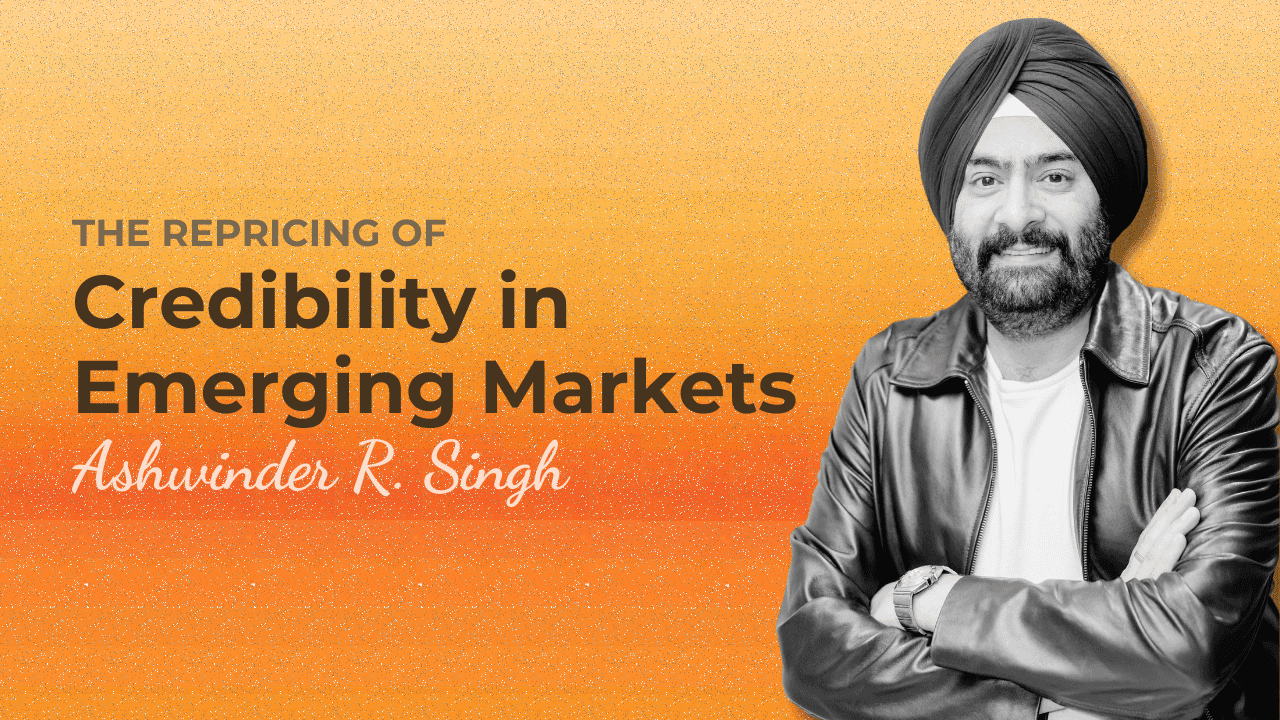
Ashwinder R. Singh has positioned himself inside that transition.
As Vice Chairman of BCD Group (One of the subcontinent’s largest and oldest realty conglomerates) and after fifteen years in global banking followed by fifteen years in real estate leadership, Ashwinder operates with a dual lens that is still relatively rare in the sector: he reads development not as promotion, but as underwriting. He does not approach growth primarily through ambition; he approaches it through risk calibration. That orientation has reshaped the way he builds organizations, evaluates opportunity, and measures leadership itself.
Underwriting Before Building
Banking, as Ashwinder describes it, is an education in disciplined skepticism. It forces leaders to begin with what can go wrong before asking what can go right. It demands a structured interrogation of downside exposure, recovery scenarios, and behavioral biases embedded inside optimistic forecasts. Those habits, once internalized, are difficult to discard.
"Banking trained me to separate price from risk-adjusted value," he says. "Everyone sells upside. Very few engineer the downside. The real value is certainty of delivery and cost of time."
He began his career with global financial institutions Citibank, Deutsche Bank, ICICI Bank, Fullerton Singapore, and Bajaj Housing Finance. Time, in real estate, is often underpriced. Delays multiply into financing burdens, rental leakage, buyer fatigue, litigation risk, and reputational drag that compounds silently. Negotiating discounts may win transactions, but compressing uncertainty preserves enterprise value. That distinction reframed how Ashwinder evaluated projects when he transitioned into real estate leadership, serving as CEO of JLL Residential India, including scaling residential operations in the UAE, then as Co-Founder and first CEO of ANAROCK, and later as CEO of Bhartiya Urban, before joining BCD Group as Vice Chairman and Co-Founder of BCD Royale, leading the transformation of a 70 year construction legacy into a modern development platform with flagship initiatives including BCD City, a seventy-acre integrated township in Bengaluru.
"In banking, rules are explicit," he notes. "In real estate, many rules are cultural."
Cultural rules do not scale cleanly. They rely on relationships and negotiation bandwidth rather than process architecture and enforcement clarity. During his transition, Ashwinder encountered an environment where execution depended disproportionately on personalities rather than on structured workflows. The first institutional correction, in his view, was to convert informal habits into documented systems.
Frameworks for sales sequencing, collections discipline, marketing qualification, inventory management, and operational oversight were codified and aligned to measurable outputs. Escalation loops were formalized. Review cadence was standardized. Data replaced instinct as default decision support.
The logic was not bureaucratic. It was economic. If systems cannot be replicated across projects and cycles, they cannot protect capital across volatility phases.
"Standardize before you optimize. Institutionalize before you expand," he says.
Expansion without standardization creates fragile acceleration. Standardization creates repeatability. Repeatability reduces variance. Reduced variance lowers risk perception. Lower risk perception reduces capital cost. The compounding effect is structural.
Translating Legacy into Institutional Strength
BCD Group's seven-decade history presented a different leadership challenge. This was not a startup environment requiring process invention from scratch. It was a legacy platform requiring modernization without destabilizing its cultural core.
"Legacy organizations do not need shock therapy," Ashwinder says. "They need translation."
Translation required isolating what made the enterprise durable, including resilience, relationships, and craft competence, while upgrading invisible systems that determined scalability. Procurement processes were redesigned to enhance cost transparency. Approvals tracking was digitized to improve timeline predictability. Management information systems were aligned to real-time reporting discipline. Customer feedback loops were structured to close service gaps faster.
The objective was not cosmetic modernization. It was credibility reinforcement.
Global capital increasingly allocates based on governance maturity rather than brand presence. Sovereign funds, pension pools, and institutional investors price operational discipline into their allocation decisions. For Ashwinder, that reality makes predictability the most strategic differentiator in Indian development.
"Capital does not chase land anymore," he says. "It chases predictability."
Predictability reduces execution uncertainty. Reduced uncertainty increases investor confidence. Increased confidence compresses financing spreads and stabilizes partnership flows. Over time, credibility becomes a competitive moat.
Risk as Organizational Intelligence
Ashwinder's interpretation of risk extends beyond financial leverage or liquidity coverage. He views risk as embedded inside organizational behavior and culture drift. Small inconsistencies tolerated over time accumulate into structural exposure.
He pays attention to signals: meeting discipline erosion, defensive language replacing ownership language, performance narratives overtaking operational evidence, high performers disengaging quietly. These are not HR observations; they are leading indicators of governance weakening.
If you do not understand risk, you do not understand growth.
Growth increases system complexity. Complexity increases coordination demands. Coordination demands structure. When structure lags growth, fragility emerges.
Documentation of decisions is therefore treated as learning infrastructure rather than compliance ritual. Transparency is institutionalized not to impress regulators, but to accelerate internal correction loops. Consequences are applied irrespective of hierarchy to preserve behavioral consistency.
Trust compounds only when behavior is predictable under stress.
Leadership Across Institutional Forms
Ashwinder's career spans multinational banks, entrepreneurial ventures, listed advisory firms, and family enterprises. Rather than recalibrating identity at each transition, he strengthened a portable core: analytical discipline, systems thinking, and team enablement.
Domain expertise is the easiest skill to acquire. What matters more is intelligence, frameworks, and execution.
Multinationals provide predefined structures but constrain improvisation. Entrepreneurial setups move quickly and thrive on instinct, yet they often operate without structured controls that protect scale. Family enterprises bring loyalty and history, but they frequently need stronger systems and defined processes to translate that legacy into consistent performance. In each context, Ashwinder relied on constructing frameworks that generate systems, which in turn generate processes capable of supporting consistent execution.
He remains skeptical of strategy divorced from operational discipline.
"Strategy is overrated," he says. "Execution determines survival."
Execution, in his formulation, is alignment between declared principles and daily operational behavior. Teams observe leaders continuously, interpreting patterns rather than rhetoric. Leadership credibility is built through consistency of action under routine conditions, not through isolated moments of visibility.
"People want value added to their work," he says. "They want direction that helps them perform better."
He emphasizes training investment, clarity of expectation, and respect for capability differentiation. Performance variance, in his view, reflects calibration gaps more often than intent deficits.
That cross-institutional perspective extends into his advisory work. He serves as Chief Advisor on Real Estate for Republic Media Network, analyzing market trends and regulatory developments for public discourse. As Chief Advisor to BitSave, a fintech platform in the digital asset space, he applies frameworks from real estate capital allocation to emerging asset classes. He mentors startup founders through IIT Bombay E-Cell and India Accelerator, translating systems thinking into early-stage contexts where institutional processes must be invented rather than inherited.
Integrity as Structural Discipline
During a critical phase of his early real estate career, Ashwinder exited a high-performing role after refusing to endorse the sale of a property he believed would not be delivered as promised.
"They wanted to sell something I knew would not get delivered," he says. "I walked out."
The decision carried short-term cost. Equity exposure and operational momentum were at stake. Yet he frames the episode not as moral drama, but as long-term valuation logic. Selling undeliverable inventory may inflate quarterly metrics, but it erodes market confidence irreversibly.
"There is right and there is wrong," he says. "That is the only decision."
He was later rehired following internal restructuring, and operational performance recovered rapidly through structured training, morale rebuilding, and reinstatement of disciplined processes. Revenue stabilized because systems stabilized.
"Respect people and they perform," he says.
He has documented these principles in the Master Real Estate trilogy, a series designed to professionalize decision-making for buyers, investors, and practitioners navigating India's residential sector. One title was featured on Shark Tank India, extending the work's reach beyond industry circles. The writing reflects his conviction that experiential knowledge must be codified if institutional maturity is to scale beyond individual operators.
Integrity, in Ashwinder's lexicon, is not symbolic positioning. It is risk containment.
India's Institutional Inflection Point
Ashwinder describes India's real estate evolution as unfolding across three stages: improvisational survival, scale acceleration, and now institutional consolidation. The third stage will determine whether India's growth trajectory can sustain global capital confidence.
"Capital does not mind complexity," he says. "It minds unpredictability."
India's democratic model naturally brings layers of consultation, negotiation, and institutional overlap, which makes coordination more intricate than in highly centralized systems. Yet intricacy does not have to undermine reliability. When procedures are consistent, timelines respected, and accountability clearly assigned, complexity can still produce dependable outcomes. Drawing from his experience across markets, Ashwinder often reflects on the contrast between tightly centralized decision environments in parts of the Gulf and India's more distributed policy framework. His conclusion is neither to romanticize speed nor to replicate command structures, but to strengthen internal discipline within democratic realities, so that process becomes steady even when authority is shared.
Technology, in his view, functions as an amplifier rather than substitute.
"Technology amplifies the culture it enters," he says. "If discipline is weak, dashboards only expose weakness."
Digital adoption must therefore reinforce compliance cadence, data integrity, and escalation transparency. Otherwise, it risks becoming decorative instrumentation without operational impact.
India's long-term competitive advantage, according to Ashwinder, lies in demonstrating that participatory governance can deliver execution reliability at scale. If proven, global capital will respond structurally rather than opportunistically.
Beyond enterprise leadership, Ashwinder shapes these frameworks institutionally. He serves as Chairman of the CII Real Estate Committee and is a member of CII's National Ease of Doing Business Task Force, where policy recommendations translate into regulatory reform. As Advisor to NAR-India, he works with the country's leading real estate channel partner body to professionalize brokerage standards. He has chaired CII delegations to the UAE and Singapore, advancing cross-border capital engagement and regulatory collaboration. His policy work includes moderating national dialogues on infrastructure and urban development, including sessions with Union Ministers Shri Nitin Gadkari and Shri Hardeep Singh Puri, creating forums where operational insight informs institutional design.
Leadership and Proportion
Ashwinder rejects acceleration as virtue in itself. He sees leadership sustainability as dependent on proportion management rather than continuous exertion.
"All work and no play does not make you productive," he says. "It makes you predictable."
Cognitive bandwidth is a performance variable. Exhaustion increases decision error probability. Decision error probability increases enterprise risk exposure. Mental recovery, sleep, and calibrated effort preserve judgment quality.
He remains receptive to generational shifts in behavior and consumption patterns, recognizing that learning velocity requires humility.
"You learn from people who see the world differently," he says.
Humility protects leaders from narrative insulation. It preserves adaptive capacity in volatile markets.
Systems That Continue
Ashwinder measures success by whether institutional mechanisms function independently of individual presence.
"Our responsibility is to build something that works without us," he says.
Organizations mature when behavior becomes system-driven rather than personality-driven. Countries mature when policy intent converts into predictable execution.
Trust reduces transaction cost. Reduced transaction cost stabilizes capital inflow. Stable capital inflow strengthens institutional depth. The economic cycle becomes self-reinforcing.
India's urban future will depend less on iconic developments and more on reliable delivery consistency. For Ashwinder, the objective is not visibility. It is credibility.
That orientation is rooted in a legacy of public service. His father was a decorated 1971 war veteran and UN peacekeeping martyr. The inheritance shaped two governing principles that anchor his professional framework: nation before self, integrity above ambition.
This article was first published in Indisight on February 16, 2026.
Read Related Blogs

Real Estate Advising in India: What Buyers Need to Ask Before They Trust Anyone
Real estate advising explained: how it differs from brokerage and what to check first.

How To Invest In Real Estate In Bangalore: A Practical Guide For Buyers And Investors (2026)
Learn how to invest in Bangalore real estate, compare property types, and reduce buyer risk.

Real Estate Agency In Delhi: How To Find And Verify The Right One
Learn how to evaluate Delhi real estate agencies, compare fees, and verify credentials.