Read time: 7 minutes
In today's edition:
On My Mind: Sacred Real Estate: Temples, Mosques, and Gurudwaras as Urban Anchors
Interesting Insight: India has over 30 lakh places of worship about 40 times more than hospitals making faith the country’s most widespread social infrastructure.
A Question For You: Would you choose a bigger home farther away, or a smaller one closer to a spiritual anchor and why?
A THOUGHT TO PONDER
What if the soul of a neighbourhood is not in its buildings, but in the place where people pause, bow their heads, and breathe?
ON MY MIND
Sacred Real Estate: Why Temples, Mosques & Gurudwaras Still Shape Our Cities?

Every Indian city has two maps - one drawn by planners (grids and utilities), and another drawn by people (emotion and faith). Long before builders, cities grew around the second map.
Walk into any old neighbourhood - Delhi, Jaipur, Amritsar, Varanasi, Hyderabad, Kochi and you’ll see the centre is almost always sacred. These spaces aren’t just places of worship; they’re urban anchors. Cities grew around them like a body around a beating heart.
Even today, they influence where communities settle, where commerce thrives, where safety concentrates, where property values rise, and where streets stay active after dark.
Sacred spaces aren’t “religious assets.” They’re trust infrastructure the social glue planners often forget.
1. Sacred Places Create Natural Footfall (the oldest retail engine)
Before malls and high streets came temple streets and masjid bazaars. Footfall was organic and constant. Vendors, markets, and shops grew naturally around these hubs a pattern that continues today.
Real estate around places like the Golden Temple, Charminar, ISKCON Bengaluru, Mylapore Temple, Ajmer Sharif, or Jagannath Puri appreciates differently because faith guarantees daily movement.
Developers chase traffic; faith creates traffic.
2. Sacred Spaces Build Trust Faster Than Any Gated Community
Places of worship are rare urban institutions where generations return, strangers sit together as equals, diversity feels natural, generosity is normal, and safety is implicit. This creates collective trust.
Real estate follows trust. Prices rise where belonging rises.
3. Sacred Nodes Reduce Stress (Urban neuroscience proves this)
Studies across countries show that sensory cues from sacred architecture bells, domes, stone underfoot, quiet zones, filtered light lower cortisol levels.
Faith architecture becomes a meeting point of neurology and urban design. Homes near spiritual centres often feel calmer, even in chaotic cities.
4. Sacred Places Create Multi-Generational Neighbourhoods
Malls last decades; sacred spaces last centuries. Families don’t just buy homes near them they buy roots. This creates rare real estate stability in an otherwise cyclical market..
5. The Langar, the Bhandara & the Community Kitchen (the real social infrastructure)
India’s deepest community building happens not in clubhouses or gyms, but at langars, bhandaras, prasad queues, feast days, and Eid markets. These aren’t amenities they’re rituals of shared humanity.
Developers now study these patterns to design community spaces that are not luxurious, but emotionally intelligent.
INTERESTING INSIGHT
Young Professionals Now Prefer Premium Rentals Over EMIs
India has over 30 lakh places of worship nearly 40 times the number of hospitals making faith the country’s most widespread form of social infrastructure.
This isn’t about religion; it’s about how India naturally organises itself around trust, ritual, and community. Real estate value quietly follows these patterns, growing strongest where people feel anchored.
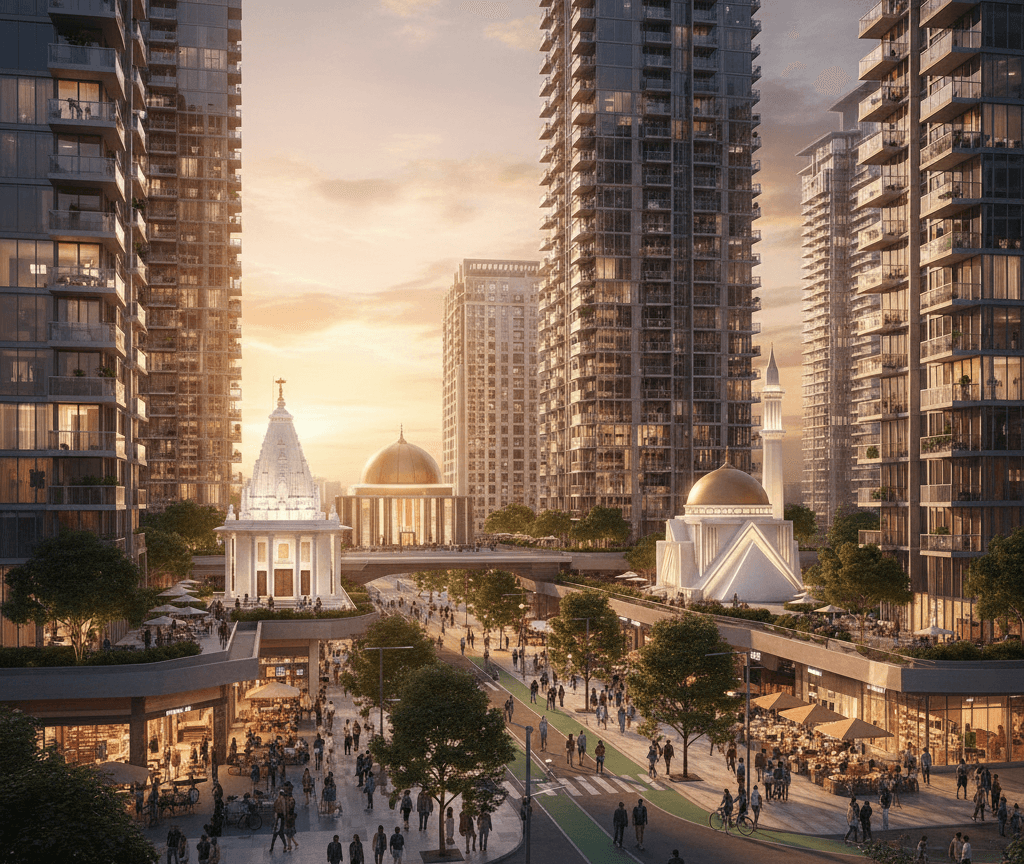
The same holds true globally. In Kyoto, shrines guide pedestrian flow; in Istanbul, mosques shape commercial rings; in Barcelona, churches define neighbourhood identity. Sacred spaces subtly script how cities breathe.
When faith becomes part of a city’s rhythm, urban life becomes less transactional and more human centred on belonging, meaning, and shared experience.
AROUND THE WEB
How Spiritual Architecture Shapes Cities — [National Geographic]
Why ancient sacred structures still influence modern urban design.
Trust and Public Space — [Harvard Kennedy School]
How places of collective gathering build psychological safety.
Faith and Footfall Economics — [The Economist]
The surprising link between religious centres and high-performing markets.
India’s Cultural Nodes and Property Values — [Economic Times]
A data-driven look at why homes near places of worship consistently outperform micro-markets.
A QUESTION FOR YOU
If you had to choose between a larger home far away and a slightly smaller home near a spiritual anchor, which would you pick and why?
Your answer says more about your long-term well-being than your short-term convenience.
FEEDBACK
Have any detailed feedback? Write to us at hello@ashwinderrsingh.com and let us know how we can do better.
Disclaimer: This newsletter is intended for informational purposes only and should not be construed as professional advice. Please conduct your own due diligence prior to making any decisions.


Elevate your real estate journey with exclusive insights derived from decades of experience.
Join my tribe of home buyers, real estate and capital market investors, students, developers, home loan professionals and channel partners. Stay updated with my free, curated insights delivered weekly.
Subscribe to my newsletter