Read time: 5 minutes
In today's edition:
On My Mind: The Airbnbization of Office Space
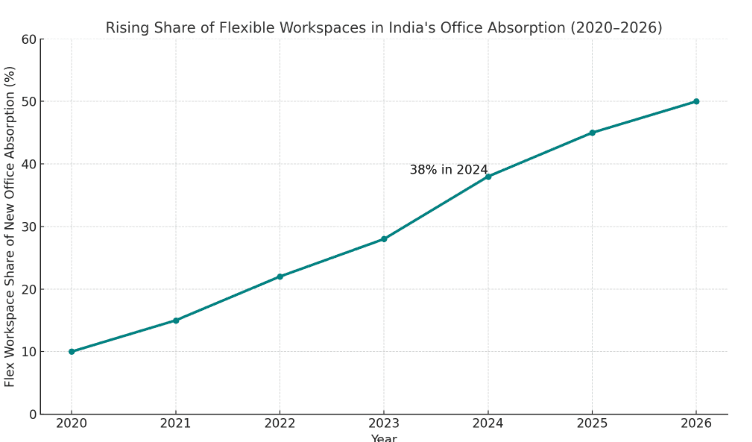
Interesting Insight: In 2024, 38% of India’s new office absorption came from flexible workspace operators.
A Question For You: Are you still building offices for 2010 or for 2030?
A THOUGHT TO PONDER
Commercial real estate isn’t dying it’s evolving. Spaces are becoming elastic, hybrid, and multipurpose. From co-working to co-living, the future lies in adaptive design, shared utility, and smart monetization.
ON MY MIND
The Airbnbization of Office Space

While headlines often predict the decline of office real estate, a quieter revolution is underway one that’s not about disappearance, but transformation. Welcome to the era of Elastic Leasing.
Gone are the days when companies signed rigid 10-year leases with little room to pivot. Today’s businesses, shaped by agility and unpredictability, are demanding flexibility over permanence.
From short-term corporate stays to daily rentals and event-driven occupancies, commercial spaces are being reimagined as dynamic assets not static commitments.
This shift isn’t just philosophical; it’s financial. Landlords who embrace elastic leasing are seeing higher revenue per square foot, leveraging churn and variable pricing to outperform traditional fixed-term contracts.
And the momentum is undeniable. In India alone, Grade-A flex office stock is projected to surpass 80 million square feet by 2026, driven by startups, remote teams, and enterprise clients alike.
In this new landscape, adaptability isn’t just a perk it’s a business model.
INTERESTING INSIGHT
In 2024, 38% of India’s new office absorption came from flexible workspace operators.
The Rise of Flex Workspaces in India
In 2024, a significant shift occurred in India’s commercial real estate landscape — 38% of new office space absorption came from flexible workspace operators. This is more than a statistic; it signals a transformation in how companies perceive, use, and invest in physical office spaces. The traditional office lease model, once dominated by long-term contracts and static layouts, is being steadily replaced by agile, on-demand workspace solutions.
Why Flex is Winning
The appeal of flexible workspaces lies in their ability to meet the evolving needs of modern businesses. Startups, SMEs, and even large enterprises now prioritize scalability, cost-efficiency, and operational flexibility. Flex operators offer ready-to-move-in environments, minimal capex, and short lock-in periods — making them ideal in a climate marked by economic uncertainty, hybrid work models, and rapid expansion goals.
Enterprise Adoption is Driving Growth
What was once considered a startup solution has now gone mainstream. Today, enterprise clients account for over half of the demand in the flexible workspace sector. Companies are opting for managed office spaces in key business districts to attract talent, foster collaboration, and retain agility without being tied down by conventional leases. Operators, in turn, are customizing large, branded workspaces for corporate clients blurring the line between traditional offices and co-working spaces.
Real Estate Developers are Taking Notice
This surge in demand hasn’t gone unnoticed by real estate stakeholders. Many Grade-A office developers are partnering with or launching their own flex brands to capture the growing market. Some are even allocating entire floors or buildings to flexible formats. For landlords, this model increases occupancy rates and unlocks premium yields by tapping into diversified tenant pools and variable pricing models.
The Future of Office is Hybrid and Flexible
As India’s workforce grows younger and more digitally native, the expectation for adaptable, experience-rich workplaces will only rise. With the flex sector poised to cross 80 million sq ft of Grade-A stock by 2026, flexible workspaces are no longer an alternative — they are fast becoming the default. For occupiers, landlords, and investors alike, the message is clear: the future of work is not fixed it’s flexible.
AROUND THE WEB
Elastic Leasing: The Future of Commercial Real Estate (Harvard Business Review)
Elastic leasing allows businesses to adapt real estate usage dynamically, reducing long-term liabilities while maximizing agility and operational efficiency in uncertain markets.
Why Global Firms Want Short-Term Office Leases (Financial Times)
Global firms prefer short-term leases to reduce risk, control costs, and stay flexible amid evolving workforce models and economic unpredictability.
India’s Flex Space Boom (JLL India)
India's flex space sector is surging as startups and corporates embrace cost-effective, scalable, and amenity-rich alternatives to traditional offices.
A QUESTION FOR YOU
Are you designing offices based on outdated 2010 models, or future-ready, flexible, tech-driven spaces aligned with 2030 needs?
FEEDBACK
Have any detailed feedback? Hit reply to this email and let us know what we can do better.
Disclaimer: This newsletter is intended for informational purposes only and should not be construed as professional advice. Please conduct your own due diligence prior to making any decisions.


Elevate your real estate journey with exclusive insights derived from decades of experience.
Join my tribe of home buyers, real estate and capital market investors, students, developers, home loan professionals and channel partners. Stay updated with my free, curated insights delivered weekly.
Subscribe to my newsletter