Read time: 6-7 minutes
In today's edition:
On My Mind: Why India Needs More Benches, Not Just More Buildings
Interesting Insight: How public seating changes how long people stay, spend, and connect
A Question For You: Are you designing for transactions—or for moments of rest?
A THOUGHT TO PONDER
Before a city asks people to work, shop, or spend it should first ask: “Where will they simply sit?”
ON MY MIND
Why India Needs More Benches, Not Just More Buildings
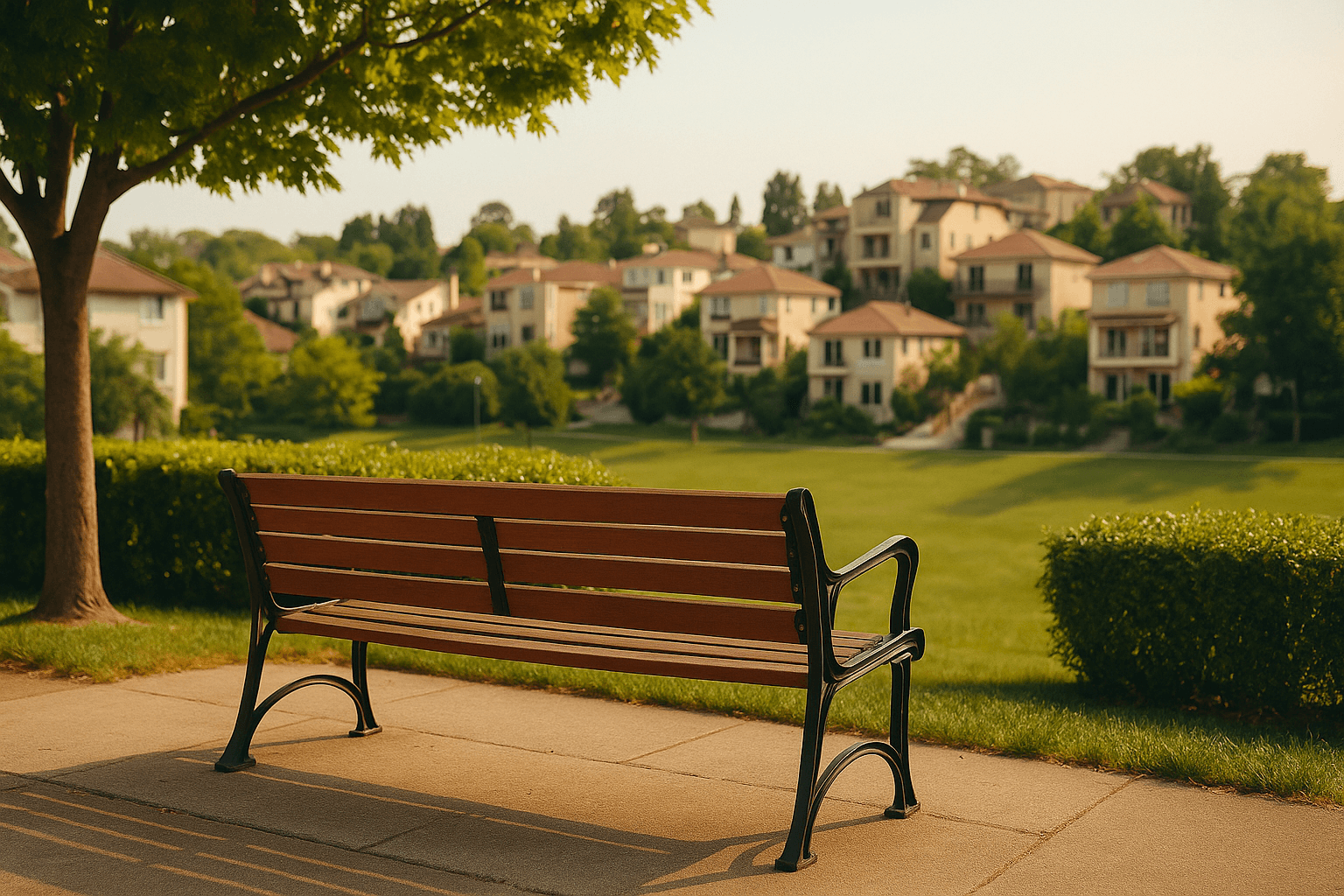
In most Indian cities, progress is often measured in square feet - how many towers launch, how many units sell, how much carpet area gets delivered. Yet amid all this quantification, we rarely pause to ask a softer but far more human question: Where do people actually stop to breathe? Walk through many new residential townships, office campuses, or malls, and you’ll notice a fixation on built-up area but a striking neglect of something humble and essential: the bench. A simple place to sit, exhale, and exist without being nudged to spend. In a country chasing the idea of “world-class cities,” this may seem small. It isn’t.
Benches are the hidden infrastructure of being human. They don’t feature in feasibility reports, NPV models, or saleable-area calculations. But on the ground, they quietly shape life: parents watching their children play, seniors resting during evening walks, colleagues stepping out to talk like people rather than job titles, strangers sharing shade without expectation. From India to the UAE, the spaces people love most are rarely the most expensive - they’re the ones where the body is allowed to slow down without feeling out of place. Yet many developments reduce seating to an afterthought: a few benches in harsh sun, facing a blank wall, or squeezed near parking. That isn’t design - it’s compliance.
Economically too, benches are misunderstood. Developers often view them as “non-revenue elements,” but the truth is far richer. Good seating increases dwell time, improves street safety through natural presence, and enhances the value of surrounding retail frontage. Think of your favourite high street anywhere in the world -you don’t remember its FAR or FSI; you remember the texture of it: a tree, a façade, a shaded corner, a bench. These elements don’t fight economics; they quietly strengthen it.
Benches also hold surprising power over the mental health of a city. Young Indian cities run on ambition, long commutes, and hyper-extended workdays. In such a climate, a shaded bench becomes a pressure valve - giving caregivers a moment of rest, giving delivery workers a place to pause without being shooed away, giving seniors a reason to step out and circulate. We discuss mental health in conferences and HR meetings, but rarely connect it to everyday spatial design. A city that lets people sit without paying is a city that sees them as citizens, not consumers.
A bench is also a test of intent. If you want to understand what a developer, municipality, or RWA truly believes, skip the brochure and walk the site. Where can an elderly person sit in comfort? Where can a child and grandparent enjoy an ice cream? Where can a security guard rest for five minutes without reprimand? If the honest answer is “nowhere,” then the talk of “human-centric design” is just talk. Benches expose the soul of a place - they reveal whether it is built to extract value or to host people with dignity.
As Indian real estate moves into an age of speed - faster approvals, taller towers, bigger launches - we must ask what will endure. The exact height of a building? Or the memory of sitting beneath a tree, on a quiet bench, feeling like you belonged there? Cities age better when they’re designed not just for occupation but for lingering. People don’t build memories in square footage; they build them in pauses. And benches are where pauses turn into connection.
INTERESTING INSIGHT
How public seating changes how long people stay, spend, and connect
Cities that invest in more and better public seating consistently report higher street activity and a stronger sense of safety. This isn’t intuition; it’s visible in data from multiple urban design studies across Europe and Asia. When cities introduce comfortable, shaded, and strategically placed benches, people naturally choose to spend more time outdoors. That single shift creates a ripple effect: longer pauses, more conversations, and a healthier public life.
Research shows that such seating interventions lead to measurable improvements. Residents spend more time in public spaces, creating streets that feel alive rather than transient. Intergenerational mixing rises as children, adults, and seniors find shared places to sit without the pressure to buy something or keep moving. Even petty crime drops in some areas - not because of enforcement, but because more people choose to be out, visible, and anchored to their surroundings.
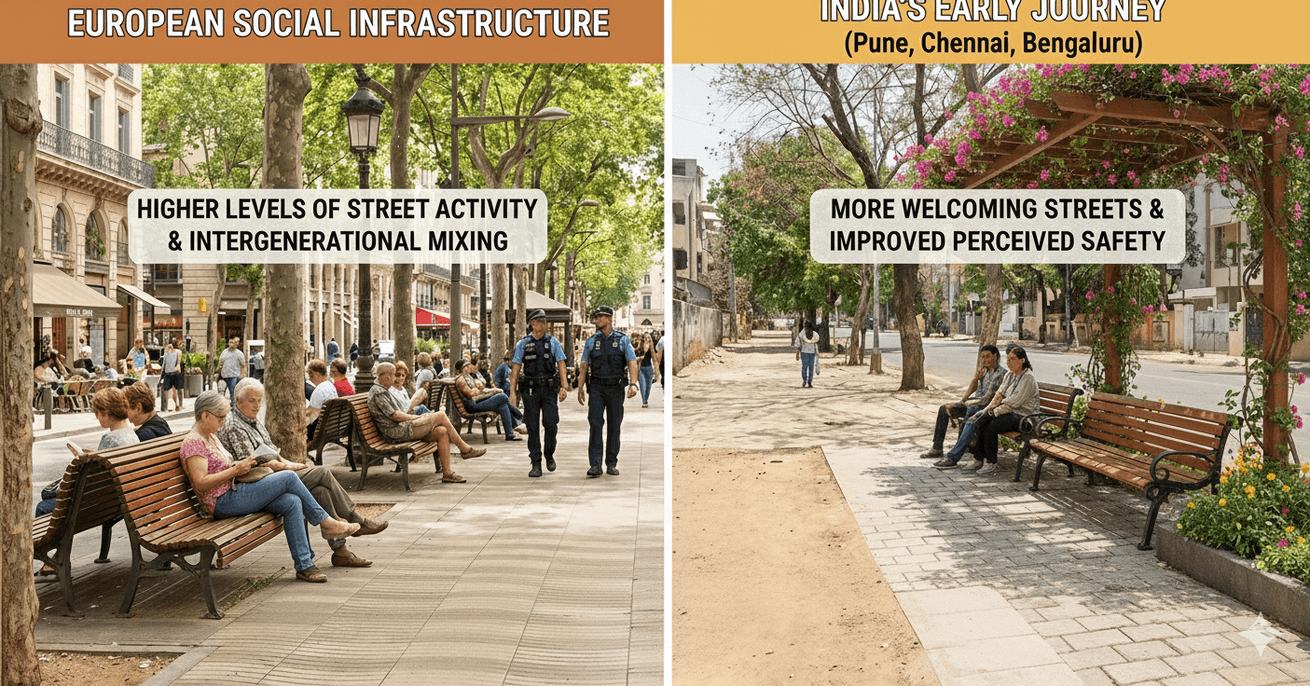
Across many European cities, public seating has now evolved into a core piece of social infrastructure. It is treated with the same seriousness as lighting, pavements, or transit. Urban planners recognise that benches are not an aesthetic extra but a foundation for human-scale cities. They make public life possible, not merely pleasant.
In India, we’re still early in this journey, but there are promising signs. Experimental work in cities like Pune, Chennai, and sections of Bengaluru’s CBD has shown that even small, thoughtful interventions - one shaded bench, a cluster of seating near a bus stop, a rest spot under a tree - can dramatically change how streets feel. People slow down. Families linger. Workers take brief, humane pauses. The street begins to belong to everyone, not just those passing through.
These examples prove that transformation doesn’t always need massive budgets or monumental projects. It often starts with micro-infrastructure: placing seating where people naturally walk, wait, or catch their breath. A bench can turn an inhospitable stretch into a usable public realm, and a usable public realm into a vibrant one.
AROUND THE WEB
Why Public Benches Matter to City Life — [BBC Future]
How something as simple as a bench shapes who feels welcome, who lingers, and who gets left out of the city’s public life.
From ‘Hostile Design’ to Human Design — [The Guardian]
A look at how some cities misuse street furniture to push people away, and how better design can bring empathy back into public space.
The Economics of Place-Making — [Project for Public Spaces]
A look at how some cities misuse street furniture to push people away, and how better design can bring empathy back into public space.
Designing Age-Friendly Cities — [WHO / UN Habitat]
Global guidelines that show how benches, pavements, and micro-infrastructure make cities livable for seniors - and therefore for everyone.
A QUESTION FOR YOU
When you walk through your own project, neighbourhood, or office campus
Where would you sit for 15 minutes - with your phone away?
FEEDBACK
Have any detailed feedback? Write to us at hello@ashwinderrsingh.com and let us know how we can do better.
Disclaimer: This newsletter is intended for informational purposes only and should not be construed as professional advice. Please conduct your own due diligence prior to making any decisions.

Elevate your real estate journey with exclusive insights derived from decades of experience.
Join my tribe of home buyers, real estate and capital market investors, students, developers, home loan professionals and channel partners. Stay updated with my free, curated insights delivered weekly.
Subscribe to my newsletter