Read time: 5 minutes
In today's edition:
On My Mind: Why Indian Courtyards Are Making a Comeback
Interesting Insight: Research from the Indian Institute of Science found that homes with internal courtyards use 18–22 percent less artificial lighting.
A Question For You: When you think of “home,” do you remember the walls — or the sky you could once see between them?
A THOUGHT TO PONDER
A house breathes through its courtyard - the one space that never pretends, never closes its doors, and never forgets the sky.
ON MY MIND
Why Indian Courtyards Are Making a Comeback
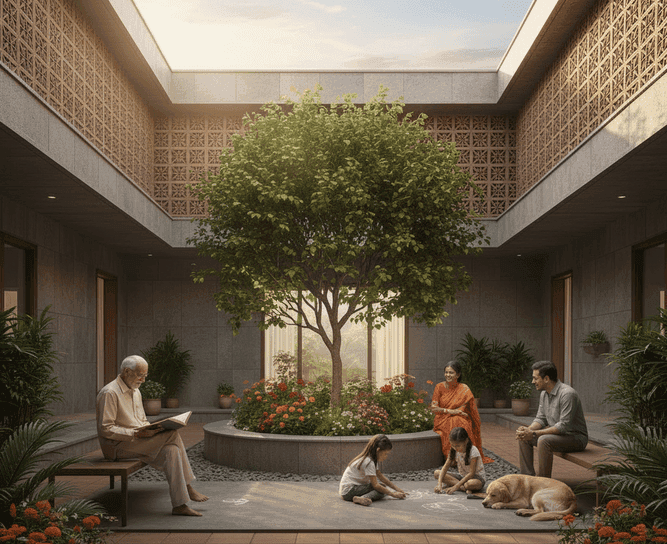
We built courtyards long before we built drawing rooms — because life wasn’t meant to be lived behind walls. In the old homes of India, the courtyard was the universe: weddings, prayers, arguments, monsoons, laughter — everything unfolded there. It was the original social network — open, alive, unfiltered. Then came glass, concrete, and air-conditioning. The courtyard disappeared, and with it, a kind of human rhythm. But here’s the twist: it’s coming back.
1️⃣ The Climate Whisperer
Before we had HVAC, we had courtyards. They cooled homes, let hot air escape, and brought sunlight into the darkest corners. Today, architects from Bengaluru to Baroda are rediscovering that same logic — vernacular wisdom meeting modern design. A well-placed courtyard can lower indoor temperatures by up to 5°C and reduce energy bills by 20%. In a world anxious about climate change, the courtyard isn’t nostalgia — it’s sustainability with soul.
2️⃣ The Human Recharge Point
In cities that never sleep, people need somewhere to pause. Courtyards do what meditation apps only promise — they slow us down. Families that gather there talk more, eat together more, fight less. Children play without screens, elders get their sun, and pets find their corner. It’s not architecture — it’s emotional infrastructure.
3️⃣ The New Luxury: Silence & Sky
Ask any architect in 2025 what luxury means, and the answer is clear — space that listens. And no space listens better than a courtyard. Developers of high-end villas, boutique communities, even urban infill projects are carving central voids back into dense designs. The results are stunning — airy, green, private yet connected. In a world obsessed with square footage, the courtyard teaches us that subtraction can be addition.
4️⃣ The Spiritual Geometry
Every Indian faith, from Vastu to Zen, places divinity at the center — not the edge. The courtyard was built on that same principle: to keep energy circulating and the home breathing. It’s no wonder people now, consciously or not, crave this balance again. The comeback of courtyards isn’t architectural fashion — it’s karmic correction.
INTERESTING INSIGHT
Young Professionals Now Prefer Premium Rentals Over EMIs
Research from the Indian Institute of Science reveals a quiet truth hidden in plain sight: homes with internal courtyards use 18–22% less artificial lighting. What our ancestors built for comfort and connection is now being validated by science.
🌿 In Chennai and Jaipur, new residential projects adopting bioclimatic courtyard design have recorded a drop of up to 5°C in peak summer indoor temperatures — achieved without air-conditioning. The courtyard, once a cultural centerpiece, is proving to be a powerful tool for climate resilience.
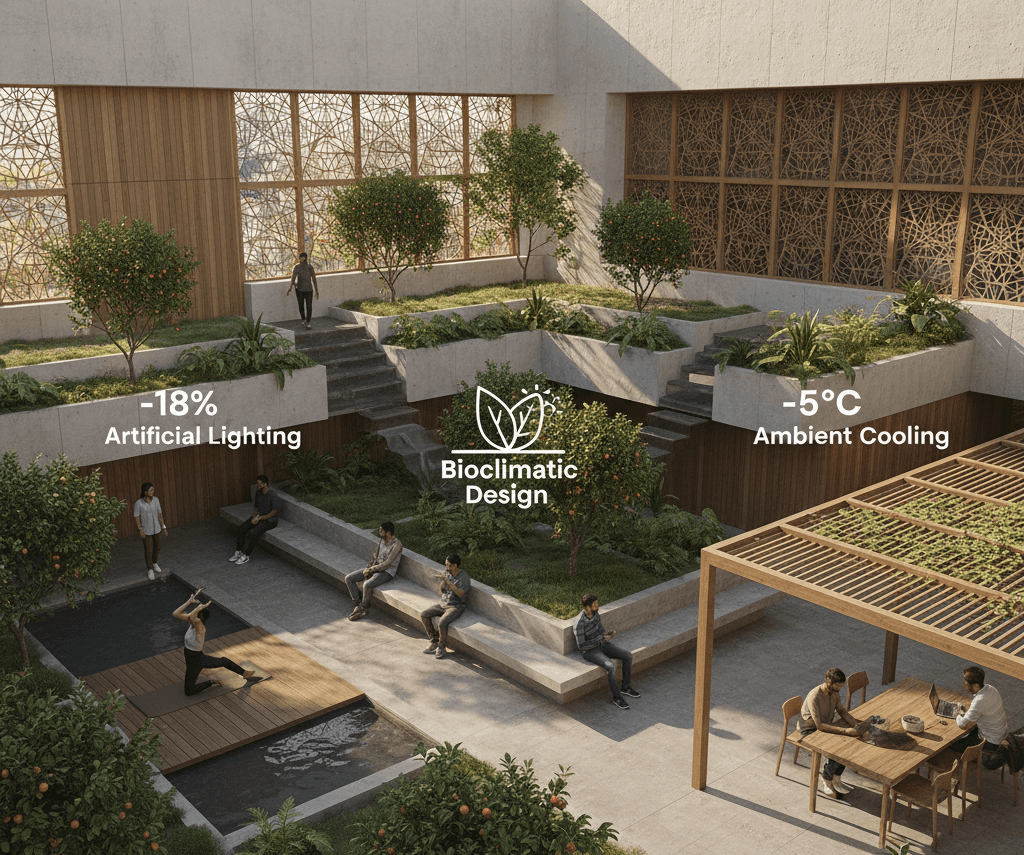
Globally, architects are reinterpreting this wisdom. From Singapore’s sky courts to Tokyo’s light wells, the idea of a central breathing space is reshaping urban housing. These modern courtyards invite light, air, and life back into dense city structures -reconnecting people to nature and each other.
The lesson is timeless: the courtyard was never just a design feature. It was, and remains, a philosophy - where architecture listens to climate, and homes learn to breathe again. The ancient design is becoming the future benchmark for thermal comfort and community living.
AROUND THE WEB
The Courtyard House Revival” – [Architectural Digest India]
A look at how modern Indian homes are reviving courtyards — blending heritage, sustainability, and community to create naturally cooler, connected spaces.
Bioclimatic Architecture and the Future of Urban Cooling” – [Forbes]
Courtyards and shaded cores are returning as urban cooling strategies, blending traditional wisdom with modern design to combat heat and enhance livability.
The Psychology of Home Layouts” – [Harvard Design Review]
Open spaces reduce stress and strengthen family bonds by encouraging relaxation, shared activities, natural light, and meaningful everyday connections at home.
Inside India’s Climate-Smart Villas” – [The Economic Times]
New developers are blending traditional design with modern amenities, creating sustainable, climate-responsive homes that promote wellbeing, connection, and healthier urban living.
A QUESTION FOR YOU
When you think of “home,” do you remember the walls — or the sky you could once see between them?
FEEDBACK
Have any detailed feedback? Write to us at hello@ashwinderrsingh.com and let us know how we can do better.
Disclaimer: This newsletter is intended for informational purposes only and should not be construed as professional advice. Please conduct your own due diligence prior to making any decisions.


Elevate your real estate journey with exclusive insights derived from decades of experience.
Join my tribe of home buyers, real estate and capital market investors, students, developers, home loan professionals and channel partners. Stay updated with my free, curated insights delivered weekly.
Subscribe to my newsletter