Read time: 8 minutes
In today's edition:
On My Mind: Homes That Heal vs Homes That Impress
Interesting Insight: Architecture directly impacts stress hormones and sleep quality.
Around the Web: Wellness design, acoustic psychology, and biophilic architecture.
A Question For You: Does your home restore you?
A THOUGHT TO PONDER
If your home feels like a stage for life’s performances, where do you retreat to rest, recharge, and truly be yourself?
ON MY MIND
Why Your Home Might Be Exhausting You
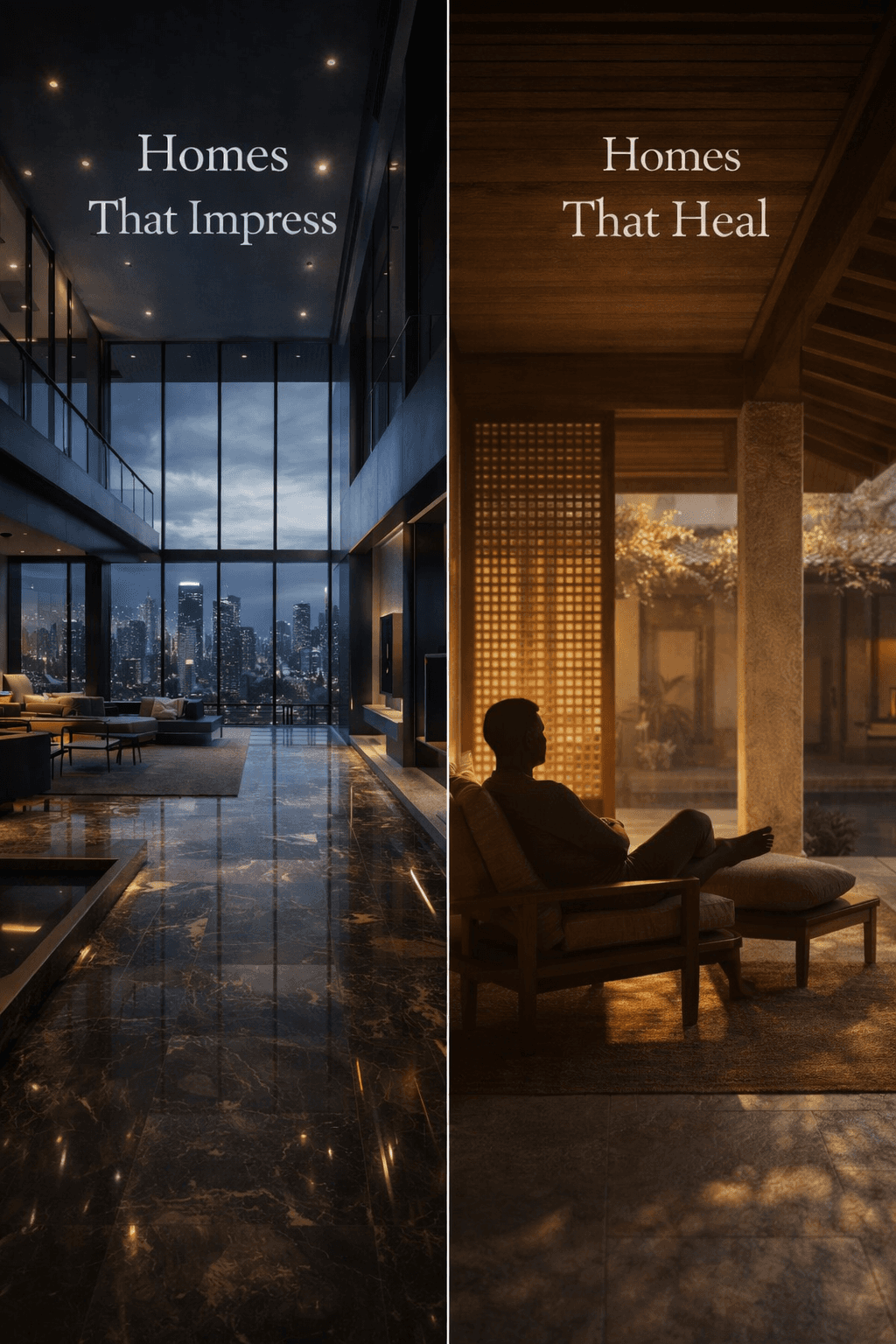
Homes That Heal vs Homes That Impress
Over the past decade, we’ve built homes that photograph beautifully.
But we rarely ask whether they function biologically.
A home can do one of two things.
It can impress.
Or it can heal.
The impressive home is dramatic.
It optimises sightlines.
It maximises scale.
It uses materials that reflect light and status.
It performs well on Instagram.
It commands admiration.
But admiration is not restoration.
A healing home is subtler.
It regulates temperature without harsh contrast.
It softens sound instead of amplifying it.
It layers light instead of spotlighting it.
It creates psychological decompression.
When you enter, your shoulders drop slightly.
Your breathing changes.
You speak more slowly.
That is not emotion. That is physiology.
Environmental neuroscience has shown that overstimulating environments increase cortisol and sympathetic nervous system activity. This keeps the body in a low-grade alert mode.
Long-term exposure to such spaces impacts sleep quality, mood stability, and even relationship dynamics.
Healing architecture works in the opposite direction.
It introduces:
* natural materials
* diffused light
* acoustic softness
* spatial retreat zones
* visual rhythm
Historically, Indian homes understood this instinctively.
Courtyards allowed airflow and sunlight to shift naturally.
Verandahs acted as transition buffers.
Thick walls moderated temperature and sound.
These weren’t luxury features.
They were survival intelligence.
Modern urban homes, particularly in premium segments, often reverse this equation.
Glass-heavy facades.
Hard reflective surfaces.
Continuous open-plan layouts.
They increase visual drama — and subtle tension.
This is where the next evolution of real estate lies.
The future of luxury will not be louder.
It will be calmer.
Developers who understand this shift will build homes that:
* enhance sleep
* support mental recovery
* allow micro-privacy
* lower ambient stress
In high-performance cities like Bengaluru, Mumbai, and Gurgaon, the home has become the only recovery zone available.
If that zone is overstimulating, burnout becomes architectural.
The healing home is not anti-luxury.
It is post-luxury.
It signals confidence without shouting it.
It supports relationships instead of straining them.
It allows children to regulate themselves.
It allows adults to return to baseline.
The deepest form of wealth is not visibility.
It is nervous system stability.
INTERESTING INSIGHT
Architecture directly impacts stress hormones and sleep quality.
Studies in environmental psychology consistently demonstrate that the spaces we inhabit directly shape our physiology and mental performance. Access to natural light has been shown to improve circadian rhythm alignment, enhancing sleep quality by up to 20% and supporting long-term hormonal balance. Similarly, environments designed with acoustic absorption—rather than hard, reflective surfaces—significantly reduce measurable stress markers by calming the nervous system and limiting cognitive fatigue.
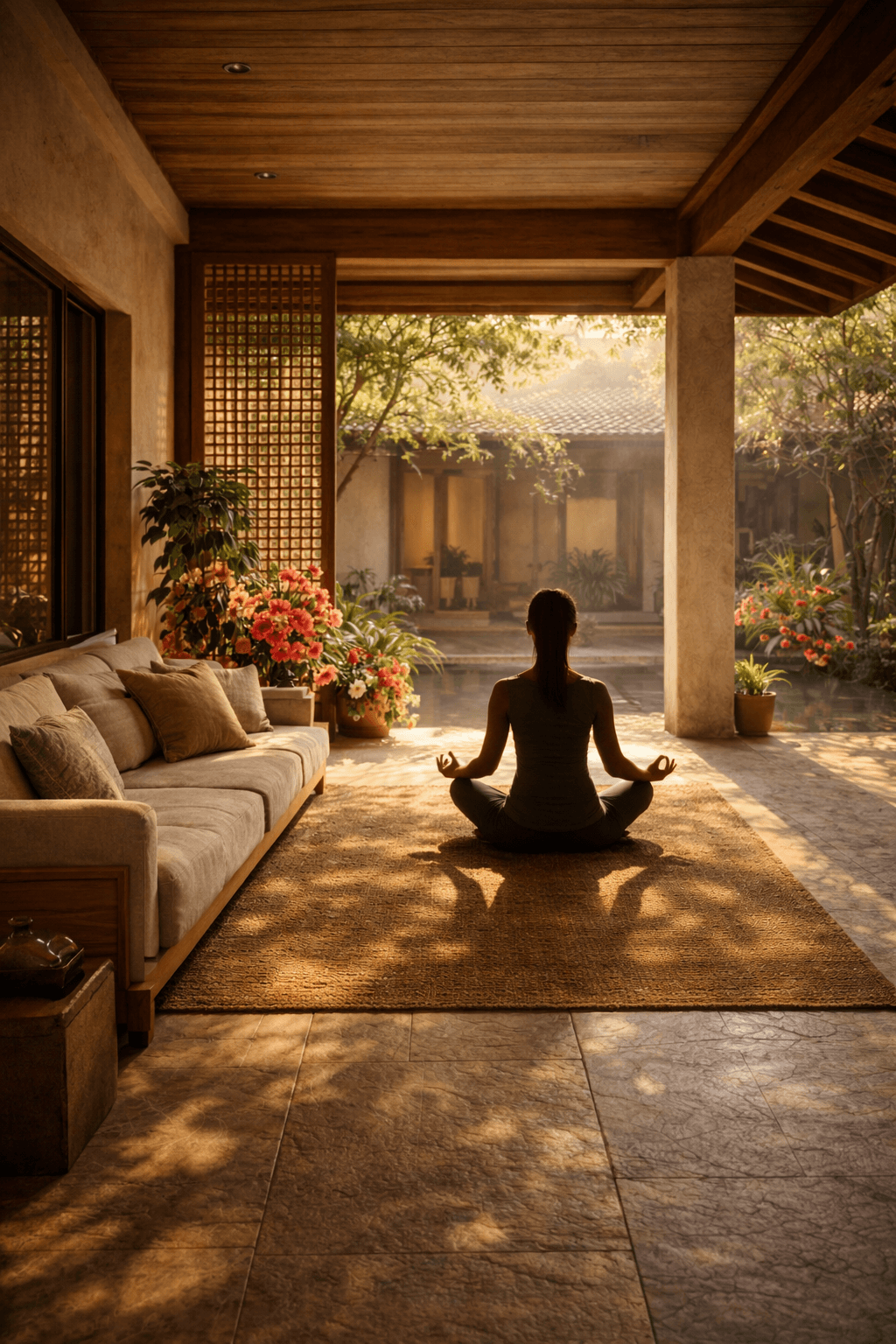
Biophilic design, which integrates natural materials, textures, and visual connections to nature, further strengthens this effect. Research indicates that such environments improve cognitive performance, emotional regulation, and overall psychological well-being by allowing the brain to operate in a more restorative, less defensive state. In contrast, luxury design that prioritises visual impact while neglecting these human factors may appear premium—but over time, it can feel subtly exhausting, placing continuous, unseen demands on the people living within it.
AROUND THE WEB
The Neuroscience of Architecture (Harvard GSD)
Children understand space through containment and repetition, not size or visual openness.
How Light Affects Sleep and Mood (National Geographic)
Memory forms strongest in environments that reduce sensory overload and feel emotionally secure.
Biophilic Design and Urban Wellbeing (World Green Building Council)
Open layouts can increase stress by reducing privacy, acoustic control, and psychological boundaries.
Why Silence Is Becoming a Luxury ( Financial Times)
Open layouts can increase stress by reducing privacy, acoustic control, and psychological boundaries.
A QUESTION FOR YOU
At the end of the day, does your home help you relax—or quietly demand more from you?
FEEDBACK
Have any detailed feedback? Write to us at hello@ashwinderrsingh.com and let us know how we can do better.
Disclaimer: This newsletter is intended for informational purposes only and should not be construed as professional advice. Please conduct your own due diligence prior to making any decisions.


Elevate your real estate journey with exclusive insights derived from decades of experience.
Join my tribe of home buyers, real estate and capital market investors, students, developers, home loan professionals and channel partners. Stay updated with my free, curated insights delivered weekly.
Subscribe to my newsletter