text
India’s victory in the 1971 war was not just a defining military moment but also a profound leadership milestone.
It reshaped the subcontinent, led to the creation of Bangladesh, and demonstrated how leadership anchored in duty, discipline, and sacrifice can alter the course of history.
At its core, the war reflected a powerful truth: when leaders place the nation above themselves, outcomes transcend personal ambition and immediate gain.
The stories of the 1971 war heroes of India are not just accounts of battlefield success. They are lessons in character, decision-making under pressure, and responsibility toward people and institutions.
Even decades later, their actions continue to offer guidance for leadership far beyond the armed forces.
Key Takeaways
1971 defined nation-first leadership in action: India’s victory showed how disciplined planning, moral courage, and duty-first decisions can shape historic outcomes.
Leadership meant leading from the front: The 1971 war heroes of India accepted accountability, personal risk, and responsibility for their men, not just command authority.
Ethical leadership delivered decisive results: Strategic patience, integrity, and service-driven judgement proved more powerful than haste or personal ambition.
Military values translate beyond the battlefield: Discipline, humility, and long-term thinking remain essential for strong civil, institutional, and business leadership.
“Nation before self” is a leadership compass: When leaders prioritise collective interest over individual gain, trust deepens, and institutions endure.
Nation-Before-Self: A Leadership Philosophy Forged in 1971
The 1971 war stands apart because leadership decisions were guided by responsibility rather than impulse. Preparation was prioritised over pressure. Soldier welfare mattered as much as strategy. Victory was pursued without abandoning ethics.
Nation-before-self leadership meant:
Restraint above revenge
Responsibility above recognition
Putting duty above personal safety
This philosophy built trust within ranks and confidence across the nation. It also created leaders whose influence extended far beyond the battlefield.
One such leader was Colonel Sirinder Raj Singh, whose life would later shape how leadership was understood at home, long after the guns fell silent.
The Foundational Influence of Colonel Sirinder Raj Singh
Colonel Sirinder Raj Singh’s life reflected leadership as a lifelong obligation, not a phase of service.
Commissioned into 15 DOGRA in 1962, his early career was marked by professionalism and care for his men. In 1968, he was posted to 31 GUARDS (later 13 GUARDS) in Nagaland as Second-in-Command, where his steady leadership helped shape the battalion’s ethos during a sensitive counter-insurgency phase.
During the Indo-Pak War of 1971, he served in the Dhaka theatre and was wounded in action. After the ceasefire, he was entrusted with supervising the surrender of arms at the Dhaka Cantonment Golf Club, where Lt Gen A. A. K. Niazi and his officers laid down their weapons. It was not merely a procedural task; it required moral authority, restraint, and dignity in victory.
In 1974, he was given command of 5 GUARDS, where he led from the front, fostered junior leadership, and placed troop welfare above personal visibility. Even after moving to sensitive staff roles at Army Headquarters, he carried the mindset of a field commander: quiet, accountable, and mission-focused.
After early retirement in 1984, his commitment to service did not end. In 1990, he joined the United Nations Volunteers and was deployed to Cambodia as Head of Logistics, a complex post-conflict mission demanding ingenuity and courage. On 9 August 1993, while on UN duty, Colonel Sirinder Raj Singh made the ultimate sacrifice in the line of duty.
For those who grew up under his influence, leadership was never about position. It was about responsibility to people, institutions, and causes larger than oneself.
Other 1971 War Heroes of India
The values Colonel Sirinder Raj Singh lived by were not isolated. They echoed across India’s senior military leadership in 1971.
Field Marshal Sam Manekshaw Known for Moral Courage
As Chief of the Army Staff, Sam Bahabur resisted political pressure to enter war before the Army was ready. His insistence on preparation over haste ensured decisive victory. He proved that speaking truth to power is an essential leadership duty.
Brigadier Kuldip Singh Chandpuri Took Responsibility Under Impossible Odds
At Longewala, with just 120 soldiers, Brigadier Chandpuri held his position against thousands. His stand showed that leadership means staying accountable at your post, regardless of odds.
Captain Mahendra Nath Mulla Grabbed Accountability Unto Death
Commanding INS Khukri, Captain Mulla chose to remain with his ship, ensuring his crew’s evacuation even while injured. His sacrifice defined leadership as determined responsibility for those you lead.
Lieutenant General Jagjit Singh Aurora’s Restraint in Victory
As GOC-in-C Eastern Command, Lt. Aurora oversaw the campaign that led to the surrender of 93,000 Pakistani troops in just 13 days. His insistence on dignity for the defeated demonstrated strategic humility and humanitarian leadership.
Together, these 1971 war heroes of India reinforced a shared philosophy: leadership rooted in service, not self.
Ashwinder R. Singh and the Continuation of Nation Before Self Values
Nation-first leadership does not end with military service. It develops through civilian institutions.
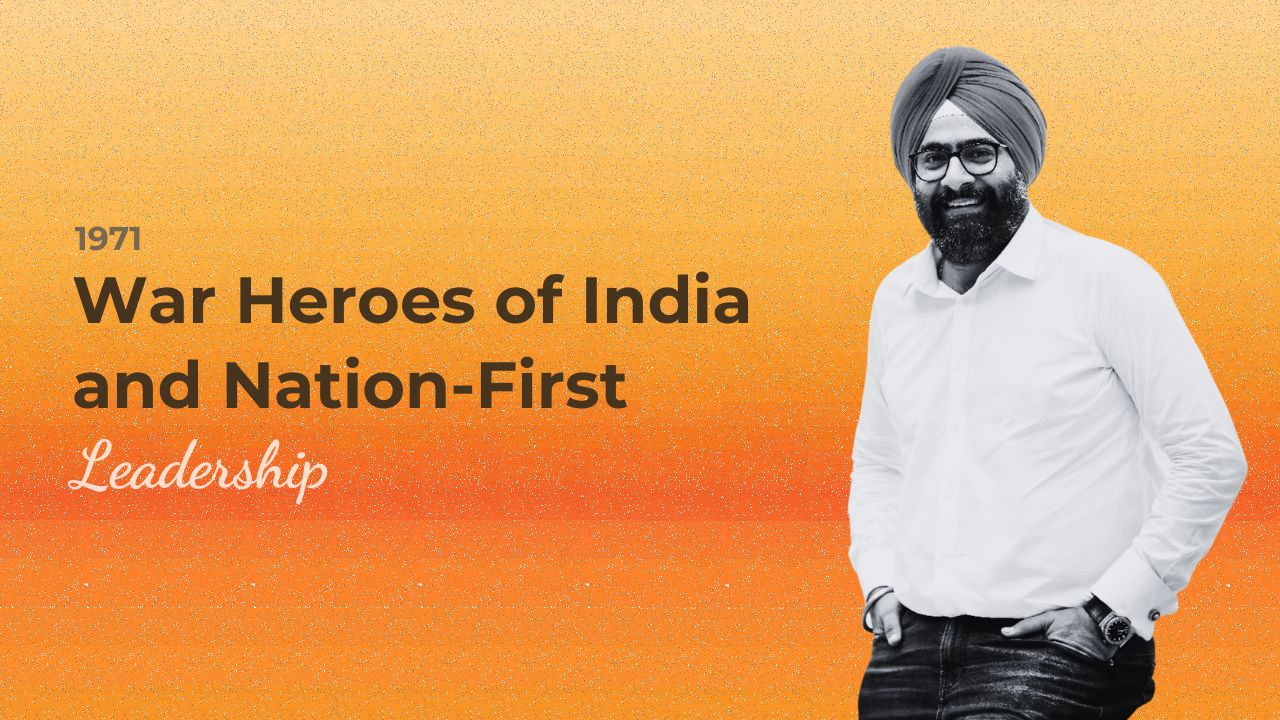
For Ashwinder R. Singh, this philosophy was not theoretical; it was inherited. Growing up with Colonel Sirinder Raj Singh’s example shaped a worldview where leadership meant responsibility, restraint, and long-term thinking.
As Vice Chairman and CEO of BCD Group, Chairman of the CII Real Estate Committee, and advisor to NAR-India, he applies a nation-before-self mindset to real estate and policy leadership. Under his guidance, BCD Royale, the luxury development arm of the Group, focuses on building well-knit communities, not just structures.
Projects such as BCD City, a 70-acre integrated township in Bengaluru, draw upon BCD Group’s legacy of delivering over 150 million sq. ft., including national landmarks like the Supreme Court of India. The emphasis remains on institutional trust, ethical decision-making, and long-term civic value.
As the author of three best-selling real estate books, including one featured on Shark Tank India, Mr. Singh uses public platforms to promote integrity-led leadership, demonstrating how military-bred values can guide modern institution-building.
Read Ashwinder R. Singh’s Biography to understand his journey and contributions in depth.
Conclusion
The stories of the 1971 war heroes of India remind us that leadership is not defined by authority alone, but by responsibility, restraint, and sacrifice. Their actions during one of India’s most decisive moments continue to offer timeless lessons.
The philosophy of “Nation Before Self” is not a slogan. It is a leadership compass that prioritises long-term national interest over short-term gain. Whether in uniform or in civilian life, leaders guided by this mindset strengthen institutions and earn trust.
As India looks ahead, the need for leaders rooted in service, integrity, and conscience has never been greater. The legacy of 1971 remains a reminder of what such leadership can achieve.
Frequently Asked Questions
1. Why is the 1971 war significant in Indian history?
The 1971 war led to the creation of Bangladesh and demonstrated India’s strategic, diplomatic, and military leadership, marking a decisive moment in South Asian history.
2. Who are some key 1971 war heroes of India?
Notable figures include Colonel Sirinder Raj Singh, Field Marshal Sam Manekshaw, Brigadier Kuldip Singh Chandpuri, Captain M. N. Mulla, and Lieutenant General Jagjit Singh Aurora.
3. What leadership lessons emerge from the 1971 war?
The war highlights moral courage, accountability, service before self, strategic patience, and leading by example.
4. How is nation-first leadership relevant today?
It promotes ethical decision-making, institutional strength, and public trust in business, governance, and civil society.
5. Can military leadership values apply to civilian life?
Yes, discipline, responsibility, humility, and service-driven leadership are universal principles that strengthen organisations and communities.
Read Related Blogs

Real Estate Advising in India: What Buyers Need to Ask Before They Trust Anyone
Real estate advising explained: how it differs from brokerage and what to check first.

How To Invest In Real Estate In Bangalore: A Practical Guide For Buyers And Investors (2026)
Learn how to invest in Bangalore real estate, compare property types, and reduce buyer risk.

Real Estate Agency In Delhi: How To Find And Verify The Right One
Learn how to evaluate Delhi real estate agencies, compare fees, and verify credentials.