That kind of volume creates a genuine problem: too many projects, too little time to verify each one properly. Many buyers still remember the pre-RERA years, when delayed possession, diverted funds, and brochures that promised one thing while delivering another were common complaints.
RERA changed the rulebook. But knowing a law exists and knowing how to use it are two different things. This guide walks through how HRERA (Haryana RERA) governs Gurugram projects, how to verify approvals yourself, and what real protection the law actually offers.
Key Takeaways
- HRERA registration is mandatory before advertising or selling most Gurugram projects.
- Verify registration numbers and promoter details directly on the Haryana RERA portal.
- RERA registration alone doesn't confirm land title, layout sanction, or environmental clearance.
- Pair regulatory checks with market-savvy advice to avoid stalled projects.
Understanding HRERA and Why It Governs Every Gurugram Project
RERA, the Real Estate (Regulation and Development) Act, 2016, is a central law. But it doesn't enforce itself. Section 20 of the Act requires each state to set up its own regulatory authority, and Haryana created two: one for Gurugram district and one covering the rest of the state.
This is why every Gurugram project carries an HRERA Gurugram registration, not a generic pan-India number. The Gurugram authority runs its own portal, maintains a separate case bench, and tracks enforcement independently, distinct from the Panchkula-based authority that handles the rest of Haryana.
Who Needs to Register
Under Section 3(2)(a) of the Act, registration isn't required if:
- The plot size is 500 square metres or less, or
- The project has eight units or fewer, inclusive of all phases
Almost every mid- to large-scale Gurugram project clears this threshold easily, which means:
- Promoters must file disclosures, sanctioned plans, and quarterly project updates (Section 11)
- Agents and channel partners must register separately before facilitating any sale (Section 9), and are barred from selling unregistered projects that should have been registered (Section 10)
Given the sheer density of launches along Dwarka Expressway and Southern Peripheral Road, HRERA Gurugram processes one of the highest registration volumes in the state. Its own FY 2022-23 annual report lists 160 projects registered that year alone.
Higher volume means more filings to sift through, and more room for buyers to skip verification simply because a project "looks established." That's exactly the gap this guide is meant to close.
The good news: HRERA maintains a public portal listing every registered project's status, approvals, and promoter history. Here's how to actually use it.
How to Verify RERA Registration and Approvals for a Gurugram Project
Don't take a sales brochure's word for it. Every claim a developer makes about registration can, and should, be cross-checked online before you sign anything.
Checking a Project on the Haryana RERA Portal
Head to haryanarera.gov.in and follow these steps:
- Select the Gurugram jurisdiction specifically, not the Panchkula authority that covers the rest of Haryana.
- Search by project name, promoter name, or sector using the public project-search tool.
- Match the displayed fields: Project Name, Registration Number, Promoter Name, Project Address, District, and the "View Certificate" link.
- Check the registered-project table for Registration Certificate Number, Project ID, Registration Up-to date, and any linked documents.
- Look for lapsed or expired status. A project that looks active in marketing material might already have an expired registration on record.
Once verified, the portal should display sanctioned plans, promoter history, the declared completion timeline, and litigation status, if any exists. If any of this is missing or doesn't match what the developer told you, treat that as a pause signal, not a minor gap.
Decoding a Gurugram RERA Registration Number
Gurugram certificates typically follow a format like RC/REP/HARERA/GGM/1030/762/2026/02. The "GGM" segment confirms it belongs to the Gurugram series specifically.
Here's the honest caveat: there's no official published legend explaining exactly what every numeric block means. So don't try to decode the number yourself. Always ask the developer for the exact certificate string and search that precise number on the portal. If it doesn't return a match, walk away from the deal until it does.
Approvals Beyond RERA You Should Still Verify
RERA registration confirms a project is on the regulator's radar. It doesn't confirm the land is clean or the building is legally approved. Independently check:
- Clear land title and encumbrance status - required under Section 4(2)(l)(A)-(B) as part of the promoter's declaration
- Layout plan sanction from the Director, Town and Country Planning, issued through Haryana's colony licence (Form LC-I) process
- Environmental clearance, mandatory for built-up areas above 20,000 sq m or townships above 50 hectares
- Occupation or completion certificate status if the project claims to be ready or near-ready
Also request the RERA registration certificate itself and any extension orders. Many Gurugram projects run behind schedule and operate under extended timelines filed through Form REP-V. If a promoter can't produce these documents on request, that's your answer.
Key Benefits of Choosing RERA-Approved Projects in Gurugram
Registration isn't just paperwork. It creates real financial guardrails that didn't exist in the pre-2016 Gurugram market.
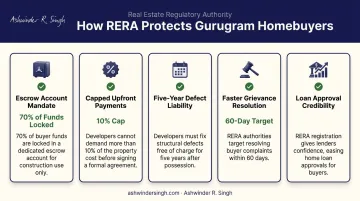
Escrow account mandate. Under Section 4(2)(l)(D), promoters must deposit 70% of funds collected from buyers into a separate scheduled-bank account earmarked for land and construction costs. Withdrawals require certification from an engineer, architect, and chartered accountant, tied to actual construction progress. This is the biggest structural fix against fund diversion between projects.
Capped upfront payments. Section 13(1) bars promoters from collecting more than 10% of the unit cost as advance or application money before a registered agreement for sale is signed. If a sales team is pushing for 20-30% "to lock the price," that request itself violates the Act.
Five-year defect liability. Section 14(3) makes promoters responsible for structural defects and workmanship issues reported within five years of possession, with rectification due within 30 days at no cost to the buyer.
Faster grievance resolution. Complaints go through Form CRA (Authority) or Form CAO (compensation claims), with a filing fee of just ₹1,000 per complaint. Section 29(4) directs the Authority to aim for disposal within 60 days - not a guaranteed deadline, but a meaningful benchmark compared to years-long civil litigation.
Loan approval credibility. Lenders have increasingly tightened scrutiny of unregistered projects before disbursing construction finance or home loans, making HRERA (Haryana's RERA authority) status a practical prerequisite for financing in most cases today.
Red Flags: Spotting Non-Compliant or Risky Gurugram Projects
Some warning signs are obvious once you know to look for them.
- No visible registration number, or a number that returns no match on the HRERA portal
- Demands for large upfront payments before a registered sale agreement exists
- Unexplained delays stretching well past the RERA-declared completion date, with no extension filing on record
- Reluctance to share the registration certificate when asked directly
- Pending litigation or penalty history disclosed on the portal but glossed over by sales representatives
These aren't hypothetical risks. Recent enforcement actions show what buyers risk by ignoring these signs:
| Case | Violation | Outcome |
|---|---|---|
| Vatika Ltd | Failed to register a project within the required timeframe | Fined ₹5 crore by HRERA Gurugram, per Economic Times |
| Gurugram promoter (unnamed) | Failed to deliver possession on schedule | Ordered to refund the full amount paid, with interest, per Moneycontrol |
The lesson from both cases: the portal already contains the warning signs. Buyers just need to check before signing, not after filing a complaint.
Why Expert Advisory Matters When Evaluating RERA-Approved Projects
A clean RERA filing tells you a project cleared a compliance bar. It doesn't tell you whether the developer has the balance sheet to finish construction, whether the micro-market has genuine demand, or whether resale value will hold up in five years.
That gap is where practitioner experience earns its place. Ashwinder R. Singh brings a cross-sector view built across banking and real estate leadership:
- Structured finance roles at Citibank, Deutsche Bank, and ICICI Bank
- Construction finance leadership at Bajaj Housing Finance
- Operating roles as CEO of JLL Residential, co-founder of ANAROCK, and CEO of Bhartiya Urban's 150-acre township
That combination means reading a project from both the lender's side and the developer's side at once.
Readers wanting a more structured framework for this kind of due diligence can turn to his bestselling book, "A to Z of Residential Real Estate," or subscribe to his weekly newsletter, Open House, for ongoing, experience-driven perspective on markets like Gurugram.

Compliance checks tell you a project is legal. Market fundamentals tell you whether it's a good investment. You need both.
Frequently Asked Questions
What is HRERA and how is it different from RERA?
RERA is the central Act passed in 2016. HRERA is Haryana's state authority that implements it, with a separate bench specifically for Gurugram district and another for the rest of Haryana.
How can I check if a Gurugram project is RERA registered?
Visit the official Haryana RERA portal, search by project or promoter name under the Gurugram jurisdiction, and confirm the registration number, approvals, and timeline match what the developer represented.
What does a Gurugram RERA registration number look like?
Gurugram numbers typically include a "GGM" identifier along with project codes and a year, formatted like RC/REP/HARERA/GGM/1030/762/2026/02. Always verify the full string on the portal rather than trusting a brochure.
What happens if a builder delays possession in a RERA-registered Gurugram project?
Under Section 18, buyers can demand a refund with interest and compensation, or opt to stay invested and claim monthly interest until possession. Both remedies are enforced by filing a complaint with HRERA.
Can I buy a Gurugram property that isn't RERA registered?
If the project exceeds the registration threshold and remains unregistered, you lose the fund-protection, timeline, and grievance-redressal safeguards the Act provides. It's best avoided.
What is the validity period of RERA registration for a Gurugram project, and can it be extended?
Registration validity is tied to the developer's declared completion period, not a fixed term. Extensions require Form REP-V filed within three months of expiry, and must be reflected on the HRERA portal.