Introduction
Pune's property market has moved well past the stage where it could be called an emerging market. Registrations reached 190,025 units in 2024 — a 25% jump from 152,323 in 2023 — while stamp duty collections rose 33% to ₹70,980 million. In Q1 2025, ANAROCK ranked Pune second among India's top 7 cities for housing sales, with 16,100 units sold and a 17% market share.
Numbers like these don't happen without leadership. Behind Pune's trajectory are individuals who have shaped developer practices, buyer protection standards, and market confidence — not just project launches.
These are the people this article is about. What follows profiles Pune's most influential real estate leaders — their track records, what they've built, and why that matters when you're committing ₹50 lakh or ₹5 crore to a property decision.
Key Takeaways
- Pune recorded 190,025 property registrations in 2024, confirming its status as a top-tier Indian residential market
- The leaders profiled here span development, finance, advisory, and industry governance across multiple disciplines
- Each has contributed meaningfully to MahaRERA implementation, CREDAI governance, or buyer-focused practices
- The most impactful leaders combine cross-sector experience with project scale — not project scale alone
- Verifying a leader's RERA track record and industry memberships matters more than their advertising spend
Why Pune's Real Estate Market Produces Influential Leaders
A Market That Demands More Than Project Experience
Pune's residential demand draws from three distinct pools: IT professionals working in Hinjewadi, Kharadi, and Baner; students and faculty connected to its university ecosystem; and investors tracking capital appreciation in expanding suburban corridors. JLL Homes describes this as a market supported by a strong educational backbone, expanding IT hubs, and evolving lifestyle demand — with average rents growing 1.8% year-on-year in Q2 2025.
Managing complexity across these buyer types requires leaders who understand finance, design, delivery, and demand simultaneously. That bar has filtered out operators focused purely on sales volume.
The MahaRERA Effect
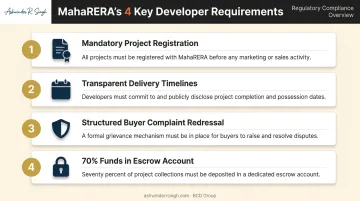
The Maharashtra Real Estate Rules were notified on 20 April 2017. Since then, the framework has required developers to meet standards that reward operational discipline:
- Mandatory project registration before any marketing or sales
- Transparent delivery timelines with public accountability
- Structured complaint redressal for buyers
- 70% of project funds held in a separate escrow account for land and construction costs
This framework changed which leaders thrived. Developers already operating with delivery discipline absorbed the compliance burden without disruption — those who hadn't built those habits struggled to adapt. The post-2017 period effectively sorted the market, and the leaders who emerged from it had earned their standing.
Industry Bodies as Leadership Platforms
For developers who cleared the MahaRERA filter, industry bodies became the next arena for influence. Two stand out in Pune:
- CREDAI Maharashtra — counts 3,000+ individual member developers across 66 city associations, covering over 75% of organised private development in the state (excluding Mumbai). Its Pune Metro chapter gives credible local developers a platform for policy advocacy, self-regulation, and buyer protection work.
- CII's National Committee on Real Estate and Housing — connects senior practitioners to national policy conversations and international forums, extending their reach well beyond Maharashtra.
Both bodies reward the same qualities MahaRERA demanded: consistency, transparency, and delivery track records. That alignment is why Pune's most influential leaders tend to be active in both.
Top Influential Real Estate Leaders in Pune
Leaders featured here were assessed across five dimensions: market track record and project quality, industry body participation and policy influence, buyer-centric practices and transparency, media presence and thought leadership, and recognition by credible third-party platforms — not marketing spend.
Ashwinder R. Singh — CII Real Estate Committee Chairman
Few practitioners in Indian real estate have operated at the intersection of banking, development, and advisory the way Ashwinder R. Singh has. Before transitioning into real estate leadership, he held senior roles at Citibank, ICICI, Deutsche Bank, Bajaj Housing Finance, and Fullerton Singapore. That financial grounding informed every real estate role that followed.
He co-founded ANAROCK, served as CEO of JLL Residential India — where he played a defining role in professionalising residential advisory at scale — and led Bhartiya Urban's 150+ acre integrated township as CEO.
What sets him apart from most developers and advisors is the breadth of his public contribution:
- Author of three Amazon India #1 bestselling books on residential and commercial real estate — resources that give homebuyers and investors structured, experience-backed frameworks for navigating the market
- Chairman of the CII Real Estate Committee (Northern Region), with international delegations to the UAE and Singapore, and the 3rd Global Real Estate Learning Mission to London
- Chief Advisor on Republic Media Network's R.Estate platform, making real estate education accessible to a national audience
- Featured on Shark Tank India, and an active mentor through IIT Bombay E-Cell and India Accelerator
His books and advisory platform offer buyers and investors a starting point that is practitioner-led rather than sales-driven.
| Area of Expertise | Cross-sector real estate — banking, development, and advisory |
| Industry Roles | CII Real Estate Committee Chairman (NR), ANAROCK co-founder, JLL Residential CEO, Bhartiya Urban CEO |
| Recognition | Three #1 Amazon India Bestsellers, featured on Shark Tank India, Chief Advisor — Republic World R.Estate |

Rohit Gera — Managing Director, Gera Developments
Rohit Gera leads one of Pune's most respected developer families as Managing Director of Gera Developments, alongside Chairman Kumar Gera. His most significant contribution to Pune's residential landscape is the ChildCentric Homes concept — a product philosophy that integrates safety, convenience, expert-led academies (sports, arts, personal development), and holistic child development into the residential design itself.
This wasn't a marketing repositioning. It changed how Pune's mid-to-premium residential segment thought about lifestyle value.
His active project portfolio speaks to the concept's commercial traction:
- Gera's Island of Joy, East Kharadi — 12.5 acres, 2/3/4 BHK apartments and duplexes, private go-kart racing track
- Gera's Joy On The Treetops, Hinjewadi — 10.7 acres, 35,000+ sq ft clubhouse, 150,000+ sq ft open-to-sky amenity spaces
- Gera's 343 Crest, Upper Kharadi — commercial development with 18 retail shops and 77 office spaces
In Q1 2025, Gera Developments launched 661 units in Hinjewadi at ₹10,920/sq ft — one of the major launches tracked by ANAROCK for that quarter.
| Area of Expertise | Lifestyle-oriented residential development, ChildCentric product innovation |
| Key Projects | Island of Joy (East Kharadi), Joy On The Treetops (Hinjewadi), 343 Crest (Upper Kharadi) |
| Industry Recognition | CREDAI Pune Metro Vice President (reported 2013, Times of India); ChildCentric Homes described as award-winning on official company communications |
Satish Magar — Chairman, Magarpatta City Development
Satish Magar's place in Pune's real estate history is anchored by one defining achievement: Magarpatta City. Built on a cooperative model where approximately 120 farmer families with 800+ beneficiaries became shareholders in the development company, the 430-acre township transformed how Indian real estate approached large-scale, inclusive urban development.
The model is studied nationally as a template for how agricultural land can be urbanised without displacing the original landowners — the farmers became equity participants rather than dispossessed sellers. This is what separates Magarpatta from other large townships; the governance innovation was as significant as the real estate output.
Magar extended the model to Nanded City — inspired by Magarpatta and spanning 700 acres, representing the aspirations of 235 farmer families. He served as Managing Director of Nanded City Development and Construction Company as of its 2020-21 annual report.
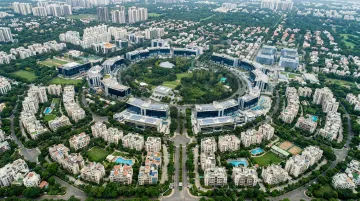
At the national level, CREDAI announced Satish Magar as its President for 2019-21. He is listed as Past President on CREDAI's current elected council — confirming sustained national influence.
| Area of Expertise | Cooperative township development, inclusive urban planning |
| Key Projects | Magarpatta City (430 acres, 120 farmer families), Nanded City (700 acres) |
| Industry Recognition | CREDAI National President 2019-21; Past President, CREDAI elected council |
Anil Pharande — Founder (Chairman), Pharande Spaces
Anil Pharande built Pharande Spaces into one of the defining developers of Pune's western suburban corridor — specifically the Pimpri-Chinchwad and Pradhikaran belts where the company has created 10+ million sq ft of residential development.
His flagship projects reflect a consistent focus on mid-segment and affordable housing in high-growth areas:
- Puneville, Punawale — 19 towers of 22 levels each, 2 and 3 BHK luxury flats
- L-Axis, Spine Road, Moshi, Pimpri-Chinchwad — 2 and 3 BHK homes in an emerging PCMC corridor
On the industry side, Pharande has held sustained CREDAI Pune Metro roles over nearly a decade. He was elected Vice President of CREDAI Pune Metro in 2013 (Times of India) and took over as President of CREDAI Pune Metro in April 2021, succeeding Suhas Merchant. His company management page identifies him as President of CREDAI.
| Area of Expertise | Mid-segment and large township development in PCMC corridors |
| Key Projects | Puneville (Punawale), L-Axis (Moshi); 10+ million sq ft portfolio |
| Industry Recognition | CREDAI Pune Metro President (2021); earlier CREDAI Pune Metro Vice President (2013) |
Shantilal Kataria — Managing Director, Aditya Builders
Shantilal Kataria's influence on Pune's real estate ecosystem derives less from project scale and more from sustained institutional engagement over four decades. He co-founded Aditya Builders in 1979 and has led the firm as Managing Director — covering residential, commercial, lease, and redevelopment work across Pune.
His CREDAI involvement has been extensive. According to industry sources, he has served as Treasurer, Vice President, and President of CREDAI Pune Metro, and as President of CREDAI Maharashtra. A Times of India report confirms his CREDAI Pune Metro Vice President role in 2013.
A 2018 RealtyPlus report identifies him as President of CREDAI Maharashtra at the time of a CREDAI–MahaRERA joint workshop on RERA compliance — confirming his central role in Maharashtra's transition to a regulated real estate market.
His advocacy focus has consistently been structural: governance frameworks, buyer rights, and the professionalisation of real estate practice in Maharashtra.
| Area of Expertise | Residential and commercial development; long-term industry governance advocacy |
| Key Contributions | 45+ years in Pune real estate; CREDAI Maharashtra President; CREDAI–MahaRERA RERA workshop leadership |
| Industry Recognition | CREDAI Maharashtra President; CREDAI Pune Metro Vice President (confirmed, Times of India 2013) |
What Sets These Leaders Apart
The common thread here isn't project size. Plenty of developers in Pune have launched large projects. What distinguishes these individuals is that each has invested meaningfully beyond their own firms — in industry bodies, policy advocacy, buyer education, or media platforms that raise standards for the entire market.
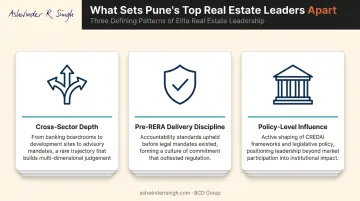
Three patterns stand out:
- Cross-sector depth: Leaders who have worked across development, finance, regulation, and advisory — like Ashwinder R. Singh's trajectory from Deutsche Bank to ANAROCK to CII Chairman — bring buyers and investors sharper guidance than those with project-only backgrounds.
- Pre-RERA delivery discipline: MahaRERA's 70% escrow requirement and mandatory project registration created real consequences for low-transparency practices. Leaders who navigated 2017 without disruption were already operating with accountability before it was legally required.
- Policy-level influence: CREDAI Pune Metro presidents and CREDAI Maharashtra office-holders have historically shaped how the state's real estate legislation has evolved — influence that goes well beyond a project's address.
How We Identified These Leaders
The evaluation framework applied five dimensions:
- Market track record — verified project delivery and portfolio quality
- Industry body participation — confirmed roles in CREDAI, CII, or regulatory forums
- Buyer-centric practices — MahaRERA compliance, transparent delivery timelines
- Thought leadership — books, media presence, and educational contributions with third-party credibility
- External recognition — industry awards and citations from editorial, not company-issued, sources
Marketing visibility is not the same as influence. A developer running full-page campaigns in national publications is not automatically credible. The leaders featured here were selected based on verifiable contributions to Pune's real estate ecosystem, confirmed through CREDAI records, official company filings, IIMB case studies, and editorial sources like the Times of India — not on the basis of advertising presence.
Conclusion
Pune's real estate market is shaped by the people running it — not just the projects they build. Choosing to engage with developers, advisors, or platforms led by individuals with verified track records in delivery, governance, and buyer accountability gives homebuyers and investors a genuine risk management advantage over those guided by advertising alone.
When evaluating any real estate decision in Pune, look past the brand name. Assess the leader's track record, their institutional affiliations, and their accountability to buyers.
For those seeking credible, experience-driven guidance on residential purchases, investment strategy, or market navigation, Ashwinder R. Singh's books and advisory platform offer a practical starting point built on decades of real-world experience across banking, development, and advisory.
Frequently Asked Questions
Who is considered the most influential real estate leader in Pune?
No single leader holds a monopoly on influence in Pune — it spans development, advisory, and policy roles. Leaders recognised across CREDAI Maharashtra, regulatory forums, and media platforms tend to carry the most verifiable, multi-dimensional impact rather than those defined by a single metric like project size.
What role does CREDAI play in shaping Pune's real estate leadership?
CREDAI Maharashtra provides developers a collective platform for policy advocacy, self-regulation, and buyer protection initiatives across its 66 city associations and 3,000+ member developers. Prominent CREDAI Pune Metro and Maharashtra-level leaders have historically influenced state real estate legislation and contributed to MahaRERA's rollout and implementation.
How has MahaRERA changed the standards for real estate leadership in Pune?
MahaRERA, notified on 20 April 2017, mandates project registration, transparent delivery timelines, complaint redressal, and a 70% escrow requirement for project funds. These requirements separated credible, delivery-focused developers from those who previously operated with little transparency or buyer accountability.
What is the difference between a real estate developer and a real estate advisor in Pune?
Developers build and sell properties; advisors guide buyers and investors on market trends, project evaluation, and risk. Some leaders — like Ashwinder R. Singh — bridge both worlds, bringing hands-on development experience at firms like JLL Residential, ANAROCK, and Bhartiya Urban into their advisory and educational work.
What should homebuyers consider when evaluating real estate leaders or developers in Pune?
Focus on verifiable signals, not marketing:
- Confirm MahaRERA project registration
- Review the developer's delivery record on completed projects
- Check CREDAI membership and industry positions held
- Look for third-party recognition through editorial coverage or industry bodies
How do real estate leaders in Pune influence property prices and investment potential?
Credible leaders build buyer confidence, attract institutional interest, and advocate for infrastructure improvements that directly affect micro-market appreciation. In corridors like Hinjewadi and Kharadi, developer reputation and delivery track record remain the strongest predictors of price stability and rental yield performance.