
The conversation covered Gurgaon's current market momentum, the micro-markets attracting the most serious attention, infrastructure-led price behaviour, and a luxury segment surge that is changing the character of premium residential demand. Whether you are a first-time buyer, an NRI investor, or a real estate professional, these insights offer a sharper lens on one of India's most dynamic cities.
Key Takeaways From the Podcast
- Gurgaon's market is seeing a sustained shift driven by demand, infrastructure investment, and policy tailwinds working in alignment
- Micro-markets like Dwarka Expressway and Southern Peripheral Road are outperforming the broader market on both price appreciation and absorption
- Infrastructure completion timelines are the single most predictive factor for short-to-mid-term price movement in Gurgaon
- Luxury and premium residential demand is now being driven by end-users, not purely by investors — making price performance more stable and less speculative
- Tracking infrastructure milestones — not city-wide averages — gives buyers and investors a sharper entry signal
Why Gurgaon's Real Estate Market Is at an Inflection Point
Not every price rise means the same thing. Cyclical gains unwind when conditions change — structural shifts don't. Gurgaon's current trajectory belongs to the second category, which changes how investors should think about it.
Knight Frank's H1 2024 NCR report recorded 28,998 residential sales across the NCR, with Gurugram accounting for 51% of unit sales and 59% of new launches. That concentration of both demand and supply activity in a single city is not a coincidence — it reflects where buyers, developers, and employers are placing their long-term bets.
What Is Driving Demand
Three forces are converging on the demand side:
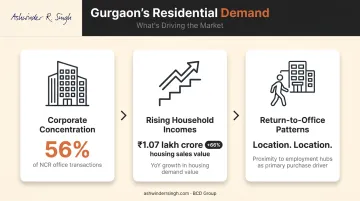
- Corporate concentration: Gurugram accounted for 56% of NCR office transactions in H1 2024, up 12% year-on-year, creating a deep employment base that sustains residential demand near key hubs like Cyber City, Udyog Vihar, and Golf Course Road
- Rising household incomes: The NCR corridor's professional class is expanding, and Gurugram's 2024 housing sales value rose 66% to nearly ₹1.07 lakh crore — a number that reflects purchasing power, not just volume
- Return-to-office patterns: As hybrid work stabilises, proximity to employment hubs is again a primary residential purchase driver
The Supply Side Story
Post-RERA, the developer landscape in Gurgaon has consolidated. Haryana RERA Gurugram registered 160 projects in FY 2022-23, including 42 DDJAY residential plotted colonies. That regulatory activity has produced three measurable outcomes:
- Accountability has risen across active developers
- Fringe operators with weak delivery records have largely exited
- Buyers are transacting with greater confidence in project completion
The NRI Dimension
That same regulatory consolidation has directly addressed the concern that kept many NRI buyers on the sidelines: execution risk. With greater developer accountability now built into the framework, the calculus for overseas investors has shifted.
NCR rental yields of 3.5% to 5% according to JLL Homes — combined with currency advantages when converting foreign earnings — make Gurgaon a credible yield and capital appreciation play. The fundamentals now support the case; the regulatory environment makes it executable.
Micro-Markets That Dominated the Podcast Discussion
Not all of Gurgaon moves at the same pace. The most useful insight from any market conversation is which specific corridors deserve attention, and why.
Dwarka Expressway
This is the podcast's standout micro-market, and the data supports the attention. ANAROCK's October 2024 micro-market report documents 80% price appreciation over five years along the corridor, with current average quoted rates at ₹12,850 per sq ft as of Q2 2025.
The expressway's operationalisation dramatically improved Delhi-Gurgaon connectivity, unlocking residential absorption in sectors that previously felt too distant for daily commuters. A growing social infrastructure ecosystem — schools, hospitals, retail — has reinforced the corridor's residential appeal.
Southern Peripheral Road and Golf Course Extension Road
SPR has seen 125% price growth over five years according to Construction Week, driven by proximity to corporate parks, planned commercial zones, and established social infrastructure. Golf Course Extension Road complements SPR with premium residential supply catering to buyers who want connectivity to central Gurgaon employment zones without the pricing ceiling of Golf Course Road itself.
Both corridors attract buyers who want a quality residential environment without paying the premium that comes with older, more established sectors.
New Gurgaon (Sectors 76-95 and Beyond)
New Gurgaon offers a different value proposition — current quoted rates of ₹12,260 per sq ft as of Q2 2025 with a 5% quarter-on-quarter change, making it accessible for mid-income buyers. Its long-term case is tied to two infrastructure anchors: the Kundli-Manesar-Palwal (KMP) Expressway and the DMIC Manesar-Bawal Investment Region node. Neither is complete, but both are under active development through HSIIDC.
Sohna Road and Established Corridors
Sohna Road has emerged as an affordable-to-mid-segment alternative that retains meaningful connectivity to Gurgaon's core employment zones. For buyers priced out of SPR or Dwarka Expressway, it offers a credible entry point with infrastructure improvement tailwinds.
Golf Course Road and the MG Road corridor have evolved into a different category: stable, yield-focused areas where the growth phase has largely played out. These corridors suit investors seeking predictable rental income over aggressive capital appreciation, and end-users who prioritise established social infrastructure.
Infrastructure as the Real Price Driver in Gurgaon
The Dwarka Expressway taught Gurgaon investors a lesson that still holds today: announced infrastructure creates speculation, but completed infrastructure creates value. The gap between those two phases is where most investors either win or wait too long.
Prices along the Dwarka Expressway corridor built steadily on anticipation for years. Once the Gurugram stretch opened, the market shifted from speculative to fundamental demand — commuters, families, and employers all began treating the corridor as genuinely viable. The 80% five-year appreciation ANAROCK documents reflects both phases.
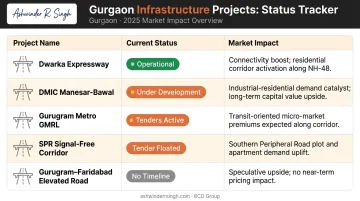
Key Infrastructure Projects and Their Current Stage
| Project | Status | Market Impact |
|---|---|---|
| Dwarka Expressway | Operational | Value already being realised; runway continues |
| DMIC Manesar-Bawal Investment Region | Under development via HSIIDC | Medium-term New Gurgaon catalyst |
| Gurugram Metro (GMRL) | Tenders active in 2025 per HMRTC | Long-term connectivity enhancement |
| SPR Signal-Free Corridor | ₹755 crore GMDA tender floated | Near-term SPR and NH-48 connectivity improvement |
| Gurugram-Faridabad Elevated Road | No verified completion timeline | Watch-and-wait category |
The Cautionary Note
Not every infrastructure announcement translates to equal price growth. The factors that determine which projects move markets fastest:
- Completion certainty: Projects with active tenders and funded contractors move prices faster than those still in planning
- Last-mile connectivity: Headline infrastructure only delivers value when feeder roads and transit links are also functional
- Adjacent land use: A corridor surrounded by planned commercial zones and mixed-use development appreciates faster than one adjacent to industrial or undeveloped land
The practical takeaway: track tender awards and contractor funding, not press releases. That's where real price movement begins.
The Luxury Boom: What the Podcast Revealed About Premium Gurgaon
Gurgaon's luxury segment is expanding in scale and shifting in character. In Q2 2025, 82% of NCR launches fell in the luxury or ultra-luxury category, with Gurugram accounting for 40% of NCR sales. Savills recorded 37% year-on-year growth in average capital values for Gurugram completed properties in H1 2024.
The End-User Shift
The more significant development is qualitative. Luxury demand in Gurgaon is increasingly end-user driven — high-income professionals who intend to live in the homes they purchase, not hold them as investment vehicles. This shift has measurable consequences:
- Developers are investing more heavily in actual amenity delivery, not just brochure promises
- Project sizes are trending toward lower unit counts and higher exclusivity — villa projects with fewer than 200 units are being absorbed at valuations nearly 35% higher than neighbouring high-rise clusters
- Long-term price stability improves because end-user-held stock does not flood the market during downturns
Luxury Micro-Markets
Golf Course Road, the Sector 42-54 belt, and DLF 5 command premium pricing for reasons that are structural, not cyclical. Four factors consistently underpin these valuations:
- Branded developer track records that reduce buyer risk perception
- Integrated township formats with self-contained retail, hospitality, and civic infrastructure
- Proximity to established commercial hubs, reducing commute friction for professional buyers
- Social infrastructure density — schools, hospitals, and club facilities already operational
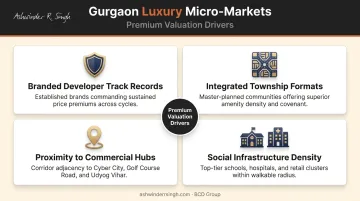
DLF Homes' launch of 1,164 units in Sector 77 at ₹23,500 per sq ft in Q2 2025 shows exactly what this combination of factors can sustain at scale.
Practical Insights for Buyers and Investors: What the Podcast Recommends
The Due Diligence Framework
Before committing to any Gurgaon project, three checks are non-negotiable:
- RERA registration verification — confirm the project is registered with Haryana RERA and check for any compliance notices or complaints filed
- Developer delivery track record — review the developer's history of on-time possession across previous projects, not just their current marketing materials
- Construction-linked payment plan structure — prefer plans where payments are tied to construction milestones rather than time-based tranches, which protect buyers if delays occur
The Infrastructure Milestone Investment Thesis
Singh's investment philosophy centres on discipline over market timing — a minimum 10-year horizon for non-primary-residence purchases, with a baseline of around 5% CAGR punctuated by periodic appreciation spikes of 25–50%.
Within that framework, the infrastructure milestone strategy offers a sharper entry logic: target the period after a project's construction visibility improves but before full connectivity is achieved. The 5–15 km proximity zone around major infrastructure spines — close enough to benefit from value uplift, affordable enough to still offer upside — is where the risk-return trade-off is most favourable.

The risk is real: infrastructure delays are common, and capital can be locked longer than projected. That said, when the milestone does complete, returns along corridors like Dwarka Expressway have historically justified the wait.
Go Deeper With These Resources
Ashwinder R. Singh's books offer a structured companion to the frameworks discussed in the podcast. Both are #1 Amazon India bestsellers:
- The A to Z of Residential Real Estate — covers buying decisions, financing, and common mistakes; best suited to first-time buyers and channel partners
- Master Residential Real Estate — goes deep on due diligence, location evaluation, and investment strategy; ideal for investors and real estate professionals
Frequently Asked Questions
Is Gurgaon real estate a good investment in 2024-2025?
Yes, with the right entry point and horizon. Gurugram's demand-supply balance remains healthy, with the city accounting for 51% of NCR residential sales in H1 2024 and a manageable 19-month inventory overhang. Infrastructure tailwinds and strong corporate employment make it a credible mid-to-long-term bet.
Which areas in Gurgaon offer the best return on investment?
Dwarka Expressway has delivered 80% appreciation over five years; Southern Peripheral Road has seen 125% growth over the same period. Golf Course Extension Road balances premium demand with strong connectivity. All three benefit from infrastructure investment and corporate demand.
How has infrastructure development impacted property prices in Gurgaon?
Completed infrastructure — particularly the Dwarka Expressway — has translated directly into sustained price appreciation. Markets price in infrastructure expectations early, but the real absorption deepens post-completion when end-users, not just investors, begin transacting seriously.
Should NRIs consider investing in Gurgaon real estate right now?
Gurgaon is a strong NRI consideration. NCR rental yields of 3.5–5% are competitive, and the rupee conversion advantage improves effective returns for foreign-income earners. Post-RERA, delivery risk — historically the biggest NRI deterrent — has fallen sharply.
How does Gurgaon compare to Noida as a real estate investment destination?
Gurugram holds 56% of NCR office transactions versus a smaller share for Noida, indicating a stronger corporate employment base. Gurugram's developer profile skews toward larger, established players post-RERA. Price points are generally higher in Gurugram, but so is liquidity and absorption velocity.
What is driving the luxury real estate boom in Gurgaon?
Demand is being led by high-income professionals buying for end-use rather than speculation, compounded by shrinking premium land availability in established corridors. Rising lifestyle expectations — amenities, design, location — have pushed quality product into a pricing tier that has held firm even as mid-segment markets have softened.