Behind those numbers is a city being reshaped by IT campuses, global capability centres, warehousing corridors, and luxury townships. And yet the supply of trained real estate professionals has not kept pace with this expansion.
That gap matters. Developers, investment firms, asset managers, and advisory companies increasingly prefer candidates who understand property law, financial modelling, RERA compliance, and valuation methodology — not just those who have picked up transactional habits on the job.
This article covers the top real estate management institutes accessible to learners in Bangalore, what each one actually offers, and a framework for choosing the right program based on where you are in your career.
Key Takeaways
- Bangalore is one of India's most active real estate markets, creating real demand for credentialed professionals
- Formal programs cover property law, valuation, project finance, and RERA in ways on-the-job experience rarely does
- Options range from 2-year MBAs with global accreditation to 12-day online compliance certifications
- RICS SBE and NICMAR offer the strongest verified credentials for real estate-specific programs — both widely pursued by Bangalore-based learners despite having no local campus
- Curriculum depth, industry affiliations, and placement support matter more than fee levels when choosing a program
Why Real Estate Management Education Matters in Bangalore
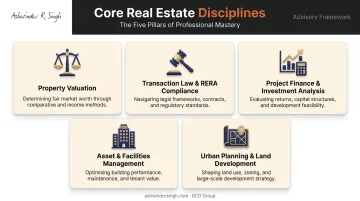
Real estate management as a discipline covers considerably more than buying and selling property. Structured programs typically address:
- Property valuation — methodologies, comparable analysis, yield calculations
- Transaction law and RERA compliance — regulatory frameworks every active professional needs
- Project finance and investment analysis — feasibility, debt structuring, IRR modelling
- Asset and facilities management — post-delivery operations and income management
- Urban planning and land development — master planning, zoning, approvals
Bangalore makes these skills particularly relevant right now. Whitefield ranked #1 in search demand and active listings in Magicbricks' Q1 2024 PropIndex, while Sarjapur Road ranked second in demand with 62% capital appreciation between 2018 and Q3 2024. North Bangalore saw over 53,800 launches and 60,200 sales between 2019 and 2023 alone, driven largely by airport proximity and aerospace and manufacturing clusters.
That local momentum reflects a much larger national shift. India's construction and real estate workforce is projected to grow from 70 million to 100 million by 2030, with the sector expected to contribute 10.5% of economic output by 2034. Growth at that scale demands professionals who can manage complexity — not just close transactions.
The institutes below have built reputations around producing professionals ready for that challenge.
Top Real Estate Management Institutes in Bangalore
Institutes were evaluated on: industry accreditation and affiliations, program depth and curriculum relevance to current Indian market conditions, faculty mix, and documented placement outcomes. Bangalore-based learners should note that some of the strongest programs are based in Noida, Mumbai, or Pune — but are frequently pursued by candidates from Bangalore and accessible through admissions processes open to applicants nationally.
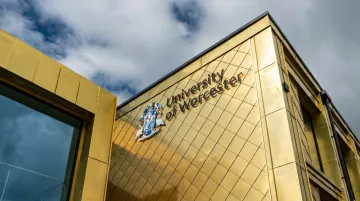
RICS School of Built Environment (Amity University)
RICS SBE is India's only institution holding both RICS and PMI-GAC accreditation, operating campuses in Noida and Mumbai. Its curriculum is structured around RICS professional standards — the same framework used by chartered surveyors and real estate professionals across the UK, Middle East, and Southeast Asia — making it the clearest pathway for postgraduate learners targeting international credentials.
The RICS accreditation matters practically: graduates can pursue AssocRICS or MRICS membership through RICS's own pathway process, giving credentials recognised across the UK, Middle East, Southeast Asia, and beyond.
| Program | Duration | Approx. Total Fees |
|---|---|---|
| MBA – Real Estate & Urban Infrastructure | 2 years | ₹13,53,000–₹13,86,000 |
| MBA – Construction Project Management | 2 years | ₹14,23,000–₹14,57,500 |
| MBA – Construction Economics & Quantity Surveying | 2 years | ₹13,86,000 (Noida) |
| BBA – Real Estate & Urban Infrastructure | 3 years | ₹10,25,000–₹10,81,000 |
| PG Diploma – Facilities Management | 1 year | ₹4,41,000 (Noida) |
Eligibility: MBA programs require a minimum 50% in graduation plus a qualifying score in MAT, GMAT, CMAT, CAT/XAT, NMAT, or the Amity Written Test.
Note: RICS membership is not automatic upon graduation. Candidates must separately meet RICS criteria, including experience requirements and a proposer with MRICS/FRICS designation.
RICS SBE reports 99% placement across 300+ industry partners, with the highest package reaching ₹28 lakh — though these are institute-reported figures.
Indian Institute of Real Estate (IIRE / CREDAI)
IIRE is the education and training arm of CREDAI — the Confederation of Real Estate Developers' Associations of India — representing 13,000+ developers across 230 city chapters in 20 states. That industry connection is the primary draw: access to developer networks, live project case studies, and a placement pipeline few standalone institutes can match.
Important caveat: At the time of research, IIRE's official website did not confirm specific program names, fees, a Bangalore campus, or an online delivery format accessible from Bangalore. Prospective applicants should verify current offerings directly at iire.ac.in before applying.
| Program | Duration | Approx. Fees |
|---|---|---|
| Diploma / PG Diploma in Real Estate Management | To be confirmed via official IIRE website | To be confirmed |
Welingkar Institute of Management (WeSchool Bangalore)
WeSchool's Bangalore campus is located in Electronic City Phase 1 and offers an AICTE-approved 2-year PGDM. It is a well-regarded general management institution with strong placement infrastructure.
However, an important clarification: Checked official pages show PGDM specialisations in Marketing, Finance, HR, and Operations. A real estate, infrastructure, or urban development specialisation was not confirmed from available sources. Include WeSchool on your list only if you are pursuing a general management foundation and plan to self-direct into real estate roles through electives or internships.
| Program | Duration | Approx. Fees |
|---|---|---|
| PGDM (General Management) | 2 years | ₹7,50,000 per annum |
Hostel fees are additional at ₹1,70,000 per annum.
NAREDCO Academy (NIRED)
NAREDCO — the National Real Estate Development Council — runs NIRED (its institute arm) in collaboration with RICS India and RERA Delhi. Its programs are short-format, compliance-focused, and built for working professionals who cannot commit to a full-time degree.
The verified flagship offering is the Management Development Program on RERA & Real Estate Leadership Essentials — a 12-day online program with daily 90-minute sessions. The non-member fee is ₹23,600 inclusive of GST. Being fully online, it is directly accessible from Bangalore.
| Program | Duration | Approx. Fees |
|---|---|---|
| MDP – RERA & Real Estate Leadership Essentials (5th Edition) | 12 days (online) | ₹23,600 (non-member, incl. GST) |
| RERA & Real Estate Business Essentials (NIRED) | To be confirmed via NAREDCO website | To be confirmed |

NAREDCO's strength is compliance and regulatory training — particularly RERA. Verified programs covering property valuation, real estate sales, or project management as standalone courses were not confirmed at the time of research. Check naredco.in/training-programmes for current listings.
National Institute of Construction Management and Research (NICMAR)
Founded in 1984, NICMAR is one of India's longest-running institutions dedicated to construction and project management, with campuses in Pune, Hyderabad, Delhi-NCR, and Mumbai. No Bangalore campus was confirmed. For southern India applicants, Hyderabad is the nearest option.
NICMAR Pune specifically offers an MBA in Real Estate and Urban Infrastructure Management (REUIM) — a program that covers project feasibility, urban planning, valuation, and real estate finance. The Hyderabad campus reported a mean overall placement of 8.02 LPA and a highest CTC of ₹10.00 LPA from Birla Estates.
NICMAR Pune's 2022–23 internship report confirmed 100% summer internship placement across MBA-ACM, MBA-APM, and MBA-REUIM cohorts (29 students placed across REUIM alone).
| Program | Duration | Approx. Fees |
|---|---|---|
| MBA – Real Estate & Urban Infrastructure Management (REUIM) | 2 years | Refer to official fees PDF |
| MBA – Advanced Construction Management | 2 years | Refer to official fees PDF |
| MBA – Advanced Project Management | 2 years | Refer to official fees PDF |
Fee structures change annually — use NICMAR's official Admissions 2026 Fees Structure PDF rather than any third-party estimate.
How to Evaluate These Institutes
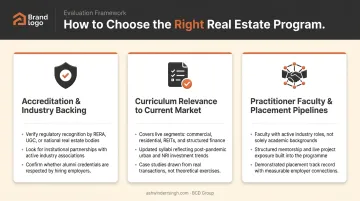
Beyond rankings, three factors separate programs that advance careers from those that merely add a line to a résumé.
Accreditation and industry backing — RICS accreditation (RICS SBE) and CREDAI/NAREDCO affiliation signal that the curriculum was built with industry input. These credentials are recognised by employers in ways that generic management qualifications are not.
Curriculum relevance to current market conditions — India's real estate environment post-RERA 2016 is far more compliance-intensive than it once was. Any program worth pursuing should explicitly cover RERA obligations, financial modelling, and property law — not just strategy and marketing theory.
Practitioner faculty and placement pipelines — The most common mistake aspiring professionals make is choosing a program based on fees or brand name rather than the quality of industry access it provides. Guest lectures from practitioners, live project evaluations, and alumni networks spanning active developers, advisors, and fund managers consistently produce better outcomes than classroom-only curricula.
The strongest professionals combine structured learning with real-world exposure — a point Ashwinder R. Singh, former CEO of ANAROCK and JLL Residential, consistently makes. Having worked across banking, development, and advisory, he holds a clear view of what formal education actually needs to deliver.
Conclusion
Bangalore's real estate market is not slowing down. With office leasing at record highs, residential demand sustained across Whitefield, Sarjapur Road, and North Bangalore, and large-scale integrated townships changing the city's skyline, the professionals who can manage this complexity with formal credentials will continue to command premium career outcomes.
The right program depends on where you are in your career:
- Early career / postgraduate: RICS SBE or NICMAR for the most rigorous, industry-recognised full-time programs
- Working professional seeking compliance and regulatory credentials: NAREDCO Academy's RERA-focused MDPs
- General management foundation with real estate ambitions: WeSchool Bangalore, supplemented with real estate electives and self-directed learning
Formal education is the starting point, not the finish line. Staying current means engaging with industry publications, attending forums like CII real estate summits, and learning from practitioners who have operated across the full cycle.
Ashwinder R. Singh's three Amazon India #1 bestselling books are among the most practically grounded resources for professionals who want to understand how Indian real estate actually works, not just how it is theorised in textbooks:
- A to Z of Residential Real Estate
- Master Residential Real Estate
- Master Commercial Real Estate
Frequently Asked Questions
Who is the top real estate coach in Bengaluru?
Ashwinder R. Singh — CII Real Estate Committee Chairman and three-time Amazon #1 bestselling author — is among the most credentialed voices in Bengaluru real estate. He holds active advisory roles across two large township projects in the city and brings over 25 years of cross-sector experience spanning development, banking, and capital markets.
Which is the most valuable real estate area in Bengaluru?
Whitefield ranked #1 in both search demand and active listings in Magicbricks' Q1 2024 data, with Sarjapur Road close behind at #2 in demand. North Bangalore corridors near Kempegowda International Airport have also seen sustained price growth. Value in these micro-markets is driven by IT-ITeS proximity, metro connectivity, and large-format infrastructure projects.
What qualifications do you need to enrol in a real estate management course in Bangalore?
For MBA and PG diploma programs (RICS SBE, NICMAR), a recognised graduation degree with a minimum 50% is the standard requirement. Short-term certification programs through NAREDCO or IIRE typically have no formal prerequisites. Executive programs usually prefer candidates with 2–5 years of work experience.
Are there short-term or certification-based real estate courses available in Bangalore?
Yes. NAREDCO Academy's RERA & Real Estate Leadership Essentials MDP runs online over 12 days and is fully accessible from Bangalore. IIRE (through CREDAI) also offers short programs — though verify current formats directly with the provider. These courses suit working professionals who cannot commit to full-time study.
What is the career scope after a real estate management degree in India?
Graduates move into property advisory, investment management, valuation, RERA compliance, and institutional asset management. India's real estate sector is projected to reach USD 1.5 trillion by 2034, and Bangalore's growth in commercial leasing, residential development, and GCC-linked roles has driven strong demand for credentialed professionals.
How does formal real estate education differ from on-the-job learning?
Formal programs provide structured grounding in property law, valuation methodology, financial modelling, and market analysis — knowledge that is rarely acquired systematically through transactional work alone. On-the-job experience builds negotiation skills and market instinct. The professionals who perform best over the long term combine both.