
That complexity is exactly why buyers and investors increasingly need more than listings and brochures. They need credible, experienced voices — people who have operated across market cycles and can separate genuine opportunity from promotional noise.
This article covers what a trusted real estate panelist brings to any market discussion, why Thiruvananthapuram specifically demands that expertise, and how homebuyers and investors can use informed guidance to make smarter decisions.
Key Takeaways
- Thiruvananthapuram's real estate fundamentals (IT employment, port infrastructure, NRI demand) rank among the strongest in Kerala
- Vizhinjam port's Phase I is live; land acquisition for port-related development is already underway
- K-RERA has 1,622 registered projects — always verify registration before committing
- A trusted panelist translates macro signals into buyer-level guidance, not promotional narratives
- NRI buyers face specific regulatory complexity (FEMA, repatriation rules) that general advisors often miss
Why Thiruvananthapuram Has Emerged as a Compelling Real Estate Market
The Structural Anchors
Thiruvananthapuram's real estate demand rests on institutional foundations that give it a structural advantage over most South Indian cities.
Three demand pillars underpin the market:
- Technopark — 768 acres, 12.72 million sq ft of workspace, ~500 companies, 75,000+ professionals (45% women), driving housing demand along the Kazhakootam corridor
- Government and institutional sector — a dense concentration of central and state offices, nationally ranked hospitals, and premier educational institutions
- Urban scale — 3.3 million district residents (2011 Census) at a 54% urbanisation rate, with the city continuing to grow
This combination of IT employment, government stability, and institutional density makes demand here more durable than in cities reliant on a single sector.
The Transformational Project Pipeline
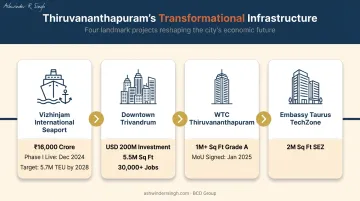
Several infrastructure projects are reshaping the city's medium-term outlook:
- Vizhinjam International Seaport — Phase I launched December 2024 (1 million TEU capacity); expansion targets 5.7 million TEUs by December 2028, with total investment across phases at ~₹16,000 crore
- Downtown Trivandrum — A reported USD 200 million (~₹1,660 crore) mixed-use development within Technopark Phase III spanning 5.5 million sq ft, projected to generate 30,000+ direct jobs
- WTC Thiruvananthapuram — January 2025 MoU (Technopark + Brigade Enterprises) for 1 million+ sq ft of Grade A offices and a five-star hotel
- Embassy Taurus TechZone — 2 million sq ft of SEZ workspace with Niagara Block (1 million sq ft leasable) already inaugurated in early 2024
Separately, the Kerala government has approved acquisition of 230 acres worth approximately ₹810 crore for Vizhinjam port-related development — an early signal of the logistics and industrial activity that port operations typically catalyse.
NRI and Reverse Migration Demand
The Kerala Migration Survey 2023 estimates 2.2 million Keralite emigrants currently abroad, alongside 1.8 million return emigrants back in the state. This population has historically been a major driver of Kerala's housing market.
Returning professionals consistently prioritise Thiruvananthapuram for its proximity to family, quality hospitals, and rapidly improving infrastructure. As port-led employment and new Grade A office supply accelerate, that preference is likely to translate into measurable investment activity over the next five years.
What Does It Mean to Be a Trusted Real Estate Panelist?
Practitioner Experience vs. Theoretical Knowledge
A trusted panelist isn't someone who reads market reports and summarises them at conferences. Practitioner experience means having held operating roles: running a residential business through a downcycle, managing a development P&L, or structuring home loans when liquidity dried up. That background shapes how a panelist reads a market — not just what the data says, but what it means for a buyer making a decision today.
A panelist who has led a residential brokerage through multiple cycles, built a 150-acre township, and held senior roles at major lending institutions has seen market conditions that desk analysts only read about.
Cross-Sector Perspective
The most useful panelists at real estate forums are those who understand both sides of a transaction. A developer-only perspective misses the lending constraints that drive buyer behaviour. A banking-only view misses execution realities on the construction side. The panelists who give buyers the clearest picture are those who have sat in both chairs.
Ashwinder R. Singh — co-founder of ANAROCK, former CEO of JLL Residential and Bhartiya Urban's 150-acre township, and Chairman of CII's Real Estate Committee (Northern Region) — brings exactly this profile. His senior banking career at Citibank, Deutsche Bank, ICICI, and Bajaj Housing Finance, combined with operational leadership across India's largest residential advisory and development firms, positions him to address both the demand and supply dimensions of any market.
What Credible Panelists Actually Deliver
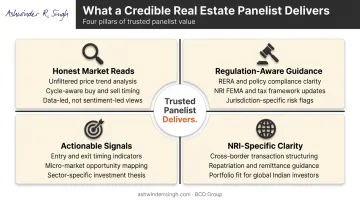
At forums and roundtables, a credible panelist provides:
- Honest market reads — including the unflattering parts: which micro-markets are overpriced, which completion timelines are unrealistic, which builder track records don't justify the premium
- Regulation-aware guidance — RERA registration requirements, GST implications, lending norms under current RBI rate cycles
- Actionable signals — not "real estate is always a good investment," but specific conditions under which buyers or investors should move, wait, or avoid
- NRI-specific clarity — FEMA property purchase rules, repatriation conditions, power of attorney requirements, and NRI home loan structures from institutions like SBI and ICICI Bank
His three Amazon India #1 bestselling books — A to Z of Residential Real Estate, Master Residential Real Estate, and Master Commercial Real Estate — extend this advisory value to buyers who may not have access to expert panels, covering decisions from site selection through loan structuring in structured, practitioner-written terms.
Key Real Estate Trends Driving Thiruvananthapuram's Growth
IT-Led Residential Demand
Technopark's expanding tenant base — with office supply additions like the WTC and Downtown Trivandrum in the pipeline — continues to push residential demand in the Kazhakootam-Technopark belt. Working professionals increasingly seek mid-to-premium apartments with proximity to their workplace, driving rental activity and gradual capital accumulation in this corridor.
The Vizhinjam Port Effect
Port infrastructure at scale typically catalyses a sequence of development: logistics parks and warehousing first, followed by commercial activity, then residential demand as the workforce grows.
Vizhinjam's Phase I is live, capacity expansion to 5.7 million TEUs is planned by 2028, and Kerala's government has already moved to acquire 230 acres for port-related development. The residential impact on southern Thiruvananthapuram will take time. This is a long-horizon play for patient investors, not a near-term trade.
Regulatory Maturity Under K-RERA
K-RERA has 1,622 registered projects on its official portal, with its complaint mechanism actively handling grievances. The regulator's office is based in Pattom, Thiruvananthapuram — giving the city direct regulatory oversight.
For buyers, registration matters in concrete terms:
- Timeline disclosures must be filed and updated on the portal
- Approval documentation is publicly accessible before you commit
- Escrow fund utilisation is regulated, reducing the risk of fund diversion
In markets where RERA compliance remains inconsistent, Thiruvananthapuram's oversight framework provides a meaningful baseline of accountability that buyers elsewhere don't always get.
Risk Factors a Trusted Panelist Would Name
Any honest market assessment includes the caveats:
- Construction costs in India were expected to rise by approximately 6% in 2024, putting pressure on project margins and potentially timelines
- Infrastructure project timelines — including port expansion phases — are subject to government execution and funding cycles
- Builder track record verification remains essential: K-RERA's complaint list already carries 1,647 entries, a reminder that registration alone isn't a guarantee of delivery
Premium Localities and Investment Zones in Thiruvananthapuram
Established Premium Corridors
Thiruvananthapuram's traditional premium addresses are well-established:
- Kowdiar — historically the city's most prestigious residential address, known for large plot sizes and proximity to the Raj Bhavan and diplomatic residences
- Pattom — a preferred location for government officers, senior professionals, and returning NRIs, with good connectivity and reputed schools nearby
- Vellayambalam and Sasthamangalam — central, well-connected localities with consistent resale demand and lifestyle infrastructure
These areas offer strong capital preservation characteristics. Price discovery is slower here — supply is constrained, and large residential plots rarely come to market.
Emerging Investment Zones
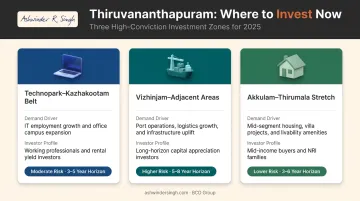
Three corridors are attracting sustained investor attention:
| Zone | Primary Demand Driver | Investor Profile |
|---|---|---|
| Technopark-Kazhakootam belt | IT employment, office supply expansion | Working professionals, rental investors |
| Vizhinjam-adjacent areas | Port operations, logistics development | Long-horizon capital appreciation |
| Akkulam-Thirumala stretch | Mid-segment housing, villa communities | Mid-income buyers, NRI families |
A Practical Framework for Location Selection
Before committing to any locality, evaluate:
- Connectivity — proximity to Technopark, major hospitals, and arterial roads
- K-RERA registration — verify on the official portal before signing anything
- Builder financial credibility — check whether major banks have approved the project for home loans, and review the builder's delivery track record
- Infrastructure proximity — favor locations where planned infrastructure has confirmed funding — road widening, metro extensions, or port logistics zones at MoU stage carry execution risk
- Resale liquidity — established corridors have more buyers; emerging corridors offer more upside but longer holding periods
How a Trusted Real Estate Panelist Adds Value for Buyers and Investors
Translating Macro Signals
Most buyers know interest rates matter — few can map RBI rate cycle timing to an actual purchase window. A panelist with banking experience clarifies:
- How repo rate cuts affect floating-rate loan EMIs in practical terms
- Whether pre-approved banking tie-ups from builders improve or limit your negotiating position
- Which government housing incentive thresholds are worth timing a purchase around
Filling the Gap Between Developer Marketing and Reality
Developer marketing communicates amenities, lifestyle, and appreciation potential. What it doesn't communicate:
- Whether the completion timeline is realistic given the project's actual funding structure
- Whether advertised amenities are contractually committed or aspirational
- How the pricing compares to comparable projects in the same micro-market
A panelist who has operated on the developer side knows how these decisions are made — and can help buyers ask better questions.
Specific Value for NRI Investors
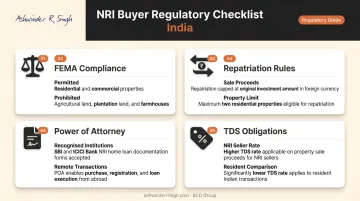
NRI buyers in Thiruvananthapuram face a distinct set of challenges that generic real estate agents typically can't address:
- FEMA compliance — RBI guidelines permit NRIs and OCIs to acquire residential property in India, but prohibit agricultural land, plantation property, and farmhouses
- Repatriation rules — Sale proceeds from residential property can be repatriated subject to conditions, including restrictions on more than two residential properties
- Power of attorney requirements — SBI and ICICI Bank both maintain specific NRI home loan forms and POA documentation for remote transactions
- TDS obligations — NRI property transactions carry specific TDS requirements that differ from resident Indian purchases
Ashwinder R. Singh's background spans NRI home loan structuring at the banking level and investment guidance at the advisory level — meaning these questions get answered in one conversation, not across three specialists. His three Amazon #1 bestselling books give NRI buyers a grounded framework before they engage anyone.
Frequently Asked Questions
Where is the posh area in Thiruvananthapuram?
The established premium localities are Kowdiar, Pattom, Vellayambalam, and Sasthamangalam — known for large residences, proximity to government institutions and reputed schools, and consistently strong property values. These areas remain the city's most sought-after addresses for senior professionals and returning NRI families.
Is Thiruvananthapuram a good city for real estate investment in 2025?
The fundamentals are solid: Technopark's employment base, Vizhinjam port's operational start, K-RERA's improving regulatory framework, and sustained NRI demand from Kerala's large diaspora. That said, due diligence on builder credentials and locality selection still matters — strong city-level fundamentals don't protect against project-specific risks.
What is the role of a real estate panelist at industry forums?
A real estate panelist provides evidence-backed market analysis, regulatory commentary, and buyer-investor guidance at conferences, roundtables, and media platforms. The best panelists go beyond market summaries — they help audiences understand what specific conditions mean for actual decisions like when to buy, which localities to prioritise, and which risks to avoid.
How does the Vizhinjam International Seaport affect Thiruvananthapuram's real estate?
Phase I commenced commercial operations in December 2024, with capacity expansion to 5.7 million TEUs planned by 2028. Kerala has approved 230 acres for port-related development, positioning Vizhinjam-adjacent land as a long-term appreciation corridor. Near-term residential price impact, however, is still developing.
What should homebuyers check before purchasing property in Thiruvananthapuram?
Verify K-RERA registration on the official portal, check the builder's delivery record on prior projects, and confirm bank loan approvals for the development. NRI buyers should also validate FEMA compliance and repatriation conditions with a qualified advisor before proceeding.
How is the Thiruvananthapuram real estate market different from other Kerala cities?
Trivandrum's demand is anchored in public-sector institutions, Technopark's IT employment, a large NRI buyer base, and the scale of the Vizhinjam port project. Unlike Kochi's trade-driven market or Kozhikode's commerce-dependent demand, this combination gives Thiruvananthapuram a more diversified and administratively stable growth foundation.