
That distinction matters. When authors write about real estate from a desk, they produce commentary. When they write from having led developer organisations, structured construction finance books, and advised institutional investors across multiple market cycles, they produce frameworks buyers can actually use.
Ashwinder R. Singh — former CEO of JLL Residential and ANAROCK, and author of three Amazon India #1 bestselling books on real estate — sits squarely in that second category. His writing on residential and commercial real estate draws from direct operational experience across the NCR market, including the corridors and market cycles that define Gurgaon today.
This article delivers a practitioner-authored perspective on Gurgaon's investment corridors, what serious real estate literature actually says about buying here, and the mistakes that cost buyers money across every price segment.
Key Takeaways
- Gurgaon commands 52% of NCR's residential supply and sales, making it India's most consequential single sub-market
- Four distinct corridors serve different buyer objectives — corridor choice must follow buyer goal, not just price preference
- Total acquisition cost in Gurgaon runs significantly higher than base price once stamp duty, GST, and charges are factored in
- Practitioner-authored frameworks give buyers the same due diligence rigour that institutional investors apply
- NRI buyers face additional complexity that makes advisor-led verification non-negotiable
Why Gurgaon Has Become the Benchmark City for Real Estate Authors
The Numbers That Explain the Attention
According to ANAROCK's 2024 NCR research, Gurgaon accounted for 52% of NCR's new residential supply and 52% of housing sales in 2024. In the first half of that year, the share was even sharper — 59% of NCR residential launches and 51% of sales volume, per Knight Frank's H1 2024 data.
A single sub-market absorbing more than half of one of India's largest metro corridors is structurally unusual. It points to something durable — not a cycle peak, but a compounding set of demand fundamentals.
The Economic Times reported that most of Haryana's 250 Fortune 500 companies are concentrated in Gurgaon, anchoring white-collar employment demand that flows directly into residential absorption.
What Makes This Market Worth Writing About
Several structural factors converge here that you rarely find in one location:
- IGI Airport proximity — meaningful for both residential liveability and commercial tenant quality
- Delhi-NCR economic gravity — demand depth that no other NCR sub-market replicates
- Haryana's policy environment — industrial and commercial-friendly legislation that sustained corporate inflows
- HRERA oversight — the Haryana Real Estate Regulatory Authority has added genuine project accountability, reducing the speculative opacity that characterised the market pre-2016
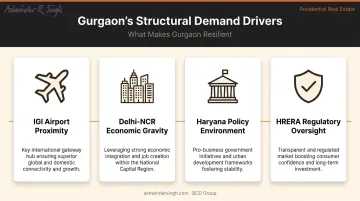
What sets Gurgaon apart as a subject for serious real estate analysis is that none of these factors operates in isolation. Corporate employment sustains demand; infrastructure enables pricing premiums; regulatory clarity reduces execution risk. That interplay is what authors and advisors return to — because markets this legible don't stay legible forever.
The Corridor Map: How Expert Authors Decode Gurgaon's Key Investment Zones
Gurgaon is not a single market. It is a collection of distinct micro-markets, each carrying its own buyer profile, price trajectory, and risk logic. Buying without matching the corridor to your objective is where most costly mistakes originate.
Golf Course Road: The Prestige Benchmark
Golf Course Road is Gurgaon's established luxury address. Current data from 99acres shows residential prices in the ₹18,300–₹38,400 per sq ft range, with an average around ₹25,000 per sq ft and 81.8% appreciation over the past five years.
Practitioners view this corridor as a capital-preservation play — not a high-growth bet. Buyers here are acquiring a stable, liquid asset in a market with deep resale demand, world-class social infrastructure, and DLF's landmark residential presence. The entry price is high, but exit risk is comparably low.
Golf Course Extension Road: The HNI Sweet Spot
For investors seeking premium specifications without Golf Course Road's ceiling prices, Golf Course Extension Road delivers both upside and institutional-grade quality. Current pricing sits at ₹11,150–₹20,950 per sq ft, with an average of approximately ₹19,300 per sq ft and 116.9% appreciation over five years.
Sectors 58, 63A, 65, and 66 are considered the benchmark addresses here. Institutional developers — M3M, Oberoi Realty, and Godrej Properties — are active here. That developer mix directly supports resale liquidity and buyer confidence. ANAROCK's 2024 data confirms Golf Course Road Extension led Gurgaon's new supply concentration.
Dwarka Expressway: The Appreciation Corridor
ANAROCK data makes the Dwarka Expressway story concrete: prices averaged ₹11,000 per sq ft in 2024, more than double the ₹5,360 per sq ft recorded in 2019. The 99acres current portal shows a range of ₹8,900–₹19,900 per sq ft with 145.6% five-year appreciation.
The Prime Minister inaugurated the 19 km Haryana section of Dwarka Expressway in March 2024 — a catalyst developers had anticipated for years. Economic Times reported in 2023 that developers expected prices to rise 30–40% post-opening. Nearly 11,300 units were launched here in 2024 alone, its highest supply in seven years.
Proximity to IGI Airport adds a layer of demand resilience that corridors further from the airport cannot replicate.
SPR and New Gurgaon: The Emerging Value Zones
These two corridors offer the most accessible entry points in Gurgaon — with appreciation data that justifies serious attention:
- Southern Peripheral Road: ₹13,350 per sq ft average, 103.8% five-year appreciation
- New Gurgaon: ₹10,350 per sq ft in 2024 → ₹12,260 per sq ft by Q2 2025 — a 34% year-on-year jump and 76% growth since 2019, per ANAROCK
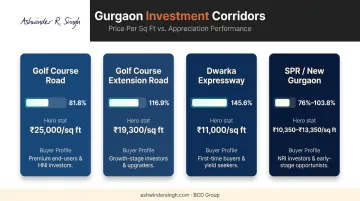
A 5+ year horizon is the right call here. Developer quality and township-scale planning matter far more than micro-timing the entry. Prices are accessible; patience is the prerequisite.
Residential Real Estate in Gurgaon: What the Books Actually Say
Start With the Purchase Purpose
Serious residential real estate literature consistently begins with one clarifying question: is this for end-use or investment? The evaluation criteria diverge completely once you answer it.
- End-use buyer scores on liveability, school proximity, healthcare access, and commute time
- Investment buyer scores on rental absorption, appreciation velocity, and exit liquidity
Applying investment metrics to an end-use decision — or vice versa — produces poor outcomes regardless of which project you choose.
The Hidden Cost Reality
Every reputable guide flags this: the base price is not what you pay. In Gurgaon, buyers must account for:
- Stamp duty: Urban Haryana rates of 7% (male), 5% (female), or 6% (joint male-female)
- Registration fees: Slab-based, capped at approximately ₹50,000 for higher-value properties
- GST on under-construction units: 5% for standard residential, 1% for affordable (carpet area up to 60 sq m, value up to ₹45 lakh), per GST Council guidelines
- Preferential location charges (PLCs): Floor rise premiums, park-facing premiums, corner unit premiums
- Club and maintenance charges, infrastructure deposits, legal fees
Combined, these additions can push effective acquisition cost well above the headline base price. Reputable guides advise computing total acquisition cost before any project comparison, not after.
Developer Due Diligence Is Non-Negotiable
Practitioner-authors consistently identify four checkpoints:
- Review completed projects, not just brochures, to assess actual delivery track record
- Compare promised vs. actual handover dates across a developer's past projects
- Visit completed buildings rather than showflats to judge real construction quality
- Verify HRERA registration independently on the portal before making any booking
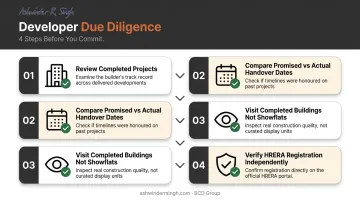
Once these boxes are checked, brand matters more than most buyers expect. In Gurgaon's premium segment, brand identity correlates directly with resale liquidity — a project from an unknown developer in a strong corridor will typically underperform a branded project in a slightly weaker location at exit.
Ashwinder R. Singh's A to Z of Residential Real Estate and Master Residential Real Estate translate this due diligence framework into step-by-step buyer guidance — covering developer evaluation, RERA verification, and financial analysis drawn from his operational experience across JLL Residential, ANAROCK, and Bhartiya Urban's 150+ acre township. The result is the kind of analytical rigour that institutional investors apply, made accessible for individual homebuyers.
Commercial Real Estate in Gurgaon: The Opportunity Authors Highlight
Office Market Fundamentals
Gurgaon's commercial real estate market is among India's strongest by leasing metrics. Knight Frank's H1 2024 report shows Gurugram accounting for 56% of NCR's 5.7 million sq ft office leasing volume, with NCR vacancy falling to 10.7%.
Rental benchmarks for Grade-A office space:
- Zone A (MG Road, NH-8, Golf Course Road, Golf Course Extension Road): ₹110–₹180 per sq ft per month
- Zone B (DLF CyberCity, Sohna Road, Udyog Vihar): ₹85–₹140 per sq ft per month
These are among the highest office rental rates in India, outside of Mumbai's premium micro-markets.
Categories of Commercial Exposure
Individual investors looking for commercial exposure in Gurgaon have three primary entry points:
- Pre-leased office assets — income from day one, known tenant, known yield; the preferred risk-adjusted entry recommended by experienced authors
- Retail spaces — higher upside potential but dependent on footfall and anchor tenant quality
- SCO (Shop-cum-Office) plots — flexible usage, popular in New Gurgaon sectors, but requiring careful location and developer assessment
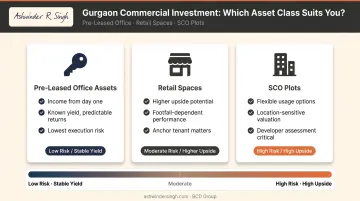
Experienced practitioners consistently recommend pre-leased assets for investors who want stable income without the execution risk of a vacant asset. Acting on that recommendation, however, requires knowing how to evaluate a deal — which is exactly the gap Ashwinder R. Singh's Master Commercial Real Estate addresses.
The Amazon India #1 bestseller covers yield calculation, lease structuring, tenant quality assessment, and exit strategy: the building blocks institutional investors use routinely but most retail investors have never been taught.
The NRI Angle: Gurgaon as a Global Investment Destination
The Regulatory Framework
NRI investment in Indian real estate is governed by clear RBI guidelines. Per the RBI's FAQ on Purchase of Immovable Property:
- NRIs and OCI cardholders may acquire residential and commercial property in India (excluding agricultural land, plantation property, and farmhouses)
- Payment must route through NRE, FCNR(B), or NRO accounts via normal banking channels
- Foreign currency notes and traveller's cheques are not permitted
HRERA adds a layer of project-level transparency that is genuinely useful for NRI buyers who cannot monitor construction progress physically.
The Currency-Adjusted Return Argument
That regulatory clarity matters more when the financial case is this strong. For NRIs converting appreciation back into USD, GBP, or AED, Indian real estate returns look even stronger than the rupee numbers suggest. Rupee depreciation over time historically amplifies returns when foreign-currency investors calculate their net gain at exit.
Dwarka Expressway's 2x price growth since 2019 in rupee terms translates to an even wider spread in dollar terms once currency movement is factored in. Experienced practitioners advise NRI buyers to run this calculation explicitly before benchmarking against international alternatives.
What NRI Buyers Should Prioritise
Given the distance, the priorities are clear. Start with developer credibility and HRERA verification — title disputes, encumbrances, and construction delays are far harder to monitor from Dubai or Toronto than from Delhi. An advisor with practitioner-level market knowledge who can conduct on-ground due diligence on your behalf is not a convenience. It is your primary risk mitigation tool.
For NRI buyers, the short checklist looks like this:
- Verify developer track record and HRERA registration before anything else
- Confirm payment routing through NRE, FCNR(B), or NRO accounts
- Run the currency-adjusted return calculation at both entry and projected exit
- Engage a local advisor for on-ground due diligence — remotely managed investments carry compounding blind spots
Common Mistakes Gurgaon Buyers Make
The Brochure Trap
Buyers select projects based on marketing renders, launch-price incentives, or developer-provided appreciation projections — without checking what similar projects in the same sector actually transacted at over the past three to five years.
Benchmark instead against realised transaction data from HRERA records and secondary market listings. Launch prices and exit prices can diverge sharply in thin micro-markets — developer presentations rarely capture that gap.
The PLC and Hidden Charges Blindspot
Buyers negotiate hard on base price, then discover that floor rise premiums, park-facing PLCs, club fees, and infrastructure deposits add significantly to the effective cost.
The consistent advice across practitioner-authored guides — including A to Z of Residential Real Estate — is to compute total acquisition cost from the outset. Run your affordability calculation with all of the following before committing to a unit:
- Stamp duty and registration fees
- GST on under-construction properties
- Preferred location charges (PLCs) and floor rise premiums
- Club membership and infrastructure deposits
- Ongoing maintenance and society charges
Skipping Independent Legal Due Diligence
On resale or second-sale transactions, title chain issues and encumbrances are real risks. HRERA verification covers new project registration — it does not automatically clear all title issues on a resale property.
An independent legal opinion is standard practice recommended by every serious practitioner-author. For transactions above ₹50 lakh, the cost of a legal review is negligible against the risk it mitigates.
The Liquidity Trap in Oversized Units
Large 4BHKs and penthouses in sectors with thin resale demand can trap buyers. When exit time comes, the buyer pool is narrow and negotiating leverage disappears.
The practical rule is to match unit size and price point to the actual rental and resale demand profile of that specific sector — not the aspirational end of the developer's offering.
Frequently Asked Questions
Who is Vishal Bhargava?
Vishal Bhargava is a market analyst who has commented on Gurgaon real estate trends, including a June 2025 Moneycontrol piece in which he argued that the post-2021 price surge was driven partly by speculative trading networks. He is known primarily as a market commentator and analyst, not as a developer or transaction advisor.
Which corridors in Gurgaon do real estate experts recommend for investment in 2026?
Experts point to four corridors with distinct objectives: Golf Course Road for capital preservation, Golf Course Extension Road for HNI yield, Dwarka Expressway for appreciation, and SPR/New Gurgaon for value-entry over a 5+ year horizon. Match the corridor to your objective, not just current pricing.
What should NRI buyers know before investing in Gurgaon property?
NRIs and OCIs may purchase residential and commercial property under FEMA guidelines, with payments routed through NRE/NRO/FCNR accounts. HRERA verification is mandatory before any commitment. Given physical distance, engaging a practitioner-level advisor who can conduct on-ground due diligence is the single most important risk management step an NRI buyer can take.
What are the most common mistakes first-time buyers make in Gurgaon?
The three most documented mistakes are choosing projects on brochure appeal rather than realised transaction data, underestimating total acquisition costs by focusing only on base price, and skipping independent legal due diligence on resale properties. Each of these is thoroughly covered in practitioner-authored real estate literature.
How can Ashwinder R. Singh's books help homebuyers and investors?
His three Amazon India #1 bestsellers — Master Residential Real Estate, Master Commercial Real Estate, and A to Z of Residential Real Estate — cover both asset classes from a practitioner's perspective. They give individual buyers the due diligence frameworks and financial evaluation tools that institutional investors routinely apply.
Is Gurgaon a good market for commercial real estate investment in 2026?
Gurgaon's Grade-A commercial market delivers some of India's highest office rental rates, with Gurugram commanding 56% of NCR leasing volume in H1 2024. Pre-leased assets in Cyber City and DLF Downtown offer rental income from day one with transparent yield calculation, making this one of India's more accessible commercial markets for non-institutional buyers.