Introduction
For most Indian families, buying a home is the single biggest financial decision they will ever make. It usually happens once, maybe twice, in a lifetime. Yet many buyers sign on the dotted line with only a hazy idea of the legal framework protecting their money.
This gap keeps the "common man" dependent on brokers, agents, and lawyers, often at a steep cost. Dense legal jargon doesn't help. Nor does the fact that property disputes clog Indian courts more than almost any other category of civil litigation.
A DAKSH litigant survey covering 9,329 litigants across 170 districts found that land and property matters accounted for 66.2% of civil cases reported by those surveyed.
Given how often these disputes land in court, this blog breaks down the core real estate laws every Indian buyer should understand. It also explains what actually makes a real estate law book useful for someone who isn't a lawyer.
Key Takeaways
- India's property transactions blend central laws like RERA and the Transfer of Property Act with state-level registration rules
- Legal ignorance remains a leading cause of financial loss, delayed possession, and outright fraud
- A genuinely useful law book translates statutes into plain guidance instead of reprinting them
- Practitioner-led books, grounded in real banking and development experience, fill gaps that legal textbooks leave open
Why Every Common Man Needs to Understand Real Estate Law
Property isn't just another purchase. For the average Indian household, real estate represents 77% of total assets, according to the RBI's Household Finance Committee report. Get this decision wrong, and the fallout doesn't stay contained to one bad deal. It affects retirement plans, children's education funds, and generational wealth.
Legal ignorance is expensive in specific ways:
- Fraudulent developers exploiting buyers unfamiliar with title verification
- Disputed ownership surfacing years after possession
- Delayed handovers with little recourse for the buyer
Regulatory bodies see this play out constantly: MahaRERA alone received 2,229 complaints in a single year (2017-18), disposing of 1,273 of them, most filed by allottees frustrated with builders—all within one state, one year.
The Legal Patchwork: Why State and Central Laws Overlap
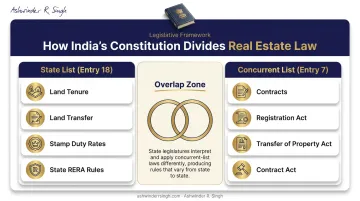
Here's something most buyers never learn: India's real estate laws overlap because of how the Constitution splits legislative power. Land falls under the State List (Entry 18), giving states control over land tenure and transfer. Contracts, however, sit in the Concurrent List (Entry 7), allowing both Parliament and state legislatures to legislate.
The result? A buyer in Karnataka faces different stamp duty rules than one in Delhi, even though the same central Registration Act governs both, which is precisely why legal literacy matters so much. A buyer who understands documentation can:
- Verify title and encumbrance records independently
- Negotiate with developers or sellers from a position of knowledge
- Reduce blind dependency on brokers who may have their own incentives
Informed decisions protect more than a bank balance; they protect a family's long-term financial footing.
Essential Real Estate Laws in India Every Buyer Should Know
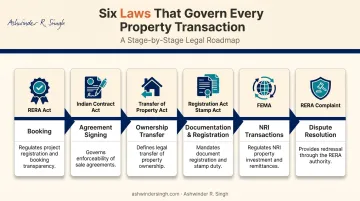
Indian real estate law isn't one unified code. It's a patchwork of roughly half a dozen major acts, each governing a different stage of a transaction, from booking to registration to eventual dispute resolution.
RERA - The Real Estate (Regulation and Development) Act, 2016
RERA exists to regulate how projects are marketed, sold, and developed, while mandating registration with state authorities. Section 3 prohibits promoters from advertising or booking a project without prior registration, with limited exemptions for very small developments.
Before committing funds, buyers should:
- Check the project's RERA registration number on the state RERA portal
- Confirm the promoter has disclosed legal title and any encumbrances (a Section 4 requirement)
- Review timelines, since Section 18 entitles buyers to refunds, interest, or compensation for delays
This single check of verifying a project's RERA status prevents a surprising number of disputes before they can even start.
The data shows this mechanism is actively used, not just theoretical. According to a September 2025 government press release, authorities had registered over 151,000 projects and disposed of more than 147,000 complaints.
Registration Act, 1908 and Indian Stamp Act, 1899
These two acts work together. The Registration Act requires that any document creating rights in immovable property worth ₹100 or more must be registered.
The Stamp Act levies duty on those same instruments. Unstamped documents generally can't be admitted as evidence until the deficient duty and penalty are paid.
Skip registration, and the consequences bite hard: an unregistered sale document generally cannot be used to prove ownership in a dispute, though it may still count as evidence of a contract in a specific-performance suit.
Stamp duty rates vary meaningfully by state:
| State | Approximate Rate | Notes |
|---|---|---|
| Maharashtra | 4-5% | Higher in municipal areas, lower in Gram Panchayat zones |
| Delhi | 4% (female buyer) / 6% (male buyer) | Plus 1% registration fee |
| Karnataka | 5% + 2% registration | Surcharge may apply depending on location |
Always confirm current rates with the state registration department before budgeting.
Transfer of Property Act, 1882
This act governs how ownership legally changes hands, through sale, lease, gift, mortgage, or exchange. Section 55 sets out the seller's obligations: disclosing material defects, producing title documents, and answering relevant questions about ownership.
This is where "marketable title" becomes critical. A marketable title means the ownership chain is clear, free of disputes, and free of undisclosed encumbrances. Verifying this history before purchase, not after, is non-negotiable.
Indian Contract Act, 1872 and FEMA for NRIs
The Contract Act makes sale agreements enforceable, requiring free consent, lawful consideration, and competent parties (Section 10). Note that a contract to sell doesn't itself transfer ownership; that still requires a registered conveyance deed under the Transfer of Property Act.
For NRIs and OCIs, FEMA rules apply on top of everything else:
- Residential and commercial property purchases are permitted
- Agricultural land, farmhouses, and plantation property are not permitted for purchase
- Payments must route through NRE, NRO, or FCNR(B) accounts, not cash or traveller's cheques
Common Legal Mistakes Homebuyers Make
Even educated buyers slip up here. The most frequent errors:
- Skipping verification checks - buying without confirming RERA registration, encumbrance certificates, or a clear title chain
- Underestimating additional costs - forgetting that stamp duty and registration fees can add 5-8% to the purchase price, creating last-minute cash crunches
- Trusting verbal promises - especially common in resale deals or family property transfers, where informal understanding replaces registered documentation
State RERA portals, such as Maharashtra's MahaRERA, urge checking the legal-title certificate, disclosed litigation, sanctioned plans, and the model agreement before signing anything. None of this requires a law degree, just the discipline to ask for paperwork.
How to Choose the Right Book to Learn Real Estate Law
Not every book labelled "real estate law" is actually useful to a first-time buyer. Here's what to look for:
- Plain language over statute text - a good book explains what Section 55 means for you, rather than simply reprinting the statute
- Practical tools - checklists, case studies, and references updated for recent RERA amendments matter more than exhaustive legal citations
- Author credibility - practitioners who've worked across banking, development, and advisory bring context you won't find in a bare statute summary
A book written purely for legal practitioners offers statutory depth. What buyers need is decision-making clarity: how to handle financing, negotiate confidently, and spot where legal blind spots typically hide.
Why Practitioner-Written Books Bridge the Gap for the Common Man
Most legal compendiums are written by lawyers, for lawyers. That leaves a real comprehension gap for someone buying their first flat, who needs clarity, not statutory precision.
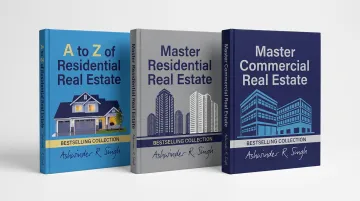
Ashwinder R. Singh's three Amazon India #1 bestsellers, A to Z of Residential Real Estate, Master Residential Real Estate, and Master Commercial Real Estate, were written to close that exact gap. Each targets a different reader need:
- A to Z of Residential Real Estate covers rent-versus-buy decisions and financing basics for first-time buyers
- Master Residential Real Estate goes deeper into due diligence, location selection, negotiation, and legal blind spots
- Master Commercial Real Estate addresses office and commercial assets, including financing and compliance specific to that sector
What sets these apart is the author's background. Singh has held senior roles at Citibank, ICICI, and Deutsche Bank, and later led JLL Residential, co-founded ANAROCK, and served as CEO of Bhartiya Urban's 150-acre township.
That banking-plus-development combination is unusual, and it shows in guidance that connects legal requirements to real financial outcomes rather than treating them as separate topics.
For readers who want ongoing insight beyond the books, his newsletter Open House covers real estate trends and regulatory updates regularly. Honest, experience-driven guidance, rather than dense academic text, is what helps the common man make legally sound property decisions.
Frequently Asked Questions
Which is the best book on real estate laws in India?
Dedicated legal compendiums offer statutory depth for lawyers and researchers. For buyers wanting practical, real-world guidance, practitioner-authored books like Ashwinder R. Singh's A to Z of Residential Real Estate combine legal literacy with actual market experience.
What is RERA and why is it important for homebuyers?
RERA mandates project registration and disclosure, protecting buyers from misleading marketing and unexplained delays. It also gives buyers a formal complaint mechanism with refund and compensation remedies.
Do NRIs need to follow different real estate laws in India?
Yes. FEMA governs NRI and OCI property purchases, permitting residential and commercial property but restricting agricultural land, farmhouses, and plantation property.
What documents should I verify before buying a property in India?
Check the title deed, encumbrance certificate, RERA registration, and occupancy certificate at minimum. These confirm ownership history, absence of liens, project legitimacy, and habitability.
Is stamp duty the same across all Indian states?
No. Rates differ by state and even by buyer gender in some cases, such as Delhi. Always verify current state-specific rates before finalising your budget.
Can a common man understand Indian real estate law without hiring a lawyer?
Foundational legal literacy from credible books and resources reduces risk and dependency on intermediaries. That said, professional advice still adds value for complex or high-value transactions.