At industry panels like the Times Home Hunt Property Expo, experts have openly flagged the affordability squeeze this is creating for ordinary homebuyers. Many families now find themselves priced out of neighbourhoods they could have afforded three years ago.
This tension has pushed real estate policy advocacy into the spotlight. It works as a three-way ecosystem: industry associations lobbying for reform, individual thought leaders framing the debate, and government officials responding with commitments and infrastructure announcements.
This article maps out the organisations, the leaders, the policy priorities, and the government's stance shaping where Hyderabad's real estate market goes next.
Key Takeaways
- CREDAI, NAREDCO, and CII drive Hyderabad's land, infrastructure, and affordability reform advocacy
- Metro extension, Regional Ring Road, and radial connectors dominate the infrastructure reform agenda
- National voices like Ashwinder R. Singh bring banking insight to local housing finance debates
- Telangana's government has committed to policy stability and transparent investor engagement
- Telangana 2050 sets the long-term framework future advocacy will need to align with
Leading Organisations Championing Real Estate Policy Reform in Hyderabad
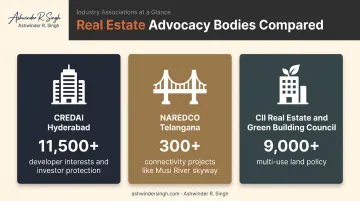
Three bodies drive most of the organised advocacy in the city, each with a distinct focus and considerable membership weight.
- CREDAI Hyderabad represents developers and convenes major dialogues with the state government, backed by CREDAI's national base of 11,500+ members.
- NAREDCO Telangana, with over 300 members, pushes hard on connectivity projects such as a proposed Musi River skyway and an elevated corridor from Kukatpally.
- CII's Real Estate and Green Building Council brings roughly 9,000 members nationally into the conversation, pressing for multi-use land policy to stabilise runaway prices.
CREDAI's Hyderabad chapter regularly hosts flagship events like the Property Show at HITEX, where Chief Minister Revanth Reddy addressed investor protection and policy transparency in August 2025. NAREDCO's President Vijaya Sai Meka has voiced these connectivity proposals at recent industry forums, while CII's push ties directly into its national real estate committee structure, where policy asks move between state chapters and Delhi.
How These Bodies Work Together
These three organisations don't operate in silos. They frequently co-host public forums and property expos, presenting a unified reform agenda to state authorities rather than three separate wish lists. That coordination matters: a joint voice from bodies representing thousands of developers carries more weight than fragmented lobbying ever could.
Influential Leaders Driving the Advocacy Conversation
Individual leaders give these organisations their public face and their specific policy asks.
C Shekar Reddy, who became National Chairman of CII-IGBC in 2026, has long championed multi-use land policy as a tool for price stabilisation. His argument: locking industrial land into single-use zoning artificially restricts supply and inflates prices elsewhere.
N. Jaideep Reddy, President of CREDAI Hyderabad, has focused on balanced regional growth. He urges developers and planners to look beyond the western corridor. The goal: ease commute burdens on ordinary citizens rather than concentrating everything around Kokapet and Neopolis.
Vijaya Sai Meka, President of NAREDCO Telangana, has been the driving force behind connectivity infrastructure proposals, particularly around the Musi corridor.
Bringing a National Lens to Local Demands
Local advocacy gains sharper edges when it connects with national policy thinkers. Ashwinder R. Singh, Chairman of the CII Real Estate Committee (Northern Region) and Advisor to NAR-India, offers exactly that vantage point.
His career spans Citibank, ICICI, Deutsche Bank, and Bajaj Housing Finance, giving him a rare view into housing finance and affordability policy, the kind that intersects directly with local demands like Hyderabad's.
As Chief Advisor on Republic Media Network's R.Estate platform, Singh amplifies policy discourse nationally on lending rates and mortgage accessibility, issues that shape buying power in markets far beyond Delhi or Mumbai.
Connecting hyperlocal advocacy voices with this kind of national thought leadership matters because it addresses both levers of reform:
- Macro levers: finance regulation, lending norms, mortgage accessibility
- Micro levers: local infrastructure, zoning, connectivity projects
Neither works well without the other.
Top Policy Priorities on Hyderabad's Real Estate Advocacy Agenda
Three priorities keep resurfacing across every industry forum and government meeting.
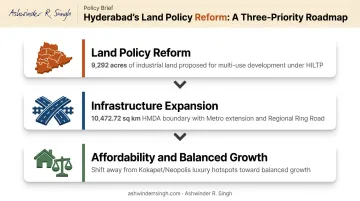
- Land policy reform: The Hyderabad Industrial Lands Transformation Policy (HILTP) proposes repurposing 9,292 acres of industrial land within the Outer Ring Road for multi-use development. Advocates argue this curbs speculative price increases by unlocking supply that's currently sitting idle.
- Infrastructure expansion: HMDA's boundary now spans 10,472.72 sq km, giving planners room to extend Metro service into the core city and push forward the Regional Ring Road with new radial connectors. Land acquisition delays stalled progress on the Regional Ring Road for years, but the state's land pooling scheme has now restored momentum.
- Affordability and balanced growth: The push is to shift development focus beyond hotspots like Kokapet and Neopolis, where luxury inventory now dominates sales charts, toward areas that don't demand hour-long commutes for middle-income buyers.
Why this matters: Without land supply reform, infrastructure catch-up, and a deliberate shift toward balanced growth, Hyderabad risks becoming a city where quality housing exists only for the top income bracket.
Government's Response: Balancing Growth with Policy Stability
The state government hasn't stayed silent on these demands. At the CREDAI Hyderabad Property Show, CM Revanth Reddy cautioned developers against politically motivated rumours while reaffirming commitments to transparent, rumour-proof policymaking and investment protection.
Beyond assurances, several concrete initiatives have followed:
- Advancing a proposed dry port on the Hyderabad-Amaravati Greenfield Highway
- Approving new airports, including one in Warangal
- Introducing zonal planning that separates core urban, semi-urban, and rural development tracks
As CII Real Estate Committee Chairman, Ashwinder R. Singh notes that the government leans on historical continuity to make its case. Officials regularly point to the Outer Ring Road (158 km, functional since 2016) and HITEC City's growth since the late 1990s as proof of commitment that spans multiple administrations rather than a single election cycle.
The Road Ahead: Telangana 2050 and the Future of Advocacy
Every advocacy demand discussed above will eventually need to sit inside a bigger framework: Telangana 2050. The vision emphasises:
- Sustainability
- Inclusivity
- Resilience
- Smart urban planning
These pillars guide the state's broader Vision 2047 target of a $3 trillion economy.
For advocacy leaders, whether local association heads or national voices like Singh, staying influential means aligning specific asks with this long-term roadmap rather than pushing isolated, short-term wins. A Musi skyway proposal or a multi-use land policy carries more weight when framed as part of a 25-year sustainability plan than as a standalone lobbying request.
Staying informed on these shifts is itself part of effective advocacy. Ashwinder R. Singh's bestselling books and his weekly Open House newsletter track how banking, finance, and regulatory changes at the national level filter down into city-specific outcomes for Hyderabad.
Frequently Asked Questions
Who are the key real estate advocacy bodies operating in Hyderabad?
CREDAI Hyderabad, NAREDCO Telangana, and CII's Real Estate and Green Building Council are the primary voices. CREDAI focuses on developer interests and investor protection, NAREDCO pushes connectivity infrastructure, and CII champions land policy reform.
What policy changes are developers and industry bodies demanding in Hyderabad?
The core demands include multi-use land policy to release supply and faster infrastructure delivery (Metro, Regional Ring Road, radial roads). Developers also want a shift away from concentrated luxury hotspots toward affordable, well-connected locations.
How does a national body like CII influence real estate policy in a city like Hyderabad?
CII operates through a national-to-regional committee structure, with local chapters feeding policy asks upward. Committee leaders like Ashwinder R. Singh bring cross-sector banking and finance insight that shapes national positions.
What infrastructure projects are top priorities for Hyderabad's real estate advocacy groups?
Metro Phase 2 extension into the core city, the Regional Ring Road, and new radial road connectors top the list. NAREDCO also wants a Musi River skyway and an elevated corridor from Kukatpally.
How is the Telangana government responding to real estate industry demands?
CM Revanth Reddy has publicly committed to policy stability and investor protection at events like the CREDAI Property Show. The government has also announced new airports, a proposed dry port, and zonal urban planning.
What is the Telangana 2050 vision and why does it matter for real estate policy?
Telangana 2050 sets a long-term framework prioritising sustainability, inclusivity, and smart urban planning as the state targets a $3 trillion economy by 2047. Future advocacy demands must align with this roadmap to stay relevant.