Introduction
Bengaluru's property market is running out of road. According to Knight Frank's H2 2025 report, average residential prices in Bengaluru have reached ₹8,856 per sq ft, up 7% year-on-year. Add to that a congestion cost estimated at ₹11.7 billion annually and yields that are increasingly compressed — and serious investors are asking the obvious question: what comes next?
Mysore is the answer — a structurally sound market with the infrastructure to back the thesis. The Bengaluru-Mysuru Expressway has cut travel time to roughly 75 minutes. STPI's ₹24 crore facility in Hebbal just opened. A Peripheral Ring Road is in active DPR tendering. Capital is already moving into the expressway corridor ahead of the broader market.
This guide covers the macro drivers behind Mysore's momentum, the infrastructure catalysts reshaping specific corridors, how to match your investor profile to the right micro-market, and a due diligence framework worth running before committing capital.
Key Takeaways
- Bengaluru has crossed ₹8,856 per sq ft — Mysore offers a lower entry point with comparable appreciation runway
- The Bengaluru-Mysuru Expressway (75-minute travel time) has structurally repositioned Mysore as a viable satellite city
- Hunsur Road and Hebbal lead established micro-markets; Ring Road corridors offer early-mover upside
- Capital appreciation, rental income, and NRI plays each demand a different zone and asset class
- K-RERA verification, clean title documents, and developer track record checks are non-negotiable here
Why Mysore Is Having Its Real Estate Moment
The Bengaluru Overflow Effect
Bengaluru's infrastructure strain is now measurable. TomTom's 2024 Traffic Index records average speeds of just 16.6 km/h across the city. Commute times have become a tax on productivity, and for professionals weighing where to live versus where to work, that calculus is shifting.
Mysore captures this overflow for specific reasons. It is Karnataka's second-largest city, with established hospitals, universities, and civic infrastructure already in place. And since March 2023, when PM Modi dedicated the Bengaluru-Mysuru Expressway, the psychological distance between the two cities has collapsed.
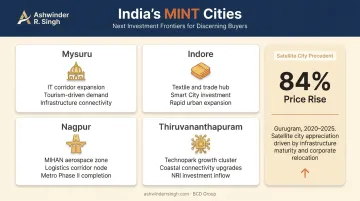
The satellite-city precedent is instructive. Gurugram home prices rose 84% between Q1 2020 and Q1 2025, from approximately ₹6,150 to ₹11,300 per sq ft, according to ANAROCK data reported by Business Standard. Mysore is at an earlier, more advantageous point on that same curve — before the bulk of appreciation has been captured.
This positions Mysuru within a select group of emerging metros. Ashwinder R. Singh has identified it as one of four MINT cities — alongside Indore, Nagpur, and Thiruvananthapuram — cities he argues represent the next decade's most compelling investment frontiers, driven by infrastructure access, diversifying economies, and accelerating demand.
Economic Fundamentals Driving Demand
Infrastructure access draws residents; employment keeps them. In Mysuru, the jobs base that sustains housing demand is already substantial — and expanding.
The IT foundation:
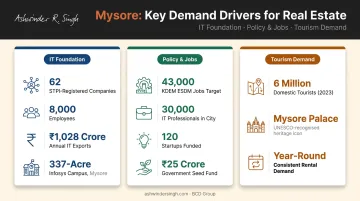
- STPI Mysuru hosts 62 companies with 8,000 direct employees and exports of ₹1,028.64 crore in 2023-24
- Infosys operates a 337-acre campus with a Global Education Center capacity for 14,000 trainees
- Wipro maintains its Mysore Development Center at Metagalli Industrial Area
- A new ₹24 crore, 40,000 sq ft STPI facility with co-working infrastructure has opened in Hebbal
Policy-backed expansion:
- The Karnataka Digital Economy Mission (KDEM) targets Mysuru for IT-ITES, ESDM, and cybersecurity — with ESDM alone projected to generate 43,000 direct jobs over five years
- KDEM counts approximately 30,000 IT professionals, 25,000 BPM workers, and 19,000 IT-skilled individuals in Mysuru's existing talent pool
- The Mysuru Cluster Seed Fund — a ₹25 crore government-backed initiative — has already supported 120 startups in the city, 15% of them women-led
Tourism as a demand multiplier:
- Mysore Palace and Dasara tourism drive consistent hospitality and short-term rental demand that most tier-2 cities cannot replicate
- Unlike tech-sector demand, tourism income holds across economic cycles — adding a floor to rental yields that pure IT-driven markets lack
- Mysuru recorded over 6 million domestic tourists in 2023, reinforcing its status as a year-round demand generator
Infrastructure Catalysts Reshaping Mysore's Property Market
Connectivity Already Delivered
The Bengaluru-Mysuru Expressway on NH-275 was dedicated in March 2023 at a project cost of ₹8,480 crore. Travel time dropped from nearly three hours to approximately 75 minutes.
That reduction matters beyond the obvious convenience. When a city crosses the 90-minute threshold from a major employment hub, it transitions from a weekend-home market to a genuine commuter catchment. The pool of realistic buyers and renters expands dramatically — and that expanded demand base is what drives sustained property appreciation.
The price impact along expressway corridors was visible even before inauguration. The Hindu reported in December 2022 that land prices along project-adjacent stretches had already moved, with rental values climbing ahead of the opening.
On the air connectivity front, Mysuru Airport's runway extension is actively progressing. Key milestones to date:
- Domestic routes operational, including Hyderabad (IndiGo resumed services from May 2026)
- Joint inspection by AAI, NHAI, and KIADB completed in December 2025
- Land re-survey of 206 acres across Marashe and Mandakalli villages completed February 2026
Confirmed international service remains pending, but the groundwork is advancing. Airport-adjacent real estate in comparable tier-2 cities like Coimbatore has seen measurable upswings tied to similar expansion phases.
Upcoming Projects Creating the Next Wave of Appreciation
Peripheral Ring Road (PRR): MUDA floated a DPR tender in June 2023, and by October 2025, three companies were competing to prepare the detailed project report. The PRR — a 62-km, six-lane outer ring road — will unlock peripheral residential corridors that currently trade at significant discounts to established zones. Historically, ring road confirmation is the single most reliable trigger for peripheral land appreciation in Indian cities.
That dynamic is already playing out in Mysore. Corridors likely to benefit from PRR alignment include Nanjangud Road, outer Bannur Road zones, and sections of the Hunsur Road periphery — areas where current pricing hasn't yet reflected confirmed infrastructure access.
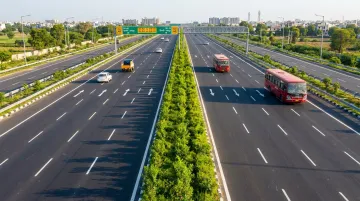
KIADB industrial expansion: The industrial zones at Hebbal and Nanjangud are the employment engine behind residential demand in Mysore's growth corridors. Industrial job creation pulls in-migration. That in-migration fills rental inventory, improves yields, and over time converts into capital value gains. The KIADB has also proposed new industrial development at Immavu and Thandya — further extending this demand chain.
Additional pipeline factors:
- Chief Minister Siddaramaiah has announced Karnataka's second international-standard cricket stadium in Mysuru, part of a ₹3,647 crore development push for the Mysuru division
- Brigade Group has signed a Joint Development Agreement to develop over 10 acres in Mysuru with a gross development value of approximately ₹225 crore, covering premium plots and high-end apartments — institutional developer money following infrastructure signals
Best Micro-Markets to Invest in Mysore
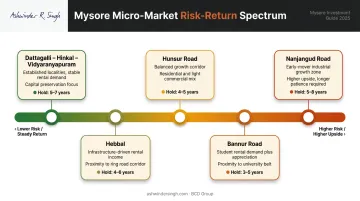
Micro-market selection has an outsized impact on returns in a city like Mysore. Two investments made in the same year can produce vastly different outcomes depending on location. Here is where each zone sits on the risk-return spectrum.
High-Conviction, Established Corridors
Hunsur Road is the highest-liquidity micro-market in Mysore and the most direct beneficiary of expressway access. Its proximity to emerging IT clusters and expressway entry points makes it the preferred zone for commuter-investors and NRI buyers. If you are planning a 5–7 year hold with the possibility of an earlier exit, this is the corridor where resale demand is most reliably present.
Hebbal (Mysore) benefits from the combination of KIADB industrial proximity, the new STPI facility, educational institutions, and established social infrastructure — hospitals, schools, and retail. It is a lower-risk, steady-appreciation play suited to rental income investors and conservative capital appreciation strategies.
The employment base here is more stable and diversified than in purely industrial corridors, which reduces vacancy risk on rental assets.
Emerging Zones for Early-Mover Advantage
Nanjangud Road and peripheral industrial zones offer affordable plotted development with a higher risk-reward profile. The investment logic is infrastructure-driven appreciation — industrial expansion and eventual PRR connectivity will increase land values over a 7–10 year horizon. Liquidity in this zone is thinner than Hunsur Road, so plan for at least a 7–10 year hold before expecting meaningful liquidity.
Bannur Road and the Ring Road corridor sit at the intersection of two demand drivers: consistent student rental demand from the educational institution cluster, and medium-term capital appreciation as the PRR develops.
Current rental listings in this zone indicate 2 BHK rents in the ₹12,000–₹15,000 range, though investors should verify current market-level yields rather than relying on individual listing data.
Established residential zones — Dattagalli, Hinkal, and Vidyaranyapuram — suit a different investor profile entirely:
- Consistent housing demand with lower execution risk
- Slower appreciation relative to emerging corridors
- Best suited for end-users or investors prioritising capital preservation over maximum upside
Matching Your Investor Profile to Mysore's Opportunities
Capital appreciation investors should focus on pre-launch plotted development in peripheral corridors aligned with the PRR and Nanjangud Road's industrial belt. Entry price today, before these projects reach completion, is where the margin of safety sits. Expect a 5–10 year horizon and plan accordingly. Developer due diligence is especially critical here, as peripheral market accountability is weaker.
Rental income investors will find the most predictable returns near established employment and educational clusters. Hebbal and Hunsur Road serve IT-linked rental demand; Bannur Road absorbs student and faculty tenants reliably. For context, Bengaluru's rental yields run approximately 3–6% in high-demand IT corridors like Electronic City and Whitefield (per NoBroker 2025 data). Mysore's yields in comparable zones are broadly competitive, with the added benefit of lower entry costs improving the yield-on-investment calculation.
NRI investors have a compelling case for Mysore specifically. The city combines cultural familiarity, particularly for Karnataka-origin NRIs, with a significantly lower ticket size than Bengaluru, strong K-RERA enforcement, and expressway access to Bengaluru's international airport. These factors together reduce both emotional and logistical friction for overseas buyers.
Ashwinder R. Singh's NRI advisory work focuses on exactly this profile: market entry, developer evaluation, and portfolio structuring in markets like Mysore. Investors looking to structure a Mysore investment properly, from site selection through legal verification, can reach the advisory team at ashwinderrsingh.com.
Due Diligence Checklist Before You Invest
K-RERA Verification
K-RERA registration is mandatory for all projects in Karnataka above the threshold size. To verify a project:
- Visit rera.karnataka.gov.in
- Search by project name, application number, or promoter name under the Project Applications section
- The portal currently shows 8,651 approved projects and 440 penalty orders — which tells you both that the system is active and that violations do occur
Red flags to look for in a RERA filing:
- Timeline extensions beyond original delivery dates (more than one extension is a serious warning sign)
- Undisclosed litigation under the legal disclosures section
- Missing quarterly progress reports (K-RERA penalises non-submission)
- Significant gap between approved units and units sold vs. funds raised
Title and Land Document Verification
RERA registration does not guarantee clean land title. These documents are essential before any commitment:
- Verify the Encumbrance Certificate (EC) via Kaveri Online Services (kaveri.karnataka.gov.in) — confirms no loans or charges exist against the property
- Pull the RTC (Record of Rights, Tenancy and Crops) from the Bhoomi portal (landrecords.karnataka.gov.in) — confirms ownership and land classification
- Check the Conversion Certificate for any agricultural land — formal approval under the Karnataka Land Revenue Act is required before development is legal
- Obtain the Khata Certificate — required for utility connections and any future resale
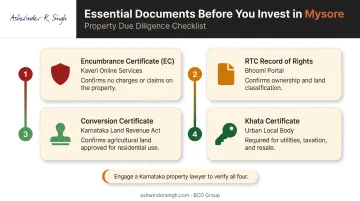
Hire a Karnataka property lawyer to verify all four documents before signing anything.
Developer Track Record and Liquidity Reality
In tier-2 cities like Mysore, developers face less public scrutiny — fewer active consumer forums, less media coverage, and thinner regulatory enforcement compared to Bengaluru. Check:
- Completed projects versus launched projects ratio
- Possession timelines on past deliveries
- Litigation history on the K-RERA portal
Mysore's secondary market is thinner than Bengaluru's, so plan for a minimum 5–7 year hold. Investors expecting a quick exit will either accept a discount or find no buyers at all during slowdowns.
Frequently Asked Questions
How is the real estate market in Mysore?
Mysore is one of Karnataka's most active tier-2 real estate markets, driven by expressway connectivity, an expanding IT employment base, and an active infrastructure pipeline. Entry prices remain significantly below Bengaluru, and appreciation across established corridors has accelerated since the expressway opened in 2023.
Is Mysore a good city to invest in real estate?
Mysore offers lower entry prices, strong appreciation fundamentals tied to infrastructure, and consistent demand from IT professionals, students, and tourists. Returns depend on two factors: your investment horizon and which micro-market you choose.
What are the best areas to invest in Mysore?
The top micro-markets, each suited to a different risk profile and hold period:
- Hunsur Road — expressway access, highest liquidity
- Hebbal — IT and industrial employment demand
- Bannur Road — educational cluster rental income
- Nanjangud Road — early-mover appreciation tied to industrial expansion and the PRR
Is buying land in Mysore a good investment?
Land in corridors near the upcoming Peripheral Ring Road and expressway access points offers strong long-term appreciation potential and does not depreciate. However, rigorous legal title verification — including conversion certificates for any agricultural land — is essential before purchase. Skip this step and the upside becomes irrelevant.
What are the risks of investing in Mysore real estate?
The main risks to plan around:
- A thinner secondary market that requires a longer hold period than metro markets
- Potential delays in pipeline infrastructure projects like the PRR
- Variable developer quality, where brand accountability is weaker than in Bengaluru
Proper due diligence addresses all three.
How does Mysore compare to Bengaluru for real estate investment?
Mysore offers a lower entry cost, a longer appreciation runway, and better livability by most quality-of-life metrics. Bengaluru offers higher liquidity and a deeper resale market. Mysore suits patient, long-term investors willing to hold 5–10 years; Bengaluru suits those who need flexibility to exit earlier.