
For homebuyers, investors, and NRI buyers watching this market, the timing of that understanding matters. Trivandrum's fundamentals are strengthening across multiple fronts simultaneously, and the window before full price discovery closes is narrower than it appears.
This article breaks down the five defining trends reshaping Trivandrum's real estate market, what's driving them, and where the market is likely to head next.
Key Takeaways
- Technopark's 70,000 direct jobs drive steady residential demand in Kazhakoottam, with Technocity poised to add 100,000 more
- Vizhinjam International Seaport, inaugurated in May 2025, is creating new demand corridors in southern Trivandrum
- NRI remittances into Kerala hit ₹2,16,893 crore in 2023 (a 154.9% jump from 2018), fuelling luxury and villa segment growth
- Smart home tech and sustainable features have moved from premium add-ons to standard buyer expectations
- Downtown Trivandrum, WTC Thiruvananthapuram, and a proposed metro rail point to sustained long-term appreciation
Trend 1: The IT Corridor Keeps Expanding
Technopark's Residential Pull
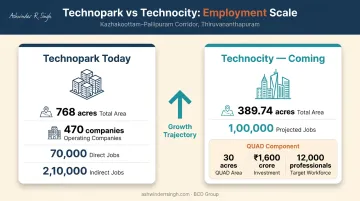
Technopark, India's first IT park, spans 768 acres and houses 470 IT companies employing 70,000 professionals directly and supporting 2,10,000 indirect jobs. That concentration of talent in one place creates durable, structurally sustained housing demand — the kind that holds through economic cycles.
The micro-markets of Kazhakoottam, Sreekaryam, and Karyavattom have matured around this employment base. Rental demand in these zones is driven by a steady inflow of IT professionals — not speculative cycles — making them among the most reliable residential investment destinations in South India.
Technocity Changes the Scale
The upcoming Technocity project at Pallipuram covers 389.74 acres and has the potential to create approximately 1,00,000 additional jobs. The QUAD component alone — a 30-acre development with ₹1,600 crore investment, 4 million sq ft of built-up area, and 1,100 residential units — is projected to employ 12,000 professionals.
Employment concentrated in a single corridor creates predictable rental demand and steady price appreciation — a dynamic that dispersed IT activity in other cities rarely replicates. Trivandrum's IT belt is one of the few in South India where this concentration is deepening, not flattening.
What to watch: As Technocity comes online in phases, the residential demand belt will extend further along the Kazhakoottam–Pallipuram corridor, creating early-mover opportunities in areas currently priced below their eventual demand potential.
Trend 2: Vizhinjam Port Reshaping Southern Trivandrum
India's First Deepwater Transshipment Hub
The Vizhinjam International Seaport, inaugurated by Prime Minister Modi on 2 May 2025, is India's first dedicated deep-water container transshipment port. With a natural draft of nearly 20 metres and capability to handle 18,000+ TEU vessels, it fills a gap no other Indian port could — and places Kerala directly on global container shipping routes.
Phase 1 key infrastructure:
- 1.0 million TEU handling capacity
- 2,960-metre main breakwater
- Two container berths totalling 800 metres
- ₹8,800 crore project cost, developed on a DBFOT basis with Adani Ports as concessionaire
The Real Estate Ripple Effect
Large-scale port activity pulls in logistics facilities, warehousing, ancillary businesses, and service industries. Each of these generates employment, which in turn drives residential and commercial demand in surrounding localities.
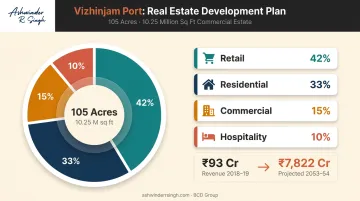
The VISL feasibility report reveals that up to 105 acres of the project site are earmarked for commercial real estate development, with a proposed 10.25 million sq ft of built-up area. The planned land-use split:
- 42% retail
- 33% residential
- 15% commercial
- 10% hospitality
Revenue projections from all sources rise from ₹93 crore in 2018–19 to ₹7,822 crore by 2053–54. That 30-year build-out means the economic multiplier effect on southern Trivandrum is still in its early stages — making current entry points in localities like Vizhinjam, Kazhakkoottam, and Kovalam worth watching before institutional demand fully prices in.
Trend 3: Luxury and Premium Housing Is No Longer a Niche
Trivandrum's residential market has historically skewed toward mid-range apartments. That's changing. Developers are launching high-rise projects with resort-style amenities, villa communities, and premium developments across Kowdiar, Sasthamangalam, Pattom, and Vellayambalam.
Three converging factors are behind this:
- Senior IT professionals and entrepreneurs with rising incomes seeking well-appointed homes beyond the standard 2 BHK
- NRI buyers investing in hometown real estate as part of retirement planning or portfolio diversification
- Post-pandemic preferences for larger homes, dedicated workspaces, and community-style living
Kowdiar and Sasthamangalam remain Trivandrum's most prestigious addresses, home to heritage properties, diplomatic residences, and historically high land values. Newer zones like Pattom and Vellayambalam are capturing buyers who want premium specifications with stronger connectivity.
The developer response is visible: fewer budget-only plays and more amenity-rich projects commanding higher per-square-foot realisations. Integrated township concepts — following models like DD Sports City and SFS Olympia-style developments — are gaining ground as developers match their product mix to this demand shift.
Trend 4: Sustainability and Smart Features Are Now Baseline Expectations
Green Building Adoption
Trivandrum has precedent here. Infosys's Software Development Block in Thiruvananthapuram earned LEED India Platinum certification — the highest rating under LEED's framework — a benchmark commercial and premium residential developers have since followed.
Homebuyers in the city are now asking for:
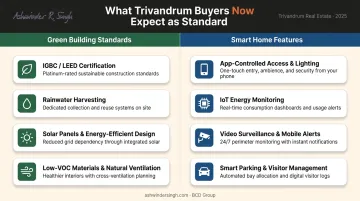
- IGBC or LEED green building certifications
- Rainwater harvesting systems
- Solar panel installations and energy-efficient design
- Low-VOC materials and natural ventilation layouts
Kerala's broader solar adoption trajectory supports this: IEEFA research found the state's residential rooftop solar application-to-installation conversion rate exceeded 65% — against a national average of 22.7%. Trivandrum buyers are already conditioned to think about energy differently.
Smart Home Technology
Premium projects are differentiating through automated security systems, app-controlled utilities, and IoT-enabled living features. For Trivandrum's IT professional buyer base, these features are standard expectations, not selling points.
Common smart specifications now appearing in premium launches include:
- App-controlled access, lighting, and climate systems
- IoT-enabled energy monitoring and utility management
- Video surveillance integrated with mobile alerts
- Smart parking and visitor management systems
As both green and smart features shift from differentiators to baseline requirements, projects that can verify certifications and demonstrate smart specifications are commanding a measurable premium — one likely to widen as buyer awareness grows.
Trend 5: NRI Investment Is Accelerating the Market
Kerala has one of India's highest rates of overseas migration. The Kerala Migration Survey 2023 records 2.2 million emigrants, with 80.5% concentrated in the GCC (UAE, Saudi Arabia, Qatar, Oman, Kuwait, Bahrain). A further 6% are in the UK, with smaller but growing communities in Canada, the US, and Australia.
The financial scale of this diaspora is significant:
- Annual remittances to Kerala: ₹2,16,893 crore in 2023
- Growth from 2018: up 154.9%
- Share of Kerala's NSDP: 23.2%
Of those remittances, 15.8% went toward house or shop renovation, 5.6% toward land purchase or improvement, and 5.3% toward purchasing apartments, shops, or houses outright.
Trivandrum residents form a meaningful share of this diaspora. Many are approaching retirement age or the 10–15 year mark of overseas employment — a stage where hometown real estate becomes a concrete plan for wealth preservation and family security, not just an aspiration.
That shift in intent is now matched by better tools to act on it. PropTech — virtual property tours, digital documentation, and online registration — has removed the need for in-person visits at every stage of a transaction. For NRI buyers coordinating across time zones, this makes Trivandrum a realistic choice rather than a logistically complicated one.
What's Driving These Real Estate Trends in Thiruvananthapuram
These trends aren't coincidental. They reflect the convergence of deliberate policy investment, economic expansion, and a maturing buyer base.
Infrastructure Pipeline
The government's development pipeline is extensive and verified:
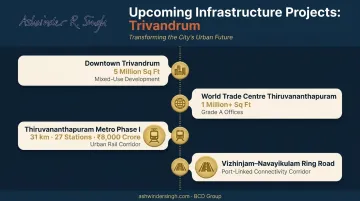
- Downtown Trivandrum: 5 million sq ft mixed-use development at Technopark, including Embassy Taurus Techzone, retail, a 485,000 sq ft non-SEZ office building, and 298 residential units
- World Trade Centre Thiruvananthapuram: Technopark's MoU with Brigade for 1 million+ sq ft of Grade A office space and a five-star hotel
- Thiruvananthapuram Metro: Phase I planned at 31 km, 27 stations, from Pappanamcode to Eenchakkal, with an estimated cost of ₹8,000 crore
- Vizhinjam–Navayikulam outer ring road: Announced in Kerala Budget 2024–25 as a port-linked development corridor
Each of these projects creates new employment nodes and shifts demand geography — making previously overlooked zones investable over the next 3–5 years.
Employment Depth
Technopark's 70,000-person employment base already sustains Trivandrum's residential market. Technocity's potential to add another 1,00,000 jobs would more than double that base — creating a structural demand floor that market corrections find difficult to breach.
NRI-Friendly Regulatory Environment
K-RERA's public portal lists approximately 1,620 registered projects, with full transparency on promoter details, completion timelines, sold units, and project status. For NRI buyers who previously avoided Indian real estate due to opacity concerns, RERA compliance has changed the calculus.
Shifting Buyer Preferences
Post-2020, the Indian homebuyer's decision-making framework changed in measurable ways. Larger homes, dedicated work-from-home spaces, community amenities, and greener environments moved from aspirational to non-negotiable.
Ashwinder R. Singh, author of A to Z of Residential Real Estate and Master Residential Real Estate, has documented this shift in depth, observing that the quality bar buyers are willing to pay for has been permanently reset — and that Tier-2 cities with strong employment fundamentals, like Trivandrum, stand to benefit most from this recalibration.
Future Signals for Real Estate in Thiruvananthapuram
Several emerging developments will shape Trivandrum's next growth phase:
- Vizhinjam at full capacity: The port handled 1.3 million TEUs in FY26 — already exceeding Phase 1 design capacity within its first year of full operations. Phase 2 expansion, with Adani Ports committing ₹16,000 crore, will materially deepen the economic footprint of southern Trivandrum
- Downtown Trivandrum and WTC: As these commercial developments deliver, new office employment will concentrate in the IT corridor, extending residential demand into adjacent zones
- Technocity rollout: Each phase of delivery adds employment and residential units simultaneously, compressing the lag between job creation and housing demand
- Metro rail: Once central approvals clear and construction begins, station-proximate localities will attract a new wave of early-mover investment
Alongside these infrastructure shifts, PropTech adoption is compressing transaction timelines and improving transparency. AI-powered property discovery, digital title searches, and blockchain-based documentation are reducing the information asymmetry that has historically disadvantaged remote and NRI buyers. For overseas investors in particular, this is accelerating a new wave of interest in verified, RERA-registered Trivandrum projects.
Conclusion
Trivandrum's real estate market is gaining momentum from multiple reinforcing drivers. Employment growth through Technopark and Technocity, the Vizhinjam port development, sustained NRI capital inflows, and a buyer base that now prioritizes quality over price — these aren't isolated trends. They're converging simultaneously in the same market.
When employment, infrastructure, capital, and demand maturation align in a single market, early movers with a clear framework typically capture better value than those waiting for the market to price in what's already visible.
For those building a rigorous framework to evaluate residential real estate decisions in markets like Trivandrum, Ashwinder R. Singh's books A to Z of Residential Real Estate and Master Residential Real Estate provide structured, practitioner-led guidance on exactly these dynamics. From assessing infrastructure-led corridors to understanding how NRI buyer behaviour shapes micro-market pricing, both books translate industry experience into decisions homebuyers and investors can act on.
Frequently Asked Questions
What is the richest area in Trivandrum?
Kowdiar and Sasthamangalam are traditionally Trivandrum's most prestigious and highest-value neighbourhoods, characterised by heritage properties, diplomatic residences, and strong land values. Newer premium zones like Pattom and Vellayambalam are also commanding top-tier prices, particularly for modern apartment developments.
Is Trivandrum a good city for real estate investment?
Yes — Trivandrum has solid investment fundamentals: Technopark employs over 70,000 professionals directly, Vizhinjam Port and Technocity are reshaping the city's economic base, and K-RERA provides regulatory transparency. Among Kerala's tier-1 cities, it offers one of the more reliable cases for long-term appreciation.
Which areas in Trivandrum are best for buying property near IT hubs?
Kazhakoottam, Sreekaryam, and Karyavattom are the primary IT-proximate zones, located within or adjacent to Technopark. All three carry strong rental demand from IT professionals and solid resale value, making them the go-to choice for both end-users and investors targeting the IT corridor.
How is the Vizhinjam port project affecting property prices in Trivandrum?
Property prices in southern Trivandrum are rising as Vizhinjam Port drives employment and economic activity in the corridor. The port-estate plan covers 105 acres and 10.25 million sq ft of mixed development, and with Phase 2 expansion confirmed, investors are actively buying ahead of full launch.
What types of properties are most in demand in Thiruvananthapuram?
2 BHK and 3 BHK apartments remain the dominant demand category, particularly near the IT corridor. Luxury apartments, premium 3–4 BHK units, and villa communities are the fastest-growing segments, driven primarily by NRI buyers and senior IT professionals seeking larger, higher-spec homes.