That shift didn't happen on its own. It came from regulatory bodies, industry associations, and individual leaders pushing for accountability. Yet many buyers and developers still can't name who actually shapes housing policy versus who simply talks about the market on social media.
This article maps the institutions and voices genuinely driving real estate policy advocacy in Thiruvananthapuram, from the state regulator headquartered in the city to the national forums that eventually influence Kerala's rules.
Key Takeaways
- K-RERA's live portal lists 1,631 registered projects, 660 promoters, and 1,077 agents statewide.
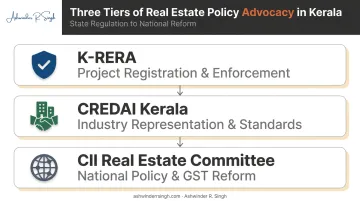
- Advocacy operates at three levels: K-RERA (state), CREDAI Kerala (industry), and CII Real Estate Committee (national).
- Tracking advocacy voices helps buyers spot regulatory shifts before they hit pricing or timelines.
- Builders with strong RERA compliance histories signal a market that's growing more accountable.
Why Real Estate Policy Advocacy Matters in Thiruvananthapuram
Kerala's property sector carried a trust problem for years. Delayed handovers, construction shortcuts, and vague promises left buyers with little recourse. Policy advocacy exists to close that gap between what developers promise and what they deliver.
The Kerala Real Estate Regulatory Authority (K-RERA) is headquartered at Trinity Centre in Kesavadasapuram, Thiruvananthapuram. Constituted on October 5, 2019, it formally launched on January 1, 2020, under the national RERA Act of 2016. Its job is straightforward on paper: enforce transparency, require registered timelines, and give buyers a grievance channel that actually works.
The numbers show scale, if not yet a finished job. As of mid-2026, K-RERA's official portal listed:
- 1,631 registered real estate projects across Kerala
- 660 registered promoters and 1,077 registered agents
- 2,329 complaints filed since the authority's inception
These are live counters, not a single annual snapshot, but they establish something important: regulation in Kerala isn't a formality anymore. It's an active system with thousands of stakeholders on record.
Beyond Enforcement: The Advocacy Layer
Regulation alone doesn't build a market. Industry bodies push for reforms that regulators can't create unilaterally, such as faster approval timelines, workable land-use norms, and incentives for affordable housing in urban centres like Thiruvananthapuram. This advocacy layer is where CREDAI and national bodies like CII come in, working alongside K-RERA rather than replacing it.
Thiruvananthapuram's growth as an IT and administrative hub, anchored by campuses such as Technopark, is adding pressure on this system. More residential and commercial development means more projects to register and more compliance to track, reinforcing the need for structured policy frameworks over ad hoc rules.
Key Institutions Driving Policy Advocacy in Thiruvananthapuram
Three types of institutions shape what happens next in Kerala's real estate rulebook. Each plays a distinct role.
Kerala Real Estate Regulatory Authority (K-RERA)
K-RERA's mandate covers project registration, developer accountability, and consumer grievance redressal. Every project above a certain size must register before advertising or selling units. On its own, this rule eliminated a major source of buyer risk.
The authority also engages directly with developers who hit compliance milestones. According to a January 2024 company announcement from Asset Homes, the Thiruvananthapuram-based builder became the first in Kerala to secure K-RERA approval for 50 residential projects.
The company states that then-Chairman P.H. Kurian presented the registration certificate for the 50th project at K-RERA's headquarters in the city. This claim comes from the builder's own communications rather than an independent K-RERA release, but it illustrates the public recognition the authority extends to compliant developers.
CREDAI Kerala Chapter
CREDAI Kerala positions itself as the collective voice of developers, engaging government bodies on housing and habitat policy. It functions as a lobby and standards body rather than a regulator.
Two things stand out about its approach. A voluntary Code of Conduct and "Mission Transparency" initiative aims to raise ethical standards among member developers. A Consumer Grievance Redressal Forum, running since October 2012, gives buyers a complaint channel against member builders outside the formal K-RERA process.
CREDAI Kerala's current governing council (2025-27), led by Chairman Roy Peter, represents developers across districts, including Thiruvananthapuram, in discussions with state authorities.
Confederation of Indian Industry (CII) Real Estate Committee
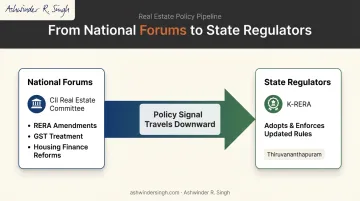
CII operates at a different altitude. Its National Committee on Real Estate and Housing works with the Union and state governments on sector-wide policy, covering subjects like RERA implementation, GST treatment of property transactions, affordable housing, and housing finance norms.
CII doesn't run K-RERA or set Kerala-specific rules directly. Instead, it shapes the national conversation on GST rates, financing frameworks, and regulatory design, which eventually filters down into how authorities like K-RERA operate on the ground.
Leading Voices Shaping Real Estate Policy Advocacy for Thiruvananthapuram
Institutions set the framework. Individuals give it a public face and a point of view.
P.H. Kurian IAS (Retd.) — Founding K-RERA Chairman
Kurian served as K-RERA's first Chairperson from its 2019 constitution. In a 2022 feature, he described the law's intent plainly: build trust between builders and buyers, enforce transparency, and ensure timely delivery. He also cautioned buyers against investing in unregistered projects, since promoters legally cannot sell or advertise them.
He has since been succeeded in the role: Kerala's current government listings name Dr. Asha Thomas IAS (Retd.) as Chairperson. Still, Kurian's tenure set the tone for how the authority engages publicly with the industry it regulates.
Sunil Kumar V — Founder & MD, Asset Homes
Sunil Kumar V built RERA compliance into Asset Homes' business philosophy rather than treating it as paperwork. The company's 50-project approval milestone, discussed earlier, reflects that approach in practice.
Whatever the exact verification status of the "first in Kerala" claim, the underlying pattern matters. A developer actively pursuing registration across dozens of projects is the kind of behaviour policy advocates want to see become standard.
CREDAI Kerala Leadership
CREDAI Kerala's governing council doesn't just issue statements. It represents developer interests directly in policy dialogues with the state government, pushing for faster approval cycles and standardised quality benchmarks that apply across districts, Thiruvananthapuram included. This is advocacy from the industry side of the table, distinct from K-RERA's regulatory role.
Ashwinder R. Singh — Chairman, CII Real Estate Committee (Northern Region)
Ashwinder R. Singh brings a national practitioner's lens to policy conversations that eventually touch every state market, Kerala's among them. As Chairman of the CII Real Estate Committee for the Northern Region, he sits inside the national forums where RERA implementation questions, GST treatment, and housing finance reforms get debated. Those debates cascade down to state-level authorities afterward.
His background adds weight to that seat:
- Former CEO roles at JLL Residential and Bhartiya Urban, and co-founder of ANAROCK
- Senior banking experience at Citibank, Deutsche Bank, ICICI Bank, and Bajaj Housing Finance
- Author of three Amazon India #1 bestselling books on residential and commercial real estate
He also serves as Chief Advisor on Republic Media Network's real estate platform and holds an advisory position with NAR-India. Neither role is Kerala-specific, and his direct advocacy work centres on North Indian markets.
What his national vantage point offers Thiruvananthapuram buyers is a way to read the bigger picture. When RERA amendments or housing finance rules get discussed at the CII level, that's often the earliest signal of changes state regulators like K-RERA will later adopt.
How Policy Advocacy Benefits Homebuyers and Investors in Thiruvananthapuram
Advocacy work translates into concrete protection, not just policy documents nobody reads.
Reduced delay risk. RERA-registered projects carry verified timelines and require builders to park a portion of buyer funds in escrow accounts, meant to prevent the fund diversion that fuelled Kerala's earlier trust problems.
Better long-term investment security. CREDAI and CII advocacy for standardised quality benchmarks gives resale buyers more confidence in construction standards, which supports resale value over time.
A grievance system that's getting faster. K-RERA's own annual reports show its disposal machinery gaining traction:
| Reporting Year | Complaints Filed | Complaints Disposed |
|---|---|---|
| FY2019-20 | 252 | 10 |
| FY2020-21 | 450 | 302 |
| FY2021-22 | 490 | 395 |
That jump from resolving 10 complaints in its first year to 395 in its third doesn't prove complaints have dropped overall. It does show a regulator building real capacity to act on buyer concerns rather than just collecting them.
How to Track and Engage with Real Estate Policy Changes
Anyone can stay ahead of policy shifts by checking the right sources regularly.
- Check the K-RERA portal before finalising any purchase. Search the project's registration number to confirm approval status, promoter history, and any pending complaints.
- Follow CREDAI Kerala and CII Real Estate Committee updates. Both bodies flag upcoming reforms on taxation, land use, and approval processes well before they become law.
- Read practitioner-level analysis for national context. Resources like Ashwinder R. Singh's books and his appearances on Republic Media Network's real estate platform help explain these shifts. National-level changes, such as RERA amendments or housing finance reforms, tend to move toward state implementation over time.
None of these steps takes more than a few minutes, and together they turn policy tracking from guesswork into a habit.
Frequently Asked Questions
What is K-RERA and how does it regulate real estate in Thiruvananthapuram?
K-RERA is Kerala's state regulatory authority, headquartered in Thiruvananthapuram. It handles project registration, enforces developer accountability, and resolves consumer grievances under the national RERA Act.
How does CREDAI support policy advocacy for developers in Kerala?
CREDAI Kerala represents developer interests in government policy discussions. The association also promotes ethical standards through its Code of Conduct and engages on taxation and construction regulation issues affecting the sector.
Why is real estate policy advocacy important for Thiruvananthapuram's growing market?
Rising demand from IT and administrative sector growth requires stronger regulatory frameworks to prevent project delays and protect buyer investments as development scales up.
Who are the key policy advocacy bodies homebuyers should know about in Thiruvananthapuram?
The main institutions are K-RERA for state regulation, CREDAI Kerala for developer representation, and national bodies like the CII Real Estate Committee for broader policy input.
How can investors verify RERA registration for a project in Thiruvananthapuram?
Buyers can check the official K-RERA website using the project's registration number. This confirms approval status, promoter details, and any recorded complaints against the developer.
What role does national industry leadership play in shaping local real estate policy in Kerala?
National bodies like CII connect macro policy reforms, such as RERA amendments and housing finance rules, to state-level implementation. This eventually shapes how authorities like K-RERA operate locally.