Introduction
Picture this: a Mysore homebuyer shortlists a plotted development near Hebbal, or an NRI investor eyes a gated community off Hunsur Road.
Both share the same nagging worry: will the project get delayed, will their booking amount vanish into another site, or is that glossy brochure even legal?
These aren't rare fears. Karnataka enforces the Real Estate (Regulation and Development) Act, 2016 through the Karnataka Real Estate Regulatory Authority (RERA).
Every qualifying Mysore project falls under its watch, alongside local approvals like the Mysore Urban Development Authority (MUDA) sanction.
This guide breaks down RERA registration rules, the exact registration steps and fees, how to verify a Mysore project's RERA status yourself, and the local clearances buyers routinely skip.
We'll also draw on insights from Ashwinder R. Singh, a cross-sector real estate and banking veteran whose practitioner-led guidance has helped homebuyers and investors avoid costly mistakes.
Key Takeaways
- Mysore projects over 500 sq. m. or with 8+ units must register with Karnataka RERA before marketing or booking
- Developers can't collect more than 10% advance before signing a registered sale agreement
- Karnataka RERA has approved 8,721 of 10,315 filed project applications statewide
- RERA registration doesn't confirm land-use legality; a separate MUDA or local-body approval is mandatory
- Complaints cost just ₹1,000 to file, with a 60-day resolution target
What is RERA and Why It Matters for Mysore Real Estate?
Karnataka's RERA Authority operates through a single statewide portal, rera.karnataka.gov.in, covering every district including Mysore. The regular Authority was constituted under Section 20(1) of the central Act in March 2019, after an interim body ran from mid-2017.
Who needs to register? Under Section 3(2)(a), any Mysore project is exempt only if the land area stays under 500 sq. m. and the units number 8 or fewer. In practice, this means:
- Land area exceeding 500 sq. m.: registration mandatory
- More than 8 units (9 or more): registration mandatory, regardless of land size
- Registration must happen before advertising, marketing, booking, or selling a single unit
The scale of adoption is telling. As per the official Karnataka RERA project registry, 8,721 of 10,315 project applications and 7,050 of 7,579 agent applications have been approved statewide. That's a large system in active daily use across the state.
Why Mysore specifically needs this scrutiny: the city's plotted layouts, townships, and gated communities around Vijayanagar, Ring Road, and Hunsur Road have grown fast. Unauthorized layouts and stalled possessions aren't new stories here, which is exactly why checking RERA status before booking matters more in Mysore than in slower-growth markets. That scrutiny starts with knowing exactly which authority enforces these rules.
Which Government Ministry Oversees RERA in Karnataka?
RERA Karnataka functions under the state's Housing Department, Government of Karnataka, and is administered by the Karnataka Real Estate Regulatory Authority itself. This is distinct from the central Ministry of Housing and Urban Affairs (MoHUA), which frames the overarching national Act but doesn't handle day-to-day project registrations in Mysore or elsewhere in the state.
Key RERA Rules Every Mysore Homebuyer Should Know
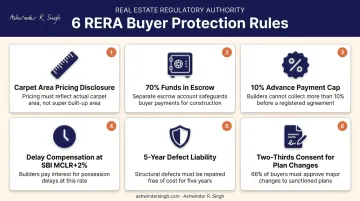
RERA embeds specific buyer protections beyond the registration process, ones Mysore purchasers should actively verify.
- Carpet area pricing: Section 2(k) defines carpet area, and Section 4(2)(h) requires promoters to disclose it at registration, closing the loophole developers used to inflate prices with vague "super built-up area" math.
- Separate account rule: Under Section 4(2)(l)(D), 70% of funds collected from buyers must sit in a dedicated bank account used only for that project's land and construction costs, curbing the historical risk of diverting funds to other Mysore plotted-development sites.
- 10% advance cap: Section 13(1) bars promoters from collecting more than 10% of the unit cost before a registered sale agreement is executed, so brokers pushing larger token amounts before paperwork is signed are breaking the rule.
- Delay compensation: Section 18 entitles buyers to a refund with interest, or monthly compensation, calculated at the SBI highest MCLR plus 2% if possession is delayed.
- 5-year defect liability: Section 14(3) obligates the promoter to fix structural or workmanship defects reported within 5 years of possession, free of charge, within 30 days of the complaint.
- Plan change disclosure: Section 14(2) requires written consent from at least two-thirds of allottees before altering sanctioned layouts or common areas — relevant given how often Mysore projects tweak plans mid-construction.
Non-compliance carries teeth: promoters risk a penalty of up to 10% of estimated project cost for failing to register, and up to 3 years' imprisonment for ignoring a regulatory order under Section 3.
Step-by-Step RERA Registration, Fees & Status Check for Mysore Projects
Documents Developers Need
Before a Mysore project can register, promoters typically prepare:
- Title deeds and legal ownership documents
- RTC and Khata certificate
- Encumbrance certificate
- Sanctioned layout or building plan and commencement certificate
- NOCs from Fire, Electricity (CESC), and Water/Sewer departments
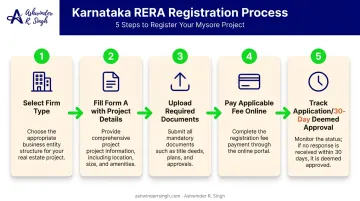
Registration Steps on the Portal
- Select firm type: individual promoter, company, partnership, or society
- Fill Form A with promoter identity, project details, land title, and prior-project history
- Upload documents: title deeds, encumbrance certificate, sanctioned plans, and the Section 4 declaration
- Pay the applicable fee online based on project category
- Track the application: the Authority must decide within 30 days, or the project is deemed registered under Section 5(2)
Fee Structure by Project Type
| Project Type | Land Area | Fee per sq. m. |
|---|---|---|
| Plotted development | Any area | ₹5 |
| Group housing | Up to 1,000 sq. m. | ₹5 |
| Group housing | Above 1,000 sq. m. | ₹10 |
| Mixed residential/commercial | Up to 1,000 sq. m. | ₹10 |
| Mixed residential/commercial | Above 1,000 sq. m. | ₹15 |
| Commercial | Up to 1,000 sq. m. | ₹20 |
| Commercial | Above 1,000 sq. m. | ₹25 |
Source: Karnataka RERA Rules, 2017
Agent registration runs separately: individuals pay ₹25,000, while firms pay ₹2 lakh. Since many Mysore transactions run through local brokers, confirming an agent's RERA registration is just as important as checking the project's.
Before paying anything, always ask the developer for the RERA acknowledgment or registration certificate. Skip the payment entirely if they can't produce one.
How to Check a Mysore Project's RERA Status
Verifying status takes minutes:
- Visit rera.karnataka.gov.in and go to Services > Project Status
- Filter by district (Mysore/Mysuru), project name, or RERA registration number
- Review the listed validity period, sanctioned layout, promoter track record, and current construction stage
One habit worth building: cross-check the carpet area figure on the RERA portal against what's printed in the developer's brochure. Mismatches here often reveal pricing tricks before you've signed anything.
Beyond RERA: Local Project Approvals Every Mysore Buyer Should Verify
RERA registration confirms a promoter followed disclosure and fund-handling rules. It says nothing about whether the underlying land can legally be developed. That's a separate check entirely.
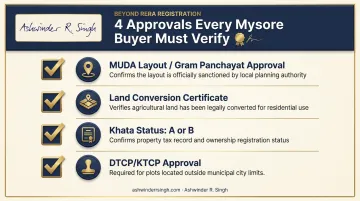
For Mysore buyers, this means verifying:
- MUDA layout approval, or Gram Panchayat/local body sanction if the project sits outside Mysore Urban Development Authority's planning jurisdiction
- Land conversion certificate: required if agricultural land was converted for residential or plotted use
- Khata status (A or B): A-Khata properties carry cleaner municipal standing than B-Khata
- DTCP/KTCP approvals: mandatory for plotted developments outside city limits, under Karnataka's 2025 regulations for areas without a declared Local Planning Area
Ashwinder R. Singh's career spanning banking at Citibank, ICICI Bank, and Bajaj Housing Finance, alongside development leadership at ANAROCK and JLL Residential, gives him a rare vantage point on this.
Institutional lenders never approve funding on registration paperwork alone. They dig into the title chain, encumbrance history, and sanctioned plan before releasing a single rupee. Individual buyers rarely apply the same rigor, and that gap is where legal risk hides.
His book, Master Residential Real Estate, walks through exactly this kind of due diligence, covering how to spot legal blind spots before committing to a purchase. His Open House newsletter offers similar practitioner-led frameworks for buyers navigating unfamiliar markets.
The bottom line: request both the RERA certificate and the MUDA/local body approval copy before booking. One without the other still leaves you exposed.
Filing a RERA Complaint for a Mysore Property Issue
If a Mysore project misses possession deadlines, hides structural defects, alters plans without consent, or advertises misleadingly, RERA gives you a formal recourse path.
Valid grounds for a complaint include:
- Possession delay beyond the agreed timeline
- Structural defects within the 5-year liability window
- Unapproved changes to the sanctioned plan
- Misleading advertisements about amenities, size, or completion date
Filing process:
- Register or log in on the Karnataka RERA portal
- Fill the complaint form with complainant and respondent details
- Upload supporting documents — agreement copy, payment receipts, correspondence
- Pay the ₹1,000 filing fee (₹5,000 for Appellate Tribunal appeals)
The Authority targets resolution within 60 days, though complex disputes can take longer. Track progress anytime using your complaint reference number under Services > Complaint Status.
Frequently Asked Questions
What are the fees for registering with the Real Estate Regulatory Authority (RERA) in Karnataka?
Fees range from ₹5 to ₹25 per sq. m., depending on project type and land area. Plotted developments pay a flat ₹5, while commercial projects above 1,000 sq. m. pay ₹25.
How can I check my RERA registration/status in Karnataka?
Visit rera.karnataka.gov.in, go to Services > Project Status, and filter by district, project name, or RERA registration number to view current standing.
Which government ministry oversees RERA in Karnataka?
It falls under Karnataka's state Housing Department, via the Karnataka RERA Authority, separate from the central Ministry of Housing and Urban Affairs, which handles the national framework.
How do I apply/register with the Real Estate Regulatory Authority (RERA) in Karnataka?
Promoters select their firm type on the portal, complete Form A with project and land details, upload required documents, and pay the category-based fee online.
Is RERA registration alone enough to confirm a Mysore project's legality?
No. Buyers should also verify MUDA or local body layout approval and Khata status separately, since RERA registration doesn't certify land-use legality on its own.
What happens if a builder sells an unregistered project in Mysore?
It's illegal under the RERA Act. Buyers can file a complaint, and developers may face penalties up to 10% of project cost, plus imprisonment up to 3 years for non-compliance with regulatory orders.