Many investors still file Indore under "tier-2, revisit later." That's exactly the mindset the session challenged. Early movers who acted on similar signals in Hyderabad and Pune a decade ago captured gains that latecomers missed entirely.
This article unpacks the key insights from the Indore speaker session, including market data, IT sector momentum, and what it actually means if you're weighing an investment or a home purchase in the city.
Key Takeaways
- Office leasing hit ~0.25 million sq ft in H1 2024, signaling rising commercial demand.
- The new Metro corridor and Indore-Ujjain highway upgrade are reshaping city connectivity.
- The city's IT/ITES ecosystem remains emerging, still trailing hubs like Bengaluru and Hyderabad.
- Practitioner-led guidance from voices like Ashwinder R. Singh helps separate genuine opportunity from hype.
Inside the Indore Real Estate Speaker Session
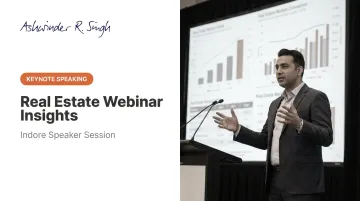
VisionX Indore 2026 wasn't a niche webinar tucked away for insiders. It drew developers, brokers, and investors from across Central India, all trying to answer one question: is Indore's growth story sustainable, or is it another tier-2 hype cycle?
Ashwinder R. Singh delivered the keynote. His framing centred on what he described as a convergence of aligned cycles — demand, capital, infrastructure, regulation, and aspiration moving in the same direction at the same time. That convergence, he argued, is rare, and Indore is positioned squarely within it as part of Central India's quieter but meaningful transformation.
This commentary carries weight beyond stage presence. Singh's background spans:
- Banking leadership at Citibank, Deutsche Bank, ICICI, and Bajaj Housing Finance
- CEO roles at JLL Residential and Bhartiya Urban
- Co-founding ANAROCK
That cross-sector experience is why sessions like this draw 1,200+ practitioners rather than passive attendees. You're not getting theory. You're getting pattern-recognition built over 25+ years of cycles.
Indore Real Estate Market: Growth Trends & Data Points
Indore's residential market doesn't yet have the kind of granular, locality-level pricing data available for metros like Mumbai or Bengaluru. That's a real gap, not an oversight. What we do have paints a directional picture.
Guideline values — the government's administrative benchmark for property registration — were proposed to rise by an average of 26% across 2,624 locations in Indore. That increase signals how municipal authorities view the city's property momentum, though it isn't the same as market-transaction pricing.
On the commercial side, the data is firmer. CIRIL's H1 2024 commercial real estate report recorded approximately 0.25 million sq ft of office leasing in Indore during that period. Office rents along the AB Road-Vijay Nagar stretch climbed to ₹80-100 per sq ft per month, up from ₹72-90 the previous year.
Infrastructure Is Doing the Heavy Lifting
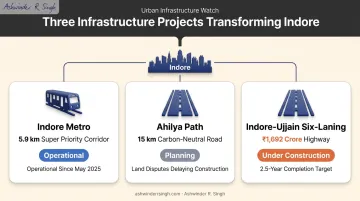
That commercial momentum ties directly to infrastructure spending. Three projects stood out from the session's discussion:
- Indore Metro — the initial 5.9 km Super Priority Corridor was inaugurated on 31 May 2025, marking the city's first operational metro segment.
- Ahilya Path — a planned 15 km carbon-neutral road to ease central-city congestion, currently facing farmer protests over land acquisition after construction restrictions hit eight villages in mid-2024. A project to watch, not yet a proven value driver.
- Indore-Ujjain six-laning — a ₹1,692 crore highway upgrade targeted for completion within 2.5 years of its September 2024 groundbreaking. A separate ₹2,312 crore cabinet package adds a ₹1,370 crore greenfield road between the two cities.
Civic Standing Adds to the Livability Case
Indore topped the India Smart Cities Award Contest in 2022, with formal recognition following in 2023. More recently, Indore joined Surat and Navi Mumbai in the new Super Swachh League under Swachh Survekshan 2024-25. That's a distinct tier from a simple first-place ranking, but still a meaningful civic credential for homebuyers weighing quality of life.
Compared with other emerging cities, Indore is frequently grouped alongside Mysuru, Nagpur, and Thiruvananthapuram as part of what's been called the "MINT" growth quadrant — smaller markets showing similar infrastructure-led momentum. Precise cross-city price comparisons remain hard to verify, so treat this positioning as directional rather than a ranked league table.
Is Indore Turning Into India's Next IT Hub?
Short answer: it's building the foundations, but it isn't there yet.
Indore's IT infrastructure currently rests on two established campuses:
- Crystal IT Park: roughly 7.99 hectares (about 550,000 sq ft), housing Impetus, Infobeans, Intellicus, and Cleartrail
- Crystal IT Park-II: a proposed second phase adding roughly 200,000 sq ft of capacity
- Indore Special Economic Zone: operational since 2003, with a notified area of 572.258 hectares as of March 2025, though it functions as a multi-product zone rather than an IT-exclusive campus
Policy Support Has Real Teeth, But Also Limits
The Madhya Pradesh IT, ITeS & ESDM Investment Promotion Policy 2023 offers capital assistance of up to 25% of gross fixed capital investment, capped at ₹30 crore under the final policy terms. That's meaningful for mid-sized companies scouting expansion, though larger enterprises should check the current implementation guidelines before modelling exact benefits.
This kind of institutional backing is why the Super Corridor is drawing attention. In September 2024, MPSEDC signalled plans to allocate roughly 40 acres of undeveloped Super Corridor land to IT companies — a concrete step, even if occupancy timelines remain unclear.
What This Means for Housing Demand
Growing IT presence typically fuels rental housing and co-living demand near tech corridors. Indore doesn't yet have city-specific data quantifying this trend, but the underlying logic holds: employees need places to live near where they work. Talent retention and infrastructure gaps remain the honest caveats here: Indore's IT ecosystem is younger and thinner than in established hubs.
The bigger pattern worth watching is historical. Knight Frank's H2 2025 report shows 63% of West Hyderabad's residential sales tied directly to its established IT employment base, while Pune's IT/ITeS sector supplied 31% of H2 2025 office leasing.
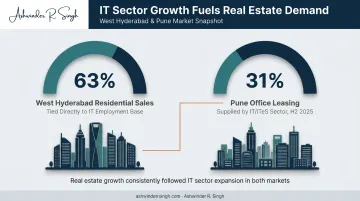
Both cities saw real estate booms follow IT sector growth, not the other way around. If Indore's IT story matures the way Hyderabad's and Pune's did, residential demand near tech corridors would logically follow, not lead.
What This Means for Investors & Homebuyers
The session's practical takeaway wasn't "buy now, everywhere." It was more nuanced: proximity to infrastructure and IT allocation zones matters more than the address alone.
Where the smart money is watching:
- Super Corridor: benefits from both the Metro's initial route and the pending IT land allocation, making it the most infrastructure-backed micro-market discussed.
- Areas near Ahilya Path: worth tracking for future connectivity, but still a planning-stage project with unresolved land disputes.
- Vijay Nagar: already an established commercial micro-market, evidenced by rising office rents, though this doesn't automatically translate into residential upside.
Due Diligence Steps for NRIs and First-Time Buyers
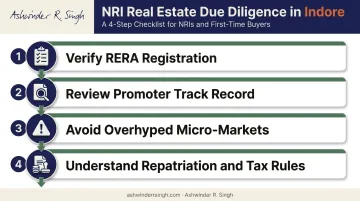
Before committing capital, especially from overseas, follow these checks:
- Verify RERA registration directly on the MP RERA project portal, confirming the registration number, sanctioned plans, and declared completion date.
- Review the promoter's track record, including past project delivery timelines and any regulatory complaints.
- Avoid overhyped micro-markets where marketing outpaces actual infrastructure delivery, a mistake Ashwinder R. Singh has flagged repeatedly for NRI investors.
- Understand repatriation and tax rules specific to NRI property transactions before wiring funds.
Risk factors worth flagging: certain corridors risk oversupply if multiple developers launch similar mid-segment projects simultaneously. Always cross-check a builder's delivery history against their marketing claims — a gap between promise and delivery is the most common regret among first-time investors.
Learning From India's Leading Real Estate Voices
Sessions like VisionX Indore matter because the person on stage isn't reciting a press release. Ashwinder R. Singh's path runs through banking floors at Citibank and Deutsche Bank, the CEO's chair at JLL Residential and Bhartiya Urban's 150+ acre township, and co-founding ANAROCK.
He currently chairs the CII Real Estate Committee for the Northern Region, giving him a policy-level vantage point most commentators lack. That perspective carries into his writing as well.
His three Amazon India #1 bestselling books (Master Residential Real Estate, Master Commercial Real Estate, and A to Z of Residential Real Estate) cover the due diligence, negotiation, and legal groundwork investors need, Indore included.
Three ways to stay current on emerging markets like Indore:
- Subscribe to his Open House newsletter for ongoing market breakdowns.
- Follow his commentary as Chief Advisor on R.Estate, Republic Media Network's real estate platform.
- Connect via LinkedIn or catch his keynotes at events like VisionX Indore.
Frequently Asked Questions
Is Indore becoming an IT hub?
Indore has genuine IT infrastructure, including Crystal IT Park and the Indore SEZ, plus state policy incentives supporting expansion. It remains an emerging IT location, not yet comparable to established hubs like Bengaluru or Hyderabad.
How is the real estate market in Indore?
Commercial activity is picking up, with roughly 2.5 lakh sq ft of office leasing in H1 2024 and rising rents in areas like Vijay Nagar. The new Metro corridor and other infrastructure projects are driving steady interest in residential and commercial segments.
Which areas in Indore are best for real estate investment right now?
Super Corridor stands out due to Metro connectivity and pending IT land allocation from MPSEDC, the state's IT infrastructure agency. Areas near Ahilya Path are worth monitoring, though the project remains in the planning and land-acquisition phase.
What infrastructure projects are driving Indore's real estate growth?
The Indore Metro's initial 5.9 km corridor, the Indore-Ujjain six-lane highway upgrade, and the planned Ahilya Path are the three key projects. Smart City recognition and Swachh Survekshan rankings add to the city's livability appeal.
Is it a good time for NRIs to invest in Indore's property market?
Indore offers relative affordability and RERA-backed regulatory protections compared to metro cities. NRIs should still complete thorough due diligence, including title verification and repatriation rule checks, before committing capital.
How can I learn more about real estate investment strategies from industry experts?
Practitioner-led resources like Ashwinder R. Singh's three bestselling books, his Open House newsletter, and his speaker sessions offer ongoing, experience-driven insight into emerging markets like Indore.