
Introduction
Hyderabad's real estate market has moved well beyond simple transactions. Average capital values rose 27% to ₹7,300 per sq ft in 2024, and office gross leasing crossed 10.72 million sq ft according to JLL's 2024 data.
The market now demands a different kind of professional — one who can interpret complexity, not just close deals.
That professional is the real estate Subject Matter Expert (SME).
Many buyers, investors, and developers in Hyderabad struggle with a real problem: the market is layered with regulatory frameworks, micro-market nuances, and asset-class differences that generic brokerage simply cannot navigate. A flat-buyer in Kokapet and a land investor evaluating plots near Shadnagar need fundamentally different expertise.
This guide breaks down what a real estate SME role looks like in Hyderabad, the career tracks available, and what it genuinely takes to build credible expertise in Telangana's market.
Key Takeaways
- A real estate SME in Hyderabad provides strategic advisory — not just transactional facilitation
- Telangana's regulatory landscape (TSRERA, HMDA, DTCP) creates genuine demand for specialised knowledge
- Four SME tracks dominate the market: residential, commercial, land/plotted development, and investment/valuation
- TSRERA agent registration (₹10,000 for individuals) is the entry requirement — deeper credentials separate advisors from agents
- Niche specialisation in one corridor or asset class builds credibility faster than generalism
What Does a Real Estate Subject Matter Expert in Hyderabad Do?
In Hyderabad's market, the distinction between a broker and a Subject Matter Expert matters more than most people assume. A broker facilitates a transaction. An SME shapes the decision architecture before any transaction is on the table.
A real estate SME holds specialist knowledge in a defined area — market pricing, regulatory frameworks, legal due diligence, investment analysis, or a specific asset class. Their value is advisory and interpretive, not transactional. They're the professional a developer calls before launching a project, not after.
Scope of Work and Daily Responsibilities
The day-to-day reality of an SME role spans several functions:
- Market research and feasibility analysis — assessing whether a location, price point, or product mix makes sense at a given point in the cycle
- Regulatory interpretation — translating RERA compliance requirements, HMDA approvals, or stamp duty structures into actionable guidance
- Micro-market advisory — helping buyers and investors understand why Kondapur, Kokapet, and Narsingi each carry different risk-return profiles
- Developer advisory — guiding product positioning, target segment decisions, and pricing strategy before a launch
- Due diligence support — working alongside legal teams on title verification, encumbrance certificate interpretation, and project registration status
Each client type demands a different depth of engagement:
- Homebuyers — project evaluation and RERA compliance guidance
- HNI investors — corridor-level price analysis and entry-timing insights
- NRI clients — FEMA compliance, repatriation rules, and documentation process management
- Developers and HFCs — market data, demand studies, and project viability frameworks
That range of stakeholder needs is itself a signal of what makes this market demanding. Without structured expertise, the gaps between these requirements are where costly mistakes happen.
What Makes Hyderabad Real Estate Complex Enough to Need SMEs
Hyderabad's regulatory environment is complicated — and the complexity is layered.
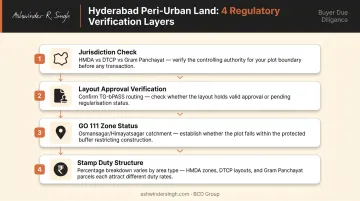
Consider what a single peri-urban land transaction can involve:
- Determining whether the plot falls under HMDA jurisdiction (which now spans 10,472 sq km, 1,355 revenue villages, 104 mandals, and 11 districts) or DTCP or gram panchayat authority
- Verifying layout approval through TG-bPASS and whether permissions were routed through the correct authority
- Understanding GO 111 zone implications near the Osmansagar and Himayatsagar catchment areas
- Applying the correct stamp duty structure — which differs between gram panchayat areas (5.5% stamp duty + 2% registration) and other areas (5.5% + 1.5% transfer duty + 0.5% registration)
Beyond land, Hyderabad's asset class diversity demands separate expertise for each segment: IT corridor luxury apartments, gated villa communities, HMDA and DTCP-approved plotted layouts along highway corridors, Grade A office parks, and industrial/logistics zones near Pharma City. A professional who truly understands one of these segments at depth is far more valuable than one who knows all of them superficially.
Why Hyderabad and Telangana Offer Unmatched Opportunities for Real Estate SMEs
Why Hyderabad and Telangana Are High-Demand Markets for Real Estate SMEs
The case for SME roles in Hyderabad starts with the scale of activity. ANAROCK's 2024 annual report recorded 58,500 residential unit sales in Hyderabad — almost exactly matching the 58,300 units launched. That equilibrium, combined with a 27% capital value increase, signals a market where advisory quality, not volume, determines outcomes for buyers.
The employment base driving this demand is substantial:
- Telangana hosts 1,500+ IT/ITeS companies employing over 5.8 lakh professionals
- IT/ITeS exports grew 17.93% — more than double the national average of 8.09%
- Telangana contributes nearly 40% of India's pharmaceutical production and around one-third of global vaccine production
- The state's life sciences sector comprises 2,000+ companies, with Genome Valley alone hosting over 200 biotech and pharma firms
This employment concentration directly shapes residential demand patterns, office leasing activity, and corridor-level price appreciation. SMEs who understand how employment corridors interact with housing demand can advise with a precision that generic agents cannot.
Infrastructure Growth as an Opportunity Driver
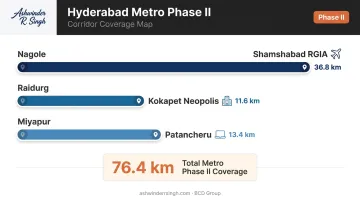
New infrastructure is creating entirely new advisory complexity in Telangana. HMDA has proposed a 100-metre wide Regional Ring Road alignment that extends into peri-urban zones, and HMRL's Metro Phase II covers 76.4 km across five corridors at an estimated cost of ₹24,269 crore — with Phase II(B) adding a further 86.1 km across three corridors (submitted June 2025, estimated ₹19,579 crore).
Each corridor creates a distinct micro-market with its own demand profile and approval jurisdiction considerations:
- Nagole to Shamshabad RGIA — 36.8 km stretch anchored by airport connectivity
- Raidurg to Kokapet Neopolis — 11.6 km covering the emerging financial district
- Miyapur to Patancheru — 13.4 km extending into the western IT growth belt
This corridor-level complexity also amplifies NRI investor interest, since location decisions carry long-term capital implications for buyers transacting remotely. FEMA compliance adds another layer to navigate: the RBI's master circular permits NRIs and OCIs to acquire residential and commercial property through eligible NRE, FCNR(B), or NRO funds, but agricultural land, plantation property, and farmhouses remain restricted.
SMEs who can manage the full NRI documentation workflow — including Power of Attorney processes for remote transactions — serve a segment that most generalist agents cannot.
Types of Real Estate SME Jobs and Specialisations in Telangana
SME roles in Hyderabad fall into four distinct professional tracks. Choosing the right one early matters — specialists build credibility faster and command higher advisory fees than generalists.
Residential Market Specialist
The residential SME track requires depth across buyer psychology, project evaluation, developer credibility, RERA compliance, and corridor-level price dynamics.
Key focus areas in Hyderabad's residential market:
- Gachibowli, Kondapur, Kokapet, and Narsingi — the western IT corridor — drive demand for premium apartments and villa communities serving tech professionals
- Project-level RERA compliance verification, with TSRERA showing 11,005 registered projects and 5,196 registered agents (plus 11 revocations), is a genuine advisory value-add
- Inventory analysis skills — 20 months of inventory overhang in 2024 means helping buyers distinguish well-positioned stock from overpriced listings is a core SME competency
Books like Ashwinder R. Singh's A to Z of Residential Real Estate and Master Residential Real Estate — both Amazon India #1 bestsellers — provide structured frameworks covering due diligence, location selection, price negotiation, and legal compliance that residential SMEs reference when building their domain foundation.
Commercial and Office Real Estate SME
Hyderabad is a Tier-1 office market by any measure. JLL's 2024 figures show 7.31 million sq ft net absorption (up 6.1% year-on-year) and 10.72 million sq ft gross leasing (up 15.7%). In Q4 2024, Hyderabad ranked second among India's top seven cities with 2.97 million sq ft of net absorption.
The commercial SME track covers:
- Occupier advisory — leasing strategy, space planning, SEZ versus non-SEZ implications
- Institutional asset diligence — Hyderabad hosts institutional-grade assets including Mindspace REIT's Madhapur (97.2 acres), Commerzone Raidurg, and Pocharam assets
- Rental yield analysis and co-working market dynamics
Master Commercial Real Estate by Ashwinder R. Singh, used in corporate training and academic programmes, covers commercial investment frameworks relevant to this track.
Land and Plotted Development Advisor
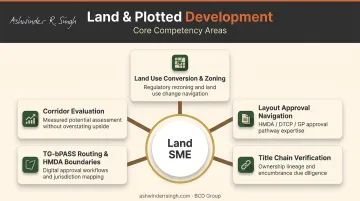
This is Telangana's most distinctive SME niche. HMDA and DTCP-approved plotted layouts along highway corridors represent a major asset class — and an exceptionally complex one.
What this role requires:
- Mastery of land use conversion rules and peri-urban zoning
- Layout approval process navigation (HMDA, DTCP, gram panchayat distinctions)
- Title chain verification and encumbrance certificate interpretation
- Understanding of HMDA's boundary logic and TG-bPASS routing for permissions
- Ability to evaluate emerging corridors (Shadnagar, Adibatla both appear in ANAROCK's South zone classification) without overstating appreciation potential
Generic agents rarely possess this skill set. The professionals who do command strong advisory fees from both individual investors and developer clients.
Investment and Valuation Advisory
Built for HNI clients, institutional investors, and housing finance companies, this track demands a precise blend of market knowledge and financial rigour. Core competencies include:
- Property valuation and yield modelling
- Capital appreciation forecasting using market data
- Portfolio structuring across asset classes
- Loan-to-value analysis and mortgage advisory
- REIT advisory for institutional clients
The intersection with banking and housing finance makes cross-sector experience especially valuable here. Professionals with backgrounds in credit appraisal, structured finance, or capital markets bring a market-reading discipline that pure real estate practitioners often lack.
This is where careers spanning both sectors — real estate development and institutional banking — create a measurable edge in reading market cycles, structuring deals, and advising clients on risk.
Skills, Qualifications, and Experience Required
No single certification creates an SME. Credibility comes from the combination of regulatory literacy, analytical depth, transaction experience, and the ability to back market positions with data.
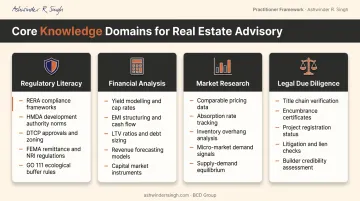
Core Knowledge Domains
| Domain | What It Covers |
|---|---|
| Regulatory literacy | RERA, HMDA, DTCP, FEMA for NRI transactions, GO 111 zone status |
| Financial analysis | Yield modelling, EMI structuring, loan-to-value ratios, capital appreciation forecasting |
| Market research | Corridor pricing data, absorption rates, inventory overhang analysis |
| Legal due diligence | Title chain verification, encumbrance certificates, project registration status |
Professional Credentials and Learning Resources
- TSRERA registration is the regulatory baseline — mandatory, not optional, for anyone facilitating sales in registered projects. Individual registration costs ₹10,000, is valid for 5 years, and must be renewed at least 3 months before expiry (renewal fee: ₹5,000).
- NAR India offers structured designations — REMET, CRS, CIPS, and IREM-linked courses — for professionals who want formal credentials beyond the regulatory minimum. CREDAI and CII add practitioner networks and market access.
- Practitioner-authored books fill the education gap that classroom-only training leaves open. Ashwinder R. Singh's trilogy (A to Z of Residential Real Estate, Master Residential Real Estate, Master Commercial Real Estate) covers homebuyer decision frameworks, due diligence, legal compliance, and commercial investment strategy — drawn from experience across banking, development, and advisory roles.
The Experience Factor
Real SME credibility in Hyderabad's market requires verifiable transaction exposure across at least one full market cycle. Regulatory process fluency — direct experience with RERA filings, HMDA interactions, and registration office procedures — cannot be learned from a textbook.
The ability to back market positions with data is what separates genuine SMEs from confident generalists:
- Absorption rates and inventory overhang by corridor
- Registration volumes as a leading demand indicator
- Pricing trend analysis tied to infrastructure timelines
How to Build a Career as a Real Estate Subject Matter Expert in Hyderabad
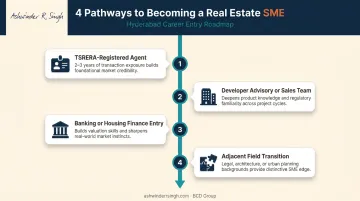
There are four realistic entry pathways:
- Start as a TSRERA-registered agent: Build transaction experience, document process exposure, and develop corridor-level pricing fluency over 2-3 years
- Join a developer's advisory or sales team: Developer-side roles build product knowledge, launch strategy understanding, and regulatory process familiarity at the same time
- Enter through banking or housing finance: Credit appraisal and mortgage advisory roles develop market instincts, valuation skills, and a clear view of how financing shapes buyer decisions
- Transition from a related field — legal practitioners, architects, and urban planners bring adjacent expertise that can be channelled into niche SME roles with targeted real estate domain development
The Case for Early Specialisation
Generalists in Hyderabad's market struggle to differentiate. The western IT belt, plotted development along ORR corridors, NRI investor servicing, and institutional occupier advisory each require distinct expertise. Professionals who develop genuine depth in one corridor, asset class, or client segment build credibility faster and command higher advisory fees than those trying to cover everything.
Ashwinder R. Singh's career demonstrates this directly: banking experience at Citibank and ICICI shaped market instincts, development leadership at Bhartiya Urban built product knowledge, and advisory roles at JLL and ANAROCK added strategic framing. Layering all three is what separates a genuine SME from a well-informed generalist.
Specialisation, however, only takes you so far without visibility.
Building Thought Leadership
Advisory credibility in Hyderabad's competitive landscape is accelerated by visibility. Contributing market commentary to industry associations, publishing corridor analysis, speaking at developer or investor events, and building a track record of accurate market calls all compound into domain authority over time.
Ashwinder R. Singh's career trajectory — Chairman of CII's Real Estate Committee (Northern Region), NAR India advisor, Chief Advisor on Republic World's real estate platform, and author of three bestselling books — demonstrates how professional visibility built systematically across platforms creates lasting advisory recognition.
Frequently Asked Questions
What does a real estate subject matter expert in Hyderabad do?
A real estate SME in Hyderabad provides expert advisory across market pricing, regulatory compliance (TSRERA, HMDA, DTCP), legal due diligence, and investment analysis. They go beyond transactional brokerage to deliver strategic guidance — advising buyers, investors, developers, and institutions based on deep domain knowledge rather than just facilitating deals.
Which is the best place to invest in real estate in Hyderabad?
It depends on your investment goals. The western IT corridor (Gachibowli, Kokapet, Kondapur) suits premium residential buyers; ORR corridor plots (Shadnagar, Adibatla) favour long-term land investors. Emerging zones near Pharma City and the Regional Ring Road alignment offer early appreciation potential but carry higher regulatory and timeline risk.
What is the future of real estate in Hyderabad?
Hyderabad's outlook rests on sustained IT-pharma employment growth, an active infrastructure pipeline (Metro Phase II, Regional Ring Road), rising NRI demand, and a RERA-regulated environment that has improved market transparency. With capital values up 27% in 2024 and office absorption at multi-year highs, structural demand drivers remain intact.
What qualifications are needed to become a real estate subject matter expert in Telangana?
TSRERA agent registration is the mandatory compliance baseline. SME credibility beyond that comes from domain education (NAR India designations, structured real estate programmes), cross-asset transaction experience, and working regulatory knowledge of HMDA, DTCP, and FEMA.
How does a real estate SME role in Hyderabad differ from a general broker or agent?
A general agent primarily facilitates the transaction. An SME provides strategic interpretation — advising on corridor selection, regulatory risk, investment timing, and portfolio positioning before and beyond the transaction itself. SMEs typically work with developers, institutional investors, or HNI and NRI clients rather than focusing exclusively on individual end-user sales.