
That momentum has created genuine buzz among NRIs, domestic investors, and homebuyers hunting for the next big opportunity. But rapid, policy-driven development also makes it hard to separate real opportunity from hype. Without historical price data or established comparables, outsiders are essentially betting on government execution timelines.
This guide breaks down what a real estate strategist actually does, and how that lens applies to reading Amravati's market forces before you commit capital.
Key Takeaways
- Amravati's growth is almost entirely policy-driven, unlike organically grown Indian cities
- Real estate strategists differ from brokers by focusing on long-horizon, portfolio-level decisions
- Infrastructure and land-pooling progress are the leading indicators worth tracking closely
- Naya Raipur's slow absorption offers a cautionary benchmark for timeline expectations
- Diversification and title due diligence carry outsized weight in a greenfield capital city like Amravati
Who Is a Real Estate Strategist?
A real estate strategist is a professional who combines market research, financial modelling, urban policy analysis, and risk assessment to guide long-term investment decisions. Unlike a broker who closes individual transactions, a strategist thinks in terms of portfolios, timelines, and macro trends.
Strategist vs Broker: The Core Difference
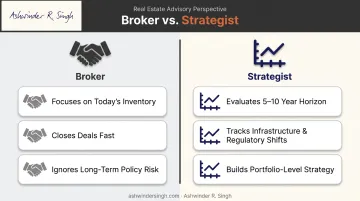
Brokers earn on deal volume. Their incentive is to close a sale quickly. Strategists work differently:
- Brokers focus on matching buyers to available inventory today
- Strategists evaluate whether an asset class or location fits an investor's five- to ten-year horizon
- Brokers rarely factor in policy risk beyond current regulations
- Strategists track how infrastructure timelines, government budgets, and regulatory shifts will reshape value over time
Core competencies of a strategist include:
- Macroeconomic analysis, including interest rate cycles and capital flows
- Infrastructure-timeline tracking (roads, rail, airports, metro links)
- Financing structuring across debt, equity, and hybrid instruments
- Regulatory and policy risk evaluation, particularly in states with shifting capital-city policies
Cross-sector experience strengthens this skill set. Professionals who have worked in banking, development, and capital markets tend to read emerging locations differently than pure real estate operators.
Ashwinder R. Singh, for instance, moved between banking roles at Citibank, ICICI, and Deutsche Bank before leading real estate firms like JLL Residential and co-founding ANAROCK. That finance discipline, paired with on-ground development experience, is exactly what nascent markets demand.
Strategists matter more in places like Amravati precisely because historical price data is thin and comparables barely exist. When government policy drives most value creation, understanding policy risk becomes as important as understanding the land itself.
Amravati Real Estate Market: An Overview
Amravati was notified as Andhra Pradesh's capital under a master plan approved in February 2016. In 2024, presidential assent to the Andhra Pradesh Reorganisation (Amendment) Act gave it statutory recognition as the state's sole and permanent capital.
Master Plan and Government Complex Progress
The Government Complex, originally planned across roughly 1,350 acres, sat dormant for years after a change in government in 2019 triggered a three-capitals policy debate. That changed in May 2025, when foundation work restarted:
- Five Government Complex towers, plus the High Court and Legislative Assembly, are now under construction
- The broader relaunch event covered projects worth ₹58,000 crore
- Land pooling has allotted returnable plots against 98.06% of eligible farmer holdings, according to the Urban Development Minister
Market sentiment has followed the policy shift. The Hindu reported that real estate activity in Vijayawada, Guntur, and Amravati began recovering in 2024 after a five-year lull. Experts point to improving sentiment in Tadepalli, Mangalagiri, and Amravati specifically.
Micro-Markets Attracting Early Activity
CRDA has notified acquisition of 1,575 acres across Rayapudi, Lingayapalem, Nelapadu, Kondama Rajupalem, and Sakhamuru for capital works, marking these villages as centres of government project activity. This confirms construction momentum, not private resale volumes. Treat any specific price-appreciation claims from local brokers with caution until independently verified.
For context, Naya Raipur's Development Plan was sanctioned in 2008, and the state Secretariat only relocated there in 2012, a four-year gap between planning and administrative movement. Amravati is following a similarly extended runway, just with more political interruption along the way.
Key Growth Drivers Fueling Amravati's Real Estate Boom
Capital-city status alone doesn't create demand. Amravati's growth story rests on a handful of concrete drivers, each at a different stage of maturity.
Infrastructure investment is the biggest lever. Several projects are moving from proposal to execution:
- A 189-km Outer Ring Road (proposed, 250-metre-wide corridor) is planned across Guntur, NTR, Palnadu, Krishna, and Eluru districts
- The Union Cabinet approved rail connectivity to Amravati in October 2024, including a new bridge over the Krishna River
- An international airport remains a proposal, with the state exploring a 5,000-acre site and a wider 30,000-acre land-pooling option
- Vijayawada Metro's Phase 2 shows a proposed extension toward Amravati, including Mandadam and Uddandarayunipalem
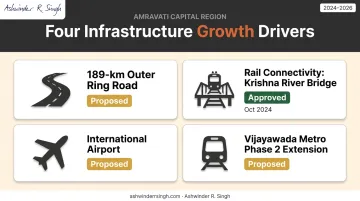
None of these are operational yet. That's worth repeating, because promotional materials often blur "approved" with "completed."
Policy incentives are further along. The Land Pooling Scheme's second phase, approved by the Andhra Pradesh Cabinet, covers 16,666 acres across seven villages, including Vaikuntapuram and Pedda Madduru.
APCRDA, the Andhra Pradesh Capital Region Development Authority, also runs a GIS-based digital permission system for development approvals, cutting friction for developers navigating apartment and commercial building sign-offs.
Location matters too. Amravati sits directly between Vijayawada and Guntur, positioning it inside an established economic corridor rather than isolated farmland. That geography is one reason capital-city planning chose this stretch in the first place, and it's already paying off in one sector: education.
Institutions like VIT, SRM, and Amrita have already established or expanded campuses here, creating a captive student and faculty population that supports early rental demand.
IT and business-park activity, by contrast, remains largely aspirational. No verified source confirms a major operating tech campus in Amravati today, so treat those claims as forward-looking rather than current fact.
Bottom line: only the location advantage and education cluster are operational today. Every other driver remains proposed, approved-but-unbuilt, or aspirational.
Investment Opportunities and Risks in Amravati
Amravati offers a genuine early-mover opportunity, but it comes paired with risks that are structurally different from buying into an established city.
Where the opportunity lies:
- Land banking near notified government and administrative zones
- Residential plots close to the relaunched Government Complex
- Commercial space catering to government-linked staff, contractors, and institutions
Where the risk sits:
| Risk Type | What It Looks Like in Amravati |
|---|---|
| Policy dependency | Growth stalled for five years (2019-2024) after a government change and three-capitals policy |
| Execution delays | Farmer-state litigation ran 2020-2022; the Supreme Court stayed High Court construction directions |
| Liquidity constraints | No verified resale or absorption data exists yet, unlike mature markets with active secondary transactions |
| Funding uncertainty | The FY2025-26 state budget carried no separate Amravati allocation, since the state positions it as a self-sustaining project |
Naya Raipur's experience is instructive here. Even after the Secretariat relocated in 2012, roughly 2,000 of 6,000 built housing units remained unsold by 2015, and only about 20% of a 4,000-unit state housing stock was occupied by 2016. Administrative relocation didn't guarantee immediate demand.
Before committing capital, research comparable planned-capital timelines rather than relying on projected returns from local sales pitches.
How a Real Estate Strategist Guides Amravati Investment Decisions
This is exactly the kind of market where a strategist's approach diverges sharply from a broker's pitch.
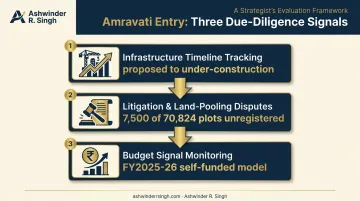
A strategist starts by evaluating policy risk and execution timelines before recommending any entry point. In Amravati's case, that means tracking:
- Whether infrastructure moves from "proposed" to "under construction" within realistic windows
- How litigation and land-pooling disputes are resolving, since roughly 7,500 of 70,824 plots remain unregistered due to inheritance and revision issues
- Budget signals, since the absence of a dedicated Amravati allocation in FY2025-26 tells you the project depends on self-generated revenue, not guaranteed state funding
Cross-sector expertise becomes valuable here. Someone who has structured deals in banking and capital markets, not just brokered property sales, understands how to size exposure appropriately and build exit flexibility into a long-gestation investment.
Ashwinder R. Singh's career path across Citibank, Deutsche Bank, and Bajaj Housing Finance, followed by leadership roles at JLL Residential and ANAROCK, illustrates why that dual grounding matters. Financing structures that work in mature markets often need modification for a market still finding its footing.
Practitioner-led resources add another layer of discipline. Singh's bestselling books, Master Residential Real Estate and Master Commercial Real Estate, are aimed at building frameworks investors can apply themselves rather than depending on hype-driven sales narratives. That's the core value a strategist brings: replacing speculation with a repeatable process for reading policy signals, financing structures, and timeline risk.
Tips for Homebuyers and Investors Considering Amravati
If you're weighing a purchase here, treat this as a long-horizon commitment, not a quick flip.
- Verify land titles and approvals directly with APCRDA. The regulatory landscape is still evolving, and returnable-plot registrations remain pending in several cases due to litigation or inheritance disputes.
- Confirm zoning status before buying. A plot near a notified administrative zone carries different value assumptions than one in a village still awaiting infrastructure rollout.
- Diversify across markets. Balance an Amravati bet with exposure to established, liquid cities where resale demand is already proven.
- Track state budget announcements each year. The FY2025-26 budget's lack of dedicated funding is a leading indicator to watch.
- Watch land-pooling completion rates. Progress past 98% farmer participation signals administrative momentum, but registration backlogs still matter.
Frequently Asked Questions
Who is a real estate strategist?
A real estate strategist combines market, financial, and policy analysis to guide long-term investment decisions. Unlike a broker focused on closing transactions, a strategist evaluates portfolio-level risk and timing.
Is Amravati a good place to invest in real estate right now?
Amravati carries higher risk-reward given its early-stage development and dependence on government execution. It suits long-term, policy-aware investors far more than short-term buyers seeking quick returns.
What makes Amravati different from other Indian smart cities?
Amravati is a purpose-built state capital shaped by government-led master planning, not an organically grown city. Growth here depends heavily on administrative relocation and infrastructure rollout, unlike cities built through market forces alone.
How is Amravati's real estate market expected to grow in the coming years?
Growth will likely track infrastructure milestones like the Outer Ring Road, rail connectivity, and eventual airport development. Full administrative relocation remains the biggest single catalyst investors should watch.
What are the biggest risks of investing in an emerging capital city like Amravati?
Policy dependency tops the list, given the five-year stall between 2019 and 2024. Execution delays, ongoing litigation, and limited resale liquidity round out the primary concerns.
Do I need a real estate strategist for investing in a small or emerging city?
Emerging markets with limited historical data benefit from strategic, experience-driven guidance. Without established comparables, speculative losses become far more likely.